

Proactive Threat Hunting with XDR: Faster Detection and Confident Containment for Enterprises
Proactive threat hunting means looking for adversary activity before noisy alerts force your hand. XDR (Extended Detection and Response) makes that approach practical by unifying telemetry, analytics, and automated response across your estate. This article shows how XDR ingests endpoint, network, cloud, and identity signals, applies analytics and AI-powered correlation, and turns hypotheses into detections that reduce dwell time and speed containment. You’ll get a clear overview of XDR architecture, hunting methodologies, how AI and analysts work together, and pragmatic steps for enterprise deployment. We also cover the advantages of managed XDR, compliance considerations, and how deep automation plus continuous SOC operations can cut alert noise and operational overhead.
Finally, we compare XDR with SIEM/EDR/NDR approaches and provide a deployment checklist to help security leaders evaluate and operationalize proactive hunting. Next, we define XDR and explain the mechanisms that make unified detection and automated response possible.

What is Extended Detection and Response and How Does It Strengthen Security?
XDR centralizes telemetry from endpoints, networks, cloud services, and identity systems into a correlated analytics and response platform so teams detect and contain threats faster. By normalizing diverse data and applying behavioral analytics, XDR closes blind spots and raises signal-to-noise, letting analysts validate hypotheses and act on high-confidence incidents more quickly. It shortens the detection-to-containment loop, enables retroactive investigation, and automates routine containment tasks so human experts can focus on complex investigations. Understanding how XDR combines multiple telemetry streams clarifies why it outperforms siloed tools and becomes the foundation for proactive hunting operations.
XDR platforms depend on three core mechanisms to improve posture and enable hunting.
- Data unification: ingest and normalize endpoint, network, cloud, and identity telemetry for one pane of analysis.
- Correlation and analytics: use rule logic, behavioral baselining, and ML to link disparate events into coherent attack timelines.
- Automated response orchestration: run containment actions and playbooks that reduce dwell time while keeping analysts in control.
These mechanisms explain how cross-layer telemetry is combined in practice to surface hidden adversary activity.
How Does XDR Bring Endpoint, Network, Cloud, and Identity Data Together for Unified Detection?
XDR ingests logs and events from endpoints, network sensors, cloud APIs, and identity systems, then normalizes them into consistent schemas so correlation and timeline reconstruction are reliable. The ingestion layer tags events with contextual metadata—host IDs, user principals, process hashes—and stores them in a time-series repository that supports retroactive queries for hunting and forensics.
Correlation and analytics stitch related events across domains (for example, a suspicious binary on a host, an anomalous cloud API call, and failed authentications) into one incident timeline so hunters can test hypotheses faster. Workflows routinely add threat intelligence and map behaviors to TTPs like those in MITRE ATT&CK, improving detection fidelity and enabling prioritized response. That unified view reduces siloed investigations and exposes staged, multi-step attacks.
What Key Components Make an XDR Platform Effective?
An effective XDR architecture includes an ingestion/normalization layer, scalable storage with historical analytics, advanced detection engines (rules and behavioral ML), SOAR orchestration and playbooks, a unified analyst UI, and integrations for endpoint, network, cloud, and identity telemetry. Cloud-native, API-first designs speed deployment and interoperability, while a centralized data lake supports retroactive analysis across long retention windows for hunting and forensics. Scalability and secure multi-tenancy let XDR support enterprise and managed-service models, and sensible retention policies balance investigative value with compliance needs. Best practices are to prioritize high-impact telemetry, onboard incrementally, and align detection outputs with runbooks so alerts translate directly into actionable workflows. These architectural choices determine how hunting and automation scale in practice.
How Proactive Threat Hunting Changes Security with XDR
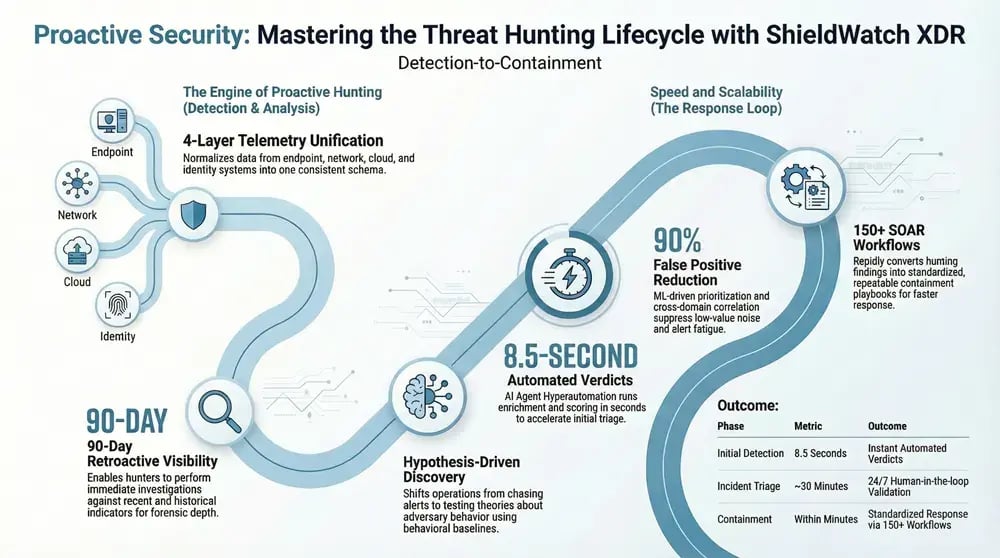
Proactive threat hunting moves operations from reactive alert chasing to hypothesis-driven discovery. With unified telemetry and analytics, hunters look for early indicators of sophisticated adversaries before they trigger volume-driven alerts. Hunters use curated queries, behavioral baselines, and TTP mappings to surface subtle deviations, then convert findings into automated playbooks that scale. XDR supports this work with correlated timelines, enrichment, and ML-assisted prioritization so hunters surface high-value findings with less manual triage. The outcome: shorter dwell time, fewer false positives, and a detection program that improves continuously as hunts feed detection engineering and response automation.
Hunting depends on repeatable methodologies that guide when and how teams search for hidden threats.
- Hypothesis-driven hunting: Create a targeted hypothesis about adversary behavior, collect the right telemetry, and test with focused queries to confirm or disprove it.
- Structured/analytics-driven hunts: Run prebuilt queries and analytics to sweep for known TTP patterns and baseline anomalies across broad datasets.
- Ad-hoc exploratory hunting: Chase anomalies surfaced by ML or user reports, iterating queries to uncover related activity.
These approaches lead directly into how AI and ML speed and scale hunting workflows.
What Hunting Methodologies Help Find Stealthy Threats?
Proactive hunting uses disciplined approaches to find adversary activity that automated detections miss. Hypothesis-driven campaigns start with a concrete theory—such as lateral movement over SMB—and gather endpoint, network, and authentication logs to validate it, turning confirmed findings into detections. Structured hunts rely on repeatable query libraries and ATT&CK mappings to scan broadly for known techniques, while ad-hoc hunts follow unexpected signals from daily operations. Each method requires clear data collection, prioritized telemetry, and a mechanism to turn results into SOAR playbooks or new analytic rules, which steadily improves detection coverage and reduces manual effort over time.
How AI and Machine Learning Accelerate Hunting in XDR?
AI and ML speed triage, surface novel anomalies, and prioritize incidents by scoring signals against behavioral deviation and contextual enrichment, helping hunters focus on the highest-impact leads. ML builds behavioral baselines that expose subtle deviations in process, network, or user activity, while correlation models link low-signal events into higher-confidence incidents. Automated verdicts and enrichment cut down on noise, but human validation remains essential to correct model drift and counter adversary evasion. Continuous tuning and feedback from hunting outcomes improve model accuracy. These AI capabilities boost analyst throughput and make hunting scalable without replacing critical human judgment, enabling findings to become automated response playbooks.
What Distinguishes the ShieldWatch XDR Platform for Proactive Hunting?
ShieldWatch is an enterprise-grade XDR platform built to pair deep automation with continuous human monitoring so teams can hunt at scale. We prioritize rapid time-to-value through unified visibility and orchestration: AI Agent Hyperautomation plus 24/7 human SOC monitoring ensures automated verdicts are validated and escalated correctly. The platform combines AI-driven analytics and hyper-automation with a library of 150+ SOAR workflows to turn hunting results into repeatable response playbooks. Deployment is fast—fully operational in minutes—and supports retroactive analysis across 90 days of logs to enable immediate hunting against recent and historical indicators. Together, these capabilities reduce false positives, speed triage, and deliver consistent, measurable outcomes for enterprise security teams.
Below is a technical mapping of ShieldWatch capabilities to attributes and outcomes to show how each feature supports proactive hunting.
How Do AI Hyperautomation and a 24/7 Managed SOC Improve Detection and Response?
AI Agent Hyperautomation speeds detection by running enrichment, scoring, and initial containment steps within seconds, while a 24/7 managed SOC provides continuous analyst oversight to validate automation and handle escalations. In practice, automated agents can produce a high-confidence verdict quickly, triggering analyst triage; ShieldWatch averages automated verdicts in about 8.5 seconds, with triage typically completed in roughly 30 minutes and containment actions executed within minutes. This hybrid model balances speed with human judgment: routine responses are automated, complex incidents get expert investigation, and SOPs route high-confidence actions to pre-approved playbooks while flagging ambiguous cases for SOC review—reducing analyst load and shortening remediation timelines.
How Does ShieldWatch Cut Alert Fatigue and Speed Incident Response?
ShieldWatch reduces alert fatigue by combining ML-driven prioritization, cross-domain correlation, and SOAR playbooks that collapse related signals into single high-confidence incidents and suppress low-value noise. Correlation enriches alerts with context—user behavior, asset criticality, and threat intelligence—so priority scores highlight truly consequential incidents. Our automation and 150+ SOAR workflows enable immediate containment for repeatable scenarios, accelerating mean time to contain and cutting manual steps for analysts. Real-world impacts include up to a 90 percent reduction in false positives and faster response metrics, lowering burnout and enabling sustained proactive hunting capacity.
What Business Benefits Do Managed XDR Services Deliver?
Managed XDR delivers continuous monitoring, expert analysis, and outcome-driven response so internal teams are freed from around-the-clock operational burdens while time-to-detect and time-to-contain improve. Enterprises that adopt managed XDR gain access to specialized SOC expertise, mature playbooks, and consistent escalation paths that scale without proportional hiring—improving efficiency and ROI. Managed services also simplify compliance by producing structured logs, evidence trails, and reports mapped to frameworks like SOC 2, HIPAA, CMMC 2.0, and ISO 27001, easing audit readiness. When evaluating managed XDR, consider continuous coverage, automation maturity, and historical analysis capabilities against your operational goals.
Below is a table mapping managed XDR service features to measurable metrics and business value.
How Do Managed SOC Services Deliver Continuous Monitoring and Expert Operations?
Managed SOC services provide 24/7 coverage via shift-based analyst teams, clear escalation protocols, and integrated playbooks that connect detection to response and customer communication—ensuring constant visibility and rapid action. Analysts follow structured runbooks that incorporate automated enrichment and verdicts, coordinating with customer incident response teams for containment and post-incident review to preserve context and reduce miscommunication. The SOC model emphasizes disciplined triage, planned hunting campaigns, and playbook refinement so intelligence from hunts feeds automated detection and response. That continuous cycle ensures automation and human expertise work together to deliver consistent security outcomes across time zones and incident volumes.
What Compliance Advantages Come with Managed XDR?
Managed XDR helps compliance by consistently collecting and retaining relevant telemetry, automating evidence capture for controls, and producing structured reports that map monitoring to regulatory requirements. Continuous monitoring and retention—paired with automated incident logs and playbook execution traces—create auditable artifacts useful for SOC 2, HIPAA, CMMC 2.0, and ISO 27001 reviews, shortening audit prep and reducing manual evidence collection. Managed providers often codify control-aligned playbooks that demonstrate control effectiveness over time, helping organizations show continuous compliance. The mix of technical controls, operational evidence, and sustained monitoring raises readiness and reduces the resource burden of regulatory obligations.
How Does ShieldWatch XDR Compare with Other Platforms and Traditional Tools?
Comparing XDR to SIEM, EDR, and NDR clarifies scope and operational trade-offs. XDR delivers integrated detection and response across telemetry domains with built-in orchestration; SIEM focuses on log aggregation and search; EDR specializes in endpoint telemetry and response; NDR centers on network visibility. Buyers should prioritize visibility breadth, automation depth, time-to-detect, and managed-service capabilities over feature checklists. ShieldWatch differentiates through deep AI hyperautomation, a broad SOAR workflow library, rapid deployment, and retroactive historical analysis—accelerating hunting and reducing operational overhead compared with fragmented toolchains. The table below summarizes capability differences to guide evaluations.
How Do XDR, SIEM, EDR, and NDR Differ?
SIEM centralizes logs and supports analytics and compliance reporting but often needs significant tuning and staffing to deliver detection value. EDR focuses on endpoint telemetry, process behavior, and host containment, enabling deep forensics but lacking unified cross-domain context. NDR offers visibility into network flows and lateral movement patterns, catching anomalies host tools might miss. XDR ingests telemetry across these domains, correlates events, and provides orchestration and SOAR playbooks to close the loop on detection and response. These technologies complement one another; integrated XDR reduces the operational burden of stitching together separate alerts and manual playbooks.
Where ShieldWatch Excels Compared to Competitors
ShieldWatch excels through AI Agent Hyperautomation, a rich prebuilt SOAR workflow library, rapid time-to-value, and managed SOC integration that together produce measurable operational gains. Our automation layer delivers fast automated verdicts (averaging 8.5 seconds) and supports containment actions within minutes, with incident triage commonly completed in about 30 minutes—accelerating remediation cycles. ShieldWatch can be fully operational in minutes and retroactively analyze 90 days of logs, giving immediate hunting capability and forensic depth without long onboarding. Those attributes drive outcomes like significant false-positive reductions—up to 90 percent in some scenarios—making the platform attractive for enterprises seeking both automation and continuous expert support.
To highlight comparative strengths, here’s a concise mapping of attributes to outcomes.
How Can Enterprises Deploy and Maximize Proactive Hunting with XDR?

Adopt a phased approach to implement proactive hunting with XDR: prioritize high-value telemetry, run a pilot with clear success criteria, align playbooks to incident response processes, and feed hunting outcomes back into automated detections and SOAR workflows. Track KPIs such as mean time to detect (MTTD), mean time to respond/contain (MTTR), false positive rate, and dwell time to measure impact and guide improvements. Cross-team training and integrated runbooks ensure hunting results are operationalized and aligned to business priorities, while threat intelligence and ATT&CK mapping supply external context for hypothesis generation. A repeatable onboarding process reduces time-to-value and helps sustain hunting capabilities at scale.
Use this deployment checklist to accelerate onboarding and enable teams effectively.
- Prioritize telemetry: Start with endpoints and identity logs, then add network and cloud sources.
- Define pilot scope: Select a constrained environment with measurable success criteria (MTTD, MTTR).
- Align playbooks: Map hunting outputs to SOAR workflows and response runbooks for automation.
- Train teams: Run joint SOC and hunting workshops and establish clear escalation protocols.
- Monitor KPIs: Track false positive rate, dwell time, and containment metrics and iterate.
Best Practices for Deploying ShieldWatch XDR and Onboarding Teams
When deploying ShieldWatch, seek quick wins by onboarding endpoints and identity telemetry first to enable instant correlation across privileged access and host behavior. Run a focused pilot that validates retroactive analysis and automated playbooks against known incidents, using reduced MTTD and fewer false positives as rollout criteria. Customize SOAR workflows from our library of 150+ playbooks to match your escalation paths and pre-approved containment actions, and schedule hands-on training for SOC analysts and incident responders to ensure consistent execution. Feed hunting outputs into detection engineering and update playbooks to codify proven responses, scaling capability while preserving governance and oversight.
How Continuous Threat Intelligence and Automation Strengthen Posture
Continuous threat intelligence adds context—indicators, campaign attribution, and TTP mappings—that improves hypothesis generation and hunt prioritization, while response automation executes validated containment steps quickly to reduce dwell time. Integrating threat feeds with analytics enables dynamic rule updates and automated enrichment so a detected indicator can trigger scoring and an appropriate SOAR playbook without delay. A typical flow is detection → enrichment → automated containment → SOC validation → post-incident review, with lessons feeding playbook evolution and model tuning. That closed loop hardens the environment over time, converting hunting insights into durable detection coverage and measurable improvements in MTTD, MTTR, and overall risk reduction.
Frequently Asked Questions
Conclusion
Implementing XDR gives enterprises the tools to hunt proactively, reduce dwell time, and respond faster. By unifying telemetry and automating repeatable actions—while preserving analyst oversight—organizations can improve security outcomes, streamline operations, and support compliance. See how ShieldWatch XDR can accelerate your detection, contain threats faster, and produce measurable security improvements for your organization.