

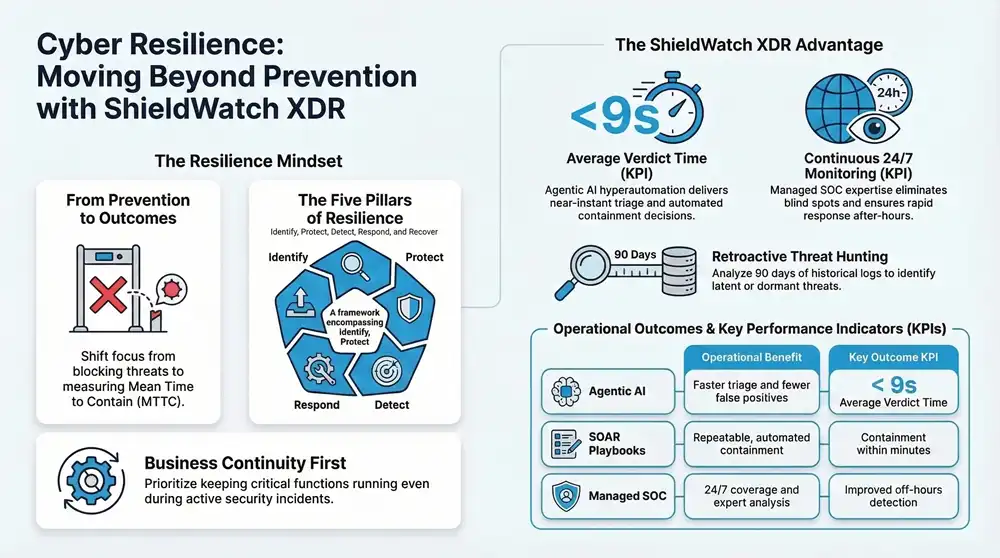
Cyber resilience is an organization’s ability to anticipate, absorb, recover from, and adapt to cyber incidents while keeping critical business functions running. This guide presents practical frameworks, measurable strategies, and operational practices security leaders can use to strengthen people, process, and technology. You’ll learn how to set resilience objectives, prioritize telemetry and analytics, deploy automated incident response, and evaluate managed services and XDR platforms that preserve continuity. We map detection and response workflows, assessment checklists, and compliance-readiness steps for mid-market and enterprise environments, focusing on measurable outcomes—shorter mean time to detect and mean time to contain.
Throughout, we show how modern capabilities—Agentic AI, integrated telemetry, and continuous SOC monitoring—turn into faster containment and sustained operations during attacks. The sections that follow cover definitions and core components, how next-generation XDR boosts resilience, managed SOC benefits, posture assessment and improvement steps, compliance mapping, and vendor selection criteria.
What is Cyber Resilience and Why is it Critical for Modern Enterprises?

Cyber resilience is a holistic discipline that combines prevention, detection, response, and recovery so the business can keep operating during and after incidents. It relies on layered controls across identify/protect/detect/respond/recover functions and designs processes that assume breaches will happen—this mindset reduces disruption and shortens recovery times. The concrete payoff is business continuity: resilient organizations suffer less downtime, have clearer incident governance, and restore services more quickly. Current research shows resilience investments shift KPIs from prevention counts to outcome metrics like MTTR and improved service availability. Framing resilience this way helps security leaders direct investments that produce measurable reductions in business risk and steady security posture gains over time.
Cyber resilience differs from traditional cybersecurity in practical ways that shape program structure and KPIs. The next subsection contrasts the two approaches and frames the core components of an effective resilience program.
How Does Cyber Resilience Differ from Traditional Cybersecurity?
Resilience treats continuity and recovery as primary goals instead of only aiming to prevent incidents. Traditional cybersecurity often counts vulnerabilities or blocked threats; resilience measures success by metrics such as mean time to detect (MTTD), mean time to contain (MTTC), and the ability to keep critical services available during incidents. A prevention-heavy program might stop most known threats but still lack tested playbooks or reliable backups for fast recovery. A resilient program plans for failures with validated runbooks and automated containment. That shift changes tooling, governance, and budgeting in favor of detection, automation, and incident orchestration. Recognizing this difference leads directly to the core components of a practical resilience framework.
What are the Core Components of a Cyber Resilience Framework?
A usable resilience framework rests on five pillars: identify, protect, detect, respond, recover—anchored by governance, testing, and continuous improvement. Identify covers asset inventory, data classification, and risk assessments; protect focuses on access controls, network segmentation, and hardening; detect depends on telemetry, analytics, and threat intelligence; respond uses orchestration, playbooks, and analyst expertise; recover emphasizes backups, runbooks, and continuity planning. Each pillar gets stronger with testing—tabletop exercises, red-team validation, and backup restores validate procedures and shorten recovery time. Organizations that operationalize these components produce prioritized remediation plans and measurable outcomes such as lower risk exposure and faster incident closure. The next section shows how integrated XDR platforms can make detection and response operational.
How Does ShieldWatch XDR Enhance Threat Detection and Response?
ShieldWatch XDR is an enterprise-grade platform that unifies telemetry across endpoints, network, cloud, and identity and applies Agentic AI-driven automation to speed detection and containment. By correlating SIEM, SOAR, UEBA, and threat intelligence on a single operational plane, the platform cuts alert noise and surfaces high-fidelity incidents for analysts. Operational benefits include a sub-9 second average verdict time for automated decisions and containment within minutes for prioritized threats—outcomes that materially reduce MTTR and limit lateral movement. Fast deployment with retroactive 90-day log analysis enables immediate historical threat hunting while establishing continuous visibility. These capabilities make ShieldWatch XDR an effective option for organizations that want automated response paired with 24/7 SOC monitoring.
Below is a feature-to-benefit mapping that highlights key ShieldWatch XDR attributes and expected operational outcomes to help evaluation.
This mapping shows how integrated XDR features convert into measurable resilience improvements and sets up a deeper look at platform capabilities below.
What are the Key Features of the ShieldWatch XDR Cybersecurity Platform?
ShieldWatch XDR brings together endpoint telemetry, identity signals, network sensors, and threat intelligence into a single detection-and-response workflow. Agentic AI modules automate triage to recommend or enact containment under policy controls, while built-in SOAR playbooks accelerate routine response steps without removing analyst oversight. The platform normalizes and ingests logs retroactively for 90 days, enabling retrospective hunting and faster incident scoping without long onboarding delays. Dashboards and investigative workbenches deliver actionable context, and integrations with enterprise SIEMs and UEBA enrich behavioral analytics. These features drive clear operational gains: fewer manual investigations, shorter verdict times, and stronger posture across telemetry sources.
How Does Agentic AI Improve Real-Time Threat Detection?
Agentic AI in ShieldWatch acts like an autonomous analyst assistant—identifying likely threats, prioritizing incidents, and recommending or executing remediation within policy guardrails. It reduces analyst fatigue by aggregating signals, running enrichment queries, and surfacing the most urgent incidents with contextual evidence. That means analysts spend less time on low-value triage and more time on complex investigations, shortening MTTR. A learning loop captures analyst feedback to refine future recommendations, improving accuracy over time while preserving human-in-the-loop controls for sensitive actions. The result is faster, more consistent detection and response that supports resilient operations.
What Benefits Do Managed SOC Services Provide for Cyber Resilience?
Managed SOC services provide continuous monitoring, specialized analyst expertise, and structured incident response that many organizations can’t staff internally at scale. A managed SOC pairs human threat hunters, detection engineering, and service-level response playbooks to keep persistent visibility and enable rapid action. This model reduces operational friction by delivering predictable coverage, mature containment playbooks, and access to broader threat intelligence. When combined with an XDR platform that offers automation and rich telemetry, managed SOC services shorten detection-to-containment timelines and support sustained operations. Key managed SOC benefits for resilience include:
- 24/7 monitoring: Around-the-clock coverage reduces blind spots and ensures after-hours incidents get immediate attention.
- Access to experienced analysts: Specialized skill sets accelerate complex investigations and improve detection quality.
- Faster containment: Coordinated response and tested playbooks limit lateral spread and reduce business impact.
- Operational scalability: Predictable costs and elastic coverage remove the need for a large in-house team.
These advantages explain why many enterprises pair managed SOC services with integrated XDR to achieve measurable posture and incident-outcome improvements. The next sections examine monitoring and SOAR automation in operational detail.
How Does 24/7 SOC Monitoring Strengthen Security Posture?
Continuous SOC monitoring strengthens posture by providing persistent visibility across time zones and enabling proactive threat hunting that uncovers latent or dormant threats. Around-the-clock analysts correlate events that span days, spot slow-moving attacks, and validate suspicious behavior that surfaces outside business hours. Continuous coverage reduces blind spots and produces measurable gains in detection speed and coverage. Proactive hunting surfaces high-risk findings that drive prioritized remediation, which in turn shrinks the attack surface and builds long-term resilience. With that foundation in place, automated incident response translates detection into rapid containment.
What Role Does Automated Incident Response with SOAR Play?
SOAR automation executes repeatable playbooks—containment, enrichment, notification—that compress manual workflows into consistent, auditable actions while preserving human approval gates when needed. Automation reduces the number of manual steps for common incidents, enforces consistent remediation policy, and frees analysts to work on complex investigations. Typical playbooks can isolate endpoints, enrich alerts with threat intelligence, and notify stakeholders automatically, producing measurable MTTR reductions. Balancing automation with human-in-the-loop controls prevents overreach, so routine cases are contained quickly while unusual incidents escalate to analysts. This orchestration is essential for maintaining operations during high-volume attack periods and for continuous improvement of response effectiveness.
How Can Organizations Assess and Improve Their Security Posture?
Assessing and improving posture requires a structured program that combines discovery, measurement, remediation, and verification. Effective programs begin with comprehensive asset inventories and telemetry mapping, continue with vulnerability scanning and threat hunting, and end with prioritized remediation plans and governance reporting. The practical outcome is a quantified roadmap that links security investments to risk reduction and operational KPIs. Use the four-step checklist below to turn assessment into action.
Follow this 4-step checklist to assess and improve security posture:
- Assess: Inventory assets, map telemetry sources, and run vulnerability scans to establish a baseline.
- Detect: Deploy analytics, UEBA, and historical log analysis to surface active and latent threats.
- Respond: Implement SOAR playbooks and incident runbooks to reduce mean time to contain.
- Recover: Test backups and continuity plans, and document lessons learned to strengthen future responses.
This checklist yields measurable outputs—risk registers, prioritized remediation backlogs, and KPIs such as reduced MTTD and MTTC—that help teams track progress. The table below compares common assessment approaches, their roles, and expected outcomes to help you choose the right mix of tools and services.
Combining automated scans with analyst-led hunting and exercises produces a comprehensive posture improvement program. The following sections dig into tactical detection strategies and stepwise assessment execution.
What are Effective Threat Detection Strategies for Enduring Attacks?
Persistent attacks demand detection strategies that prioritize diverse telemetry, behavioral baselining, and intelligence fusion. Focus on high-value telemetry—identity logs, endpoint data, and network flows—and apply behavioral analytics and UEBA to detect anomalies that signatures miss. Retroactive log analysis complements continuous monitoring by revealing attacker dwell time and enabling thorough scope determination. Normalized, correlated threat intelligence improves hunting context and cuts enrichment time. Together, these tactics create layered detection that adapts to changing attacker techniques and strengthens resilience.
How to Conduct a Comprehensive Security Posture Assessment?
A comprehensive posture assessment follows discovery, analysis, remediation planning, and validation with clear deliverables at each stage. Discovery maps assets, telemetry, and controls; analysis uncovers control gaps, attack paths, and residual risk; remediation planning prioritizes fixes by business impact and feasibility; validation checks changes with rescans, tabletop exercises, or red-team engagements. Deliverables typically include a risk register, a prioritized remediation plan, and an executive summary with KPIs like expected risk reduction and projected MTTR improvements. Iterating this process ensures ongoing posture improvement aligned to resilience objectives.
How Does Compliance Support Cyber Resilience and Risk Management?

Compliance frameworks set baseline controls and reporting that support resilience by enforcing logging, access controls, and documented processes needed during incidents. Continuous monitoring and centralized logging simplify audit evidence collection and speed incident documentation, shortening recovery times and lowering regulatory risk. Mapping compliance controls to technical capabilities reveals where XDR, SIEM, and SOAR can automate evidence collection and reporting. Below is a practical mapping that shows how common frameworks align with platform capabilities to aid audit readiness and resilience planning.
This mapping shows how XDR and continuous monitoring materially support compliance readiness and business continuity by providing audit evidence and faster incident reporting. Next, we describe specific frameworks the platform supports and how readiness improves continuity.
Which Compliance Frameworks Does ShieldWatch XDR Support?
ShieldWatch XDR includes capabilities aligned with common frameworks referenced in vendor guidance—SOC 2, HIPAA, CMMC 2.0, and ISO 27001. Features like centralized audit logging, configurable retention, automated reporting, and role-based access controls simplify evidence collection for audits and compliance workflows. Continuous monitoring and integrated reporting reduce manual effort during audits and speed incident documentation, helping teams meet reporting and control requirements more efficiently. These capabilities improve audit readiness and make it easier to demonstrate control effectiveness during examinations.
How Does Compliance Readiness Enhance Business Continuity?
Compliance readiness boosts business continuity by enforcing documented processes and evidence trails that accelerate investigation and recovery. Runbooks and audit trails created for compliance double as incident artifacts that speed root-cause analysis and regulator communication. Regular compliance activities—control testing and monitoring—surface process gaps early, enabling remediation before incidents escalate. The combination of procedural rigor and continuous evidence collection shortens recovery timelines and reduces operational and regulatory impact when incidents occur.
Why Choose ShieldWatch for Building Cyber Resilience?
ShieldWatch positions itself as a resilience partner by pairing a comprehensive XDR platform with managed SOC services focused on automation, continuous monitoring, and rapid response. Key differentiators include Agentic AI hyperautomation for faster triage, 24/7 SOC monitoring for persistent coverage, and rapid incident response metrics such as sub-9 second average verdict time and containment within minutes. These outcomes align with resilience goals—reduced MTTR, consistent playbooks, and audit-ready logging—making ShieldWatch a fit for mid-market and enterprise organizations seeking measurable posture improvements. The table below summarizes where ShieldWatch stands out on outcomes and capabilities.
This comparison highlights outcomes—automation, coverage, speed, and compliance support—that typically drive vendor selection for resilience programs. The following examples illustrate impact without naming clients.
How Does ShieldWatch Compare to Other XDR and Managed SOC Providers?
Against traditional XDR or homegrown SOC models, ShieldWatch combines Agentic AI-led automation with managed SOC coverage and predefined rapid response SLAs. That combination reduces onboarding friction through retroactive log analysis, accelerates detection via cross-telemetry correlation, and improves containment with automated playbooks. Organizations evaluating providers should weigh automation effectiveness, analyst coverage, response metrics, and compliance capabilities as primary criteria. ShieldWatch’s emphasis on measurable metrics—fast verdicts and containment within minutes—helps buyers map platform features to resilience KPIs like reduced MTTR and improved service availability.
What Success Stories Demonstrate ShieldWatch’s Impact on Cyber Resilience?
Customers that combine unified XDR with managed SOC services report faster detection and reduced operational impact during incidents, including measurable MTTR reductions and improved audit readiness. Environments that adopt integrated telemetry and automation typically see fewer manual investigations and quicker containment, leading to less business disruption and clearer compliance posture. These anonymized outcomes show how platform and service models turn technical capabilities into operational resilience. Teams assessing next steps should request a demo of automation, SOC workflows, and compliance reporting to validate expected results.
- Implementation benefits: Rapid onboarding with retroactive analysis enables immediate hunting and threat visibility.
- Operational outcomes: Automation and 24/7 monitoring shorten detection and containment times substantially.
- Compliance improvements: Centralized logging and reporting simplify audit preparation and incident documentation.
These insights help organizations picture how platform capabilities translate into business continuity improvements and measurable posture gains.
Frequently Asked Questions
What are the key challenges organizations face in achieving cyber resilience?
Common challenges include a shortage of skilled staff, limited budget for security initiatives, and the complexity of integrating diverse security tools. Many organizations also run legacy technology that can’t keep up with evolving threats, and the rapid growth in threat volume makes proactive defense harder. Overcoming these barriers requires targeted training, a risk-based investment approach, and strategic use of automation to extend team capabilities.
How can organizations measure the effectiveness of their cyber resilience strategies?
Measure effectiveness with core KPIs such as mean time to detect (MTTD), mean time to contain (MTTC), and the frequency of incidents that disrupt operations. Complement those metrics with regular testing of incident response plans, tabletop exercises, and post-incident recovery time analysis. Inputs from security audits and compliance reviews also point to improvement areas and validate progress over time.
What role does employee training play in enhancing cyber resilience?
Employee training is essential: it equips staff to recognize and respond to threats, reduces human error, and ensures teams follow incident procedures. Ongoing training—phishing simulations, role-based exercises, and clear reporting paths—turns the workforce into an active layer of defense and shortens detection and response cycles.
How often should organizations conduct security posture assessments?
At minimum, conduct posture assessments annually; more frequent checks are advisable after significant IT changes such as new deployments, mergers, or major configuration updates. Regular assessments help identify vulnerabilities, verify control effectiveness, and maintain compliance. Perform assessments after incidents, too—lessons learned should feed back into the next assessment cycle.
What are the benefits of integrating threat intelligence into cyber resilience strategies?
Threat intelligence provides context about emerging threats and attacker behaviors, enabling teams to prioritize defenses and prepare targeted detections. It improves situational awareness, speeds decision-making during incidents, and enhances hunting efforts. Properly normalized and correlated intelligence reduces enrichment time and makes response actions more effective.
How can organizations ensure compliance with cybersecurity regulations while building resilience?
Align security practices with established frameworks such as NIST, ISO 27001, or GDPR. Implement required controls, keep thorough documentation, and run regular audits to verify compliance. Investing in automation for evidence collection and reporting reduces manual audit effort. Integrating compliance into resilience programs ensures controls are both enforceable and verifiable during incidents.
Conclusion
Building cyber resilience is essential for organizations that must withstand and recover from cyber threats while keeping critical operations online. By adopting a practical framework—continuous monitoring, automated incident response, and compliance-ready processes—businesses can measurably improve their security posture. Integrated solutions like ShieldWatch XDR, combined with managed SOC services, enable faster detection and response and clearer audit evidence. Learn how our platform can support your journey to stronger, operationally resilient cybersecurity.
Sign up now and access top-converting affiliate offers!
Sign up now and access top-converting affiliate offers!
Promote our products—get paid for every sale you generate!
https://shorturl.fm/AXmdf
https://shorturl.fm/8Leco
https://shorturl.fm/trp5w
https://shorturl.fm/qOORB