

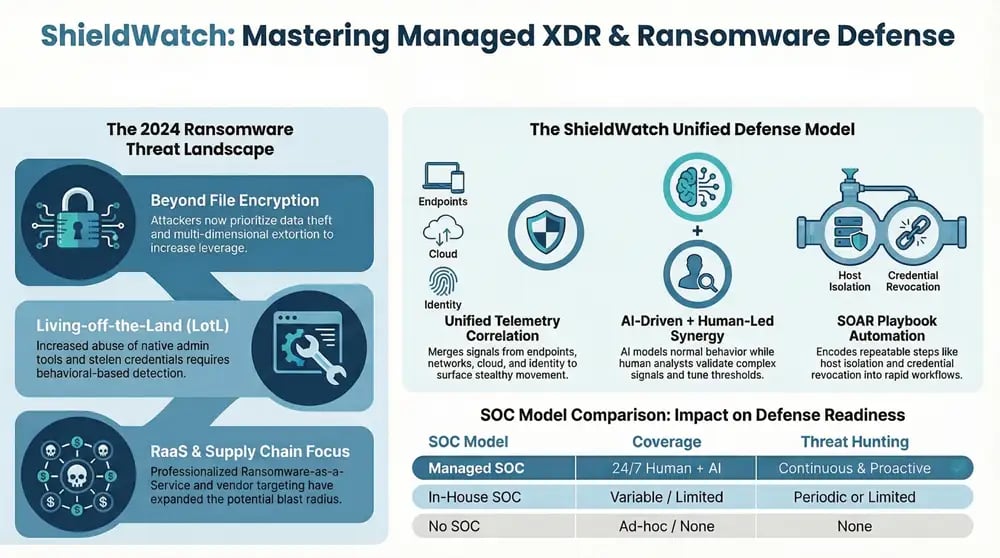
Managed XDR for Ransomware: Practical, Enterprise-Grade Defense
Ransomware remains one of the top operational and financial risks for enterprises in 2024. This guide clarifies what managed XDR looks like in practice, why AI-driven detection paired with a human-led SOC is now essential, and how to map controls across the ransomware kill chain to shrink risk. You’ll get concise threat trends, concrete detection and containment tactics, incident response playbooks, and compliance-minded resilience steps. Our focus is practical: telemetry consolidation, SOAR playbooks, threat-hunting workflows, and tested recovery practices that reduce mean time to remediate. Each section ties real attacker behavior to actionable controls so security teams, risk owners, and MSP partners can prioritize mitigations that lead to faster containment and reliable recovery.

Ransomware Trends Shaping Enterprise Risk in 2024
In 2024 ransomware has evolved beyond simple file encryption into multi-dimensional extortion campaigns that squeeze organizations and their partners. Attackers are combining RaaS economics with data theft, triple-extortion tactics, and supply-chain compromise—raising regulatory exposure and reputational damage. Recognizing these shifts lets security teams prioritize detection of lateral movement, exfiltration channels, and backup integrity as part of a resilient defense. Below are the trends with the clearest operational impact.
Top ransomware trends enterprises must address:
- Multi-vector extortion: Adversaries steal data for public release or targeted extortion in addition to encrypting systems, increasing pressure to respond quickly.
- RaaS and commoditized tooling: Professionalized services lower the barrier to entry and let campaigns scale across industries.
- Supply-chain targeting: Compromised MSPs and vendors expand blast radius, demanding stronger vendor controls and segmentation.
- Living-off-the-land techniques: Abuse of native admin tools and stolen credentials reduces noisy indicators and requires behavioral detection.
From Encryption to Data Extortion: What’s Changed?
Ransomware actors now prioritize exfiltrating high-value datasets—IP, customer PII, and regulated records—and use publication threats or partner-targeted extortion to increase leverage. That shift means defenders can’t rely only on file-encryption signatures. Effective detection monitors cloud uploads, large outbound transfers, and anomalous identity behavior, and correlates endpoints, cloud logs, and identity telemetry to catch pre-encryption data movement that signals imminent impact and demands immediate triage.
Which Industries Face the Highest Ransomware Risk?
Some sectors remain attractive targets because the operational impact or data value increases the chance of payment. Healthcare faces patient-safety and breach-notification exposure. Energy and utilities are critical-infrastructure targets where availability affects public safety. Manufacturing and logistics suffer direct financial loss from production stoppages. Financial services hold high-value data and transactional leverage. These patterns should shape detection priorities, playbooks, and regulatory engagement to reduce surface area and accelerate recovery.
How ShieldWatch XDR Detects Ransomware Early
ShieldWatch XDR detects ransomware across the kill chain by correlating telemetry from endpoints, networks, cloud, and identity sources to spot attack patterns early and automate containment. Our approach combines AI-driven behavioral baselines, cross-signal correlation, and SOAR orchestration so initial access or lateral movement triggers prioritized alerts and fast containment steps. When telemetry is unified, we can surface suspicious service creation, credential abuse, or anomalous transfers before encryption spreads—shrinking scope and recovery cost.
Compare XDR capabilities mapped to detection and response attributes to see how integrated telemetry outperforms siloed tools.
That integrated view yields earlier detection and actionable containment. The next section explains the AI capabilities that help prioritize high-fidelity incidents and cut noise.
What Role Does AI Play in Preventing Ransomware?
AI models normal behavior, surfaces anomalous sequences, and speeds triage so analysts can focus on high-risk activity. Agentic AI enriches alerts with context—historical logs, process trees, and user activity—creating a fuller incident picture that reduces false positives and accelerates decisions. But AI is most effective under human supervision: analysts validate outputs, tune thresholds, and investigate complex signals automation can miss. The combination of AI scoring and human judgment produces more reliable detections and faster containment of multi-stage campaigns.
Why Unified Visibility Improves Defense
Unified visibility turns disparate anomalies into coherent attack narratives. For example, an unexpected Azure storage write plus a spike in privileged account activity and a new executable on a host can indicate exfiltration and lateral movement. Correlating these signals shortens time to detection and supports targeted containment—isolating hosts, revoking sessions, and blocking C2—before encryption spreads. It also preserves richer forensic context that speeds recovery planning and root-cause analysis.
Why Managed SOC Services Matter for Fast Ransomware Response
Managed SOCs provide continuous monitoring, expert threat hunting, and orchestration that significantly shorten detection windows and mean time to remediate. They augment automated detections with human analysts who triage nuanced threats, validate AI recommendations, and escalate high-confidence incidents under SLA-driven playbooks. For organizations without large in-house teams, a managed SOC delivers 24/7 coverage and consistent response quality—critical when ransomware campaigns evolve outside standard hours.
Decide quickly by comparing coverage and response across SOC models.
Managed SOCs close operational gaps that give attackers time to exfiltrate data or encrypt systems. The sections that follow show how threat hunting and SOAR playbooks operate in practice and why human-led operations improve detection outcomes.
How 24/7 Human-Led Threat Hunting Reduces Dwell Time
Continuous threat hunting finds stealthy activity automation may miss—living-off-the-land techniques, dormant implants, and slow exfiltration channels. Hunters use hypothesis-driven investigations and AI-augmented queries to look for TTPs linked to ransomware groups, uncover lateral movement, and surface persistence. This proactive stance reduces dwell time by catching threats before encryption and feeds discoveries back into detection rules and SOAR playbooks to improve future fidelity.
What SOAR Playbooks Do for Incident Response
SOAR playbooks encode repeatable containment and remediation steps into automated workflows that cut manual effort while keeping analysts in control for critical decisions. Typical ransomware playbooks automate host isolation, network containment, credential revocation, forensic collection, and escalation to responders. Automation removes slow manual steps and reduces human error; human approvals guide high-impact actions like taking systems offline or evaluating ransom options. The result: faster, more consistent containment and a measurable drop in mean time to remediate.
Building Ransomware Resilience with Compliance and Best Practices
True resilience mixes effective technical controls, proven recovery processes, and alignment with compliance frameworks that require monitoring and auditable evidence. Core pillars include strong identity controls, timely patching, network segmentation, immutable backups, and tabletop exercises to validate playbooks. Mapping standards to concrete controls helps prioritize investments that both reduce ransomware risk and meet regulatory obligations.
The table below links common standards to the controls they emphasize and shows how XDR features support monitoring and evidence collection.
These mappings show how platform capabilities produce the telemetry and audit artifacts needed for both detection and regulatory evidence. Below we expand on those standards and list prioritized prevention and recovery practices.
Which Compliance Standards Strengthen Ransomware Defenses?
Frameworks that directly support ransomware controls include SOC 2 for monitoring and incident response, HIPAA for protecting health information, CMMC 2.0 for defense industrial base maturity, and ISO 27001 for enterprise risk management. Each emphasizes controls that map to ransomware defenses—robust logging and retention, strict access controls and breach processes, and disciplined configuration management. Aligning telemetry and playbooks with these frameworks reduces exposure and creates auditable evidence for regulators and partners.
Essential Prevention and Recovery Practices
Focus on a compact set of high-impact controls that reduce risk and speed restoration: enforce MFA and least-privilege, run a disciplined patching program, maintain endpoint protections with behavioral detection, and keep tested immutable backups backed by documented RTO/RPO objectives. Network segmentation and regular tabletop exercises further limit blast radius and validate recovery steps.
Prevention & recovery checklist:
- Enforce MFA and role-based access controls across critical systems.
- Apply timely patching and endpoint protections with behavioral detection.
- Maintain and regularly test immutable backups with clear RTO/RPO targets.
- Run tabletop exercises and update incident playbooks after each drill.
Each item reduces a specific ransomware risk and speeds recovery—setting the stage for the operational gains from combining AI XDR with a managed SOC.
Key Benefits of Combining AI-Powered XDR and a Managed SOC

Pairing AI-enhanced XDR with a managed SOC delivers measurable operational improvements: faster detection and containment, less alert fatigue, and unified context that speeds decisions during incidents. AI narrows triage effort by surfacing higher-fidelity signals while the managed SOC provides continuous human validation, hunting, and SLA-driven containment. Together they create a feedback loop—hunting and incidents refine detection models and SOAR playbooks—delivering continuous improvement in coverage and response speed.
Main benefits and expected outcomes for enterprise defenders:
- Faster detection and remediation through automation plus expert oversight.
- Reduced alert noise and analyst fatigue with prioritized, context-rich incidents.
- Broader coverage by correlating endpoint, network, cloud, and identity signals.
- Quicker operationalization of playbooks and simplified compliance reporting for audits.
These outcomes reduce business disruption and make incident results more predictable. The sections below explain hyper-automation and how we differentiate from legacy solutions.
How Hyper-Automation Cuts Response Time and Alert Fatigue
Hyper-automation uses SOAR workflows, agentic AI triage, and orchestration to automate routine containment and enrich alerts with context, shrinking manual effort and response times. Automated triage validates alerts by checking process lineage, network connections, and recent configuration changes before presenting a single high-confidence incident to analysts. Playbooks can then execute containment—network isolation, credential revocation, forensic capture—while queuing human review for policy-critical steps. The result is fewer false positives, lower cognitive load, and faster, more consistent remediation.
How ShieldWatch XDR Stands Apart
ShieldWatch delivers a unified defense model that stitches AI automation together with a 24/7 human-led SOC to close gaps left by siloed EDR and legacy SIEM. Differentiators include extensive pre-built SOAR workflows, unified licensing across NG-SEN, ITDR, SOAR, UEBA, and threat intel, plus rapid deployment that enables immediate analysis of historical logs. Those capabilities accelerate time-to-value, and the human+AI SOC ensures expert validation and continuous threat hunting to catch stealthy ransomware tactics.
Compare the unified XDR + managed SOC model with traditional stacks:
For teams that want to validate these capabilities, ShieldWatch offers an enterprise-grade XDR platform paired with managed SOC services. Request a demo or a managed SOC evaluation to see operational impact and fit.
Frequently Asked Questions
Conclusion
Managed XDR paired with a human-led SOC materially improves ransomware defense: faster detection, less alert fatigue, and full visibility across attack vectors. That combination streamlines response, powers continuous improvement through hunting and validation, and makes recovery more predictable. Prioritizing these capabilities helps organizations mitigate risk and protect critical assets—explore ShieldWatch solutions to see how we can strengthen your security posture.