

Zero Trust Architecture—commonly summarized as “never trust, always verify”—assumes no implicit trust for users or devices and requires continuous verification of identity, device posture, and context to reduce risk. This guide shows how Zero Trust limits lateral movement and sharpens detection and response by combining identity‑first controls, microsegmentation, and ongoing telemetry. You’ll find core principles, a phased implementation roadmap, practical technical controls such as ZTNA and microsegmentation, and how XDR plus managed SOC capabilities speed adoption.
We also map vendor capabilities to Zero Trust controls, align recommendations to NIST SP 800‑207 and the CISA Zero Trust Maturity Model, and outline mitigation strategies for common organizational obstacles. Throughout, we connect identity, device posture, policy enforcement points, and real operational examples so CISOs and architects can turn Zero Trust from concept into executable steps.
What Are the Core Principles of Zero Trust Framework?

Zero Trust is a practical security framework that requires explicit verification of every access request, enforces least privilege, operates under an “assume breach” mindset, continuously monitors telemetry, and segments resources to limit blast radius. It pairs identity verification, contextual policy decisions, and fine‑grained enforcement to prevent unauthorized access and lateral movement, yielding measurable reductions in compromise scope. The outcome is an adaptive security posture where access decisions factor in user identity, device health, location, and behavior before granting short‑lived privileges. These principles align with NIST SP 800‑207 and the CISA Zero Trust Maturity Model and guide control selection and architecture design in real environments.
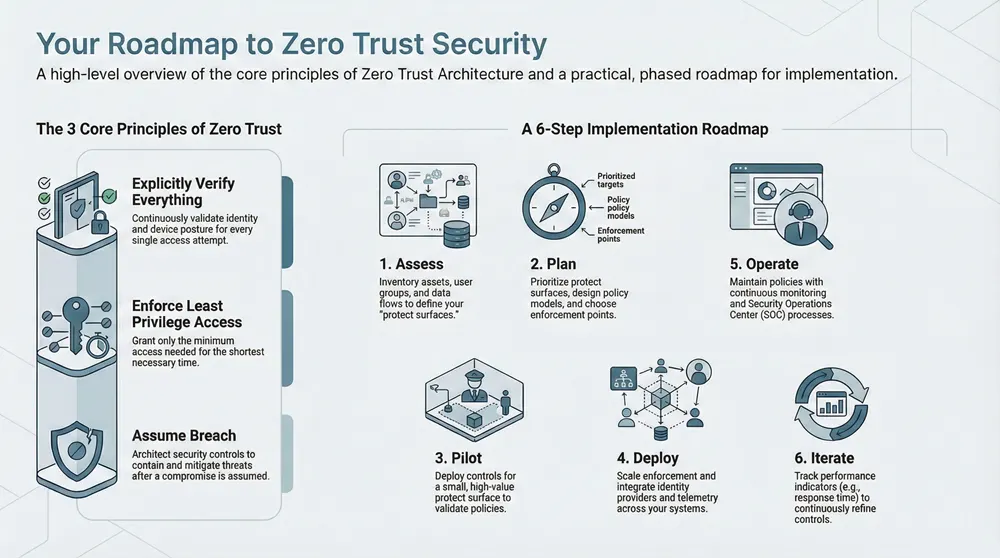
The core Zero Trust principles include:
- Explicit verification: Continuously validate identity and device posture for every access attempt.
- Least privilege access: Grant only the minimum access needed, for the shortest necessary time.
- Assume breach: Architect controls to contain and mitigate threats after an assumed compromise.
- Continuous monitoring: Collect and analyze telemetry to detect anomalies and enforce policies.
- Microsegmentation: Segment assets to restrict east‑west traffic and limit lateral movement.
- Policy enforcement at PEPs: Apply dynamic policies at enforcement points closest to the resource.
These principles work together: explicit verification enables least privilege, continuous monitoring informs policy decisions, and microsegmentation enforces containment. Recognizing how they interrelate prepares teams for the phased work of assessment, policy definition, and enforcement.
How Does Explicit Verification Enhance Security?
Explicit verification requires every access request to prove identity and device integrity before access is granted, which reduces unauthorized access and lateral movement. Authentication elements—identity providers, multi‑factor authentication (MFA), and device posture checks—supply the signals policy engines need, while session‑level authorization keeps access time‑bound and context‑aware. Paired with real‑time telemetry from endpoints and identity systems, explicit verification converts a static allow/deny model into an adaptive risk decision, improving the ability to block compromised credentials or unhealthy devices. Typical implementations use identity federation, continuous authentication signals, and policy engines that weigh user risk, device health, and resource sensitivity.
That continuous verification model naturally supports least privilege: richer context lets policies grant minimal, short‑lived privileges instead of broad, persistent access. The next section explains how least privilege reduces blast radius and stops privilege escalation.
Why Is Least Privilege Access Essential in Zero Trust?
Least privilege limits permissions for users, services, and devices to only what’s necessary, dramatically reducing the blast radius after a compromise. Controls such as role‑based access control (RBAC), attribute‑based access control (ABAC), privileged access management (PAM), and just‑in‑time (JIT) elevation enforce fine‑grained restrictions and temporary privilege grants. Eliminating excessive standing privileges reduces pathways for lateral movement and makes it harder for attackers to pivot to critical assets. Examples include per‑application access tokens, ephemeral session credentials, and time‑boxed administrative sessions—measures that curb exposure while preserving productivity.
Operationalizing least privilege depends on an accurate asset inventory and dynamic policy evaluation: know who needs access to which protect surface, then use telemetry to adjust privileges in real time. The following section shows how to translate these principles into a phased enterprise implementation plan.
How to Implement Zero Trust Architecture: A Step-by-Step Guide

Zero Trust is best delivered as a phased program: assess, define protect surfaces, pilot, enforce policies, integrate monitoring and automation, then iterate toward maturity. Start with discovery and risk‑based prioritization, then deploy policy enforcement points (PEPs) and telemetry collection, and use automation to reduce manual toil and ensure repeatable responses. This approach delivers incremental security value, measurable KPIs, and lower operational risk—rather than attempting a risky rip‑and‑replace. The roadmap aligns with the CISA Zero Trust Maturity Model and the real constraints of mid‑market and enterprise teams.
A practical step‑by‑step roadmap looks like this:
- Assess: Inventory assets, user groups, data flows, and existing controls to define protect surfaces.
- Plan: Prioritize protect surfaces, design policy models, and choose enforcement points (ZTNA, microsegmentation).
- Pilot: Deploy controls for a small, high‑value protect surface and validate policies and telemetry.
- Deploy: Scale enforcement, integrate identity providers, and instrument telemetry across endpoints and networks.
- Operate: Maintain policy fidelity with continuous monitoring, SOAR playbooks, and SOC processes.
- Iterate: Track KPIs (MTTR, false positive rates, access violations) and refine controls.
Each phase produces concrete artifacts—inventory lists, risk matrices, policy definitions, and runbooks—that reduce execution risk. Assign stakeholders (IT, security operations, application owners) and success metrics up front to ensure accountability and measurable progress.
What Are the Key Phases in Zero Trust Deployment?
Breaking the program into phases creates clear deliverables stakeholders can own and measure. The assess phase produces a protect‑surface inventory and risk ranking; planning yields policy templates and enforcement architecture; piloting validates controls and telemetry; deployment scales enforcement and ties in automation; operation embeds SOC workflows and continuous improvement. Typical owners include application teams for protect surfaces, IAM for identity integration, networking for segmentation, and the SOC for monitoring. Useful KPIs include MTTR, percentage of critical assets under policy, and reductions in exposed privileges.
This phased approach also prepares teams to integrate automated response and managed detection services, accelerating time‑to‑value and reducing alert fatigue. The next subsection explains how continuous monitoring supports Zero Trust in operational terms.
How Does Continuous Monitoring Support Zero Trust Implementation?
Continuous monitoring supplies the telemetry and analytics that turn static policies into adaptive, context‑aware controls by aggregating endpoint, network, and identity signals for real‑time policy evaluation. Sources include EDR‑style endpoint agents, network flow logs, identity provider logs, and cloud workload telemetry; these feeds enable behavior analytics, risk scoring, and automated playbooks. Analytics correlate multi‑domain signals to lower false positives and surface high‑confidence incidents, while SOAR workflows automate containment and policy tuning. Continuous monitoring closes the detection‑to‑response loop and keeps policies effective as environments and threat vectors evolve.
Robust monitoring influences vendor selection and operational design; many teams leverage managed SOC services and XDR platforms to centralize correlation and automated response. The next section maps platform features to Zero Trust controls and shows how XDR can accelerate adoption.
How Does ShieldWatch XDR Facilitate Zero Trust Security Solutions?
ShieldWatch XDR links platform capabilities to Zero Trust controls by combining AI‑assisted automation, pre‑built SOAR workflows, and a managed SOC to speed verification, containment, and continuous monitoring. Our AI‑driven triage and correlation reduce alert fatigue and support enforcement by surfacing prioritized incidents with rich context. Rapid deployment features—including retroactive 90‑day log analysis—let teams validate detection coverage and tune policies quickly, while compliance tools map controls to SOC 2, HIPAA, CMMC 2.0, and ISO 27001 requirements. These capabilities act as practical accelerators for enterprises and MSPs adopting Zero Trust.
This mapping clarifies how platform features support specific Zero Trust controls and operational outcomes. ShieldWatch’s blend of automation and SOC support reduces operational friction and helps teams move from policy definition to enforced, observable controls.
What AI and Automation Features Support Zero Trust?
AI and automation—ML‑based correlation, automated triage, and pre‑built SOAR playbooks—help maintain continuous verification and speed containment while reducing human workload. Machine learning links identity, endpoint, and network signals to surface higher‑fidelity incidents, and automation executes repeatable containment steps like isolating endpoints or revoking session tokens. Pre‑built playbooks codify verification and response steps, delivering consistent, auditable actions that align with Zero Trust policies. Together, these capabilities reduce alert fatigue and accelerate MTTR, freeing analysts to focus on complex investigations.
Automation should integrate with identity systems and enforcement points so policy decisions can be enacted in real time—improving policy fidelity and shrinking the window of exposure. The next subsection explores how 24/7 SOC integration enhances detection and response in practice.
How Does 24/7 SOC Integration Enhance Threat Detection?
A 24/7 SOC pairs continuous machine‑assisted monitoring with human analysis to validate alerts, carry out complex containment, and refine detection rules—a true human+machine defense. Analysts use correlated telemetry across domains to contextualize incidents, decide when to escalate or remediate, and update playbooks as tactics evolve. This model shortens detection‑to‑response cycles and ensures consistent enforcement of Zero Trust policies across time zones and off‑hours. For teams without internal SOC capacity, managed SOC services provide an operational bridge to maintain continuous verification and incident handling.
SOC integration also creates feedback loops: analysts tune detections and automation from real incidents, improving accuracy while preserving continuity of operations. The next section explains how microsegmentation complements monitoring and enforcement to limit lateral movement.
Note: The table above and SOC integration descriptions are illustrative mappings of platform features to Zero Trust controls and should be validated during vendor selection and pilot work.
What Is Microsegmentation and Its Role in Zero Trust Security?
Microsegmentation divides a network or environment into small, policy‑governed segments to control east‑west traffic and enforce least privilege at a granular level. It uses policy engines, host‑based controls, or network overlays to restrict which principals can communicate with which resources, containing breaches and limiting lateral movement. The payoff is a smaller attack surface and clearer enforcement boundaries that complement identity and access controls by preventing verified sessions from reaching unrelated protect surfaces. Microsegmentation works across cloud, on‑prem, and hybrid environments and is a core pillar of practical Zero Trust deployments.
Microsegmentation techniques differ by environment and trade‑offs, so pick an approach after mapping application flows and protect surfaces. The table below compares common options and their operational impacts.
How Does Microsegmentation Reduce Attack Surfaces?
Microsegmentation shrinks attack surfaces by isolating workloads and enforcing explicit communication policies so a compromised component cannot freely access neighboring systems. Policy‑driven segmentation permits only the flows required for application functions, cutting off lateral movement paths attackers exploit after initial access. In practice, a compromised endpoint can be quarantined by denying flows to database or management tiers, with telemetry triggering policy changes or automated containment when behavior looks anomalous. This containment substantially reduces incident scope and simplifies investigation and remediation.
Because effective microsegmentation depends on accurate flow mapping, implementations start with discovery and service labeling, which ties directly into the phased best practices described next.
What Are Best Practices for Implementing Microsegmentation?
Start small—protect your highest‑value protect surfaces first—then iterate using automation and policy validation to scale safely. Best practices include mapping application flows, labeling assets, enforcing least‑privilege communication policies, integrating enforcement with telemetry for continuous validation, and automating policy deployment through orchestration tools. Test and validate: simulate failures and confirm legitimate traffic remains uninterrupted while unauthorized flows are blocked. Integrating XDR and SOC telemetry improves policy tuning by exposing blocked flows and anomalies.
A checklist for deployment:
- Discover assets
- Model flows
- Create minimal allowlists
- Pilot on a single environment
- Monitor and adjust
- Expand coverage
Following these pragmatic steps helps ensure microsegmentation delivers containment without disrupting operations.
What Is Zero Trust Network Access and How Does It Compare to VPN?
Zero Trust Network Access (ZTNA) enforces per‑session, contextual access to applications and resources instead of granting broad network‑level connectivity like a traditional VPN. Each connection request is evaluated on identity, device posture, and contextual risk, and ephemeral access is issued only to the requested resource. Compared with VPNs, ZTNA dramatically reduces lateral access risk, makes least privilege easier to enforce, and supports per‑application policies aligned with Zero Trust principles. ZTNA is well suited for remote work, third‑party access, and cloud‑first architectures where fine‑grained control matters.
The operational differences between ZTNA and VPN make ZTNA a better fit for modern, adaptive architectures. The decision matrix below summarizes the tradeoffs.
What Are the Benefits of ZTNA in Zero Trust Models?
ZTNA provides targeted, per‑session access that minimizes exposure and enforces least privilege through contextual policy evaluation. Benefits include a smaller attack surface (no wide network tunnels), adaptive access that factors device and user risk, and simpler auditing because access is logged at the application level. ZTNA works particularly well for remote workers, contractors, and cloud applications where traditional network controls fall short. Organizations that adopt ZTNA typically gain clearer visibility into access patterns and fewer opportunities for lateral movement.
These benefits make ZTNA a foundational enforcement point for Zero Trust. The next subsection explains how ZTNA enforces least privilege operationally.
How Does ZTNA Enforce Least Privilege Access?
ZTNA enforces least privilege by evaluating each access request against dynamic policies that consider identity attributes, device posture, session context, and risk signals before granting ephemeral, scoped access. The flow usually involves authenticating to an identity provider, a policy decision from a central engine that reviews contextual signals, and issuance of a short‑lived access token or brokered session to the application. This design prevents broad or persistent privileges and allows rapid revocation as risk changes. Integration with IAM, MFA, device health checks, and continuous monitoring ensures policy decisions reflect the current posture.
Operational setups must ensure the policy decision point receives timely telemetry; when tied to monitoring and automation, ZTNA supports fast revocation and remediation and further reduces exposure.
How to Achieve Compliance and Overcome Challenges in Zero Trust Adoption?
Operationalizing Zero Trust and meeting compliance obligations requires mapping controls to regulatory requirements and addressing organizational barriers through phased adoption and managed services. The approach aligns Zero Trust controls—identity verification, least privilege, logging, and segmentation—with audit requirements for frameworks like SOC 2, HIPAA, CMMC, and ISO 27001, producing the evidence artifacts auditors expect. The benefit is a defensible compliance posture that’s also more resilient because Zero Trust reduces breach likelihood and scope. Practical options include vendor partnerships, automation, and managed SOCs to bridge capability gaps.
The next table maps Zero Trust controls to common regulatory requirements to help audit and compliance teams prioritize work.
This mapping helps security and compliance teams prioritize implementations that deliver both security and audit value. The following subsections cover aligned frameworks and common challenges with practical solutions.
Which Regulatory Frameworks Align with Zero Trust Architecture?
Zero Trust naturally maps to guidance such as NIST SP 800‑207 and the CISA Zero Trust Maturity Model, which offer architecture‑level direction on identity, device, and network controls. NIST SP 800‑207 defines principles and deployment models, while CISA’s maturity model helps assess progress across identity, devices, networks, applications, and analytics. Zero Trust controls also support SOC 2 and HIPAA requirements by strengthening access controls, logging, and incident response, and they provide useful evidence for ISO 27001 and CMMC audits. Framing your Zero Trust program against specific control objectives simplifies audit readiness.
Documenting control mappings and retention policies during each phase creates artifacts that ease compliance reviews and provide clear audit trails for assessors.
What Are Common Challenges and Solutions in Zero Trust Implementation?
Common obstacles include legacy systems built on implicit trust, limited in‑house expertise, budget constraints, and the complexity of mapping application flows. Practical solutions are phased adoption focused on protect surfaces, running pilots to demonstrate ROI, using automation to reduce operational overhead, and partnering with managed SOC or XDR providers to fill skills gaps. Relevant KPIs include reduced MTTR, percentage reduction in exposed privileges, and fewer false positives through correlated telemetry.
- Problem: Legacy systems and broad trust zones.
- Solution: Start with protect surfaces and use segmentation pilots.
- Problem: Limited SOC capacity and skills.
- Solution: Leverage managed SOC and pre‑built SOAR workflows to automate triage and response.
These approaches lower executive risk and provide measurable indicators of progress that help secure ongoing investment and operational buy‑in. When evaluating partners, prioritize platforms with AI‑driven triage, SOAR playbooks, and managed SOC support to reduce operational risk and speed Zero Trust outcomes.
Frequently Asked Questions
Conclusion
Zero Trust Architecture strengthens cybersecurity by enforcing continuous verification and minimizing lateral movement. Adopting core principles—least privilege, microsegmentation, and continuous monitoring—reduces attack surface and supports regulatory compliance. If you’re ready to move from planning to action, explore tailored Zero Trust solutions that match your environment. Learn how our services can help you integrate Zero Trust principles into your existing infrastructure with practical, measurable outcomes.
https://shorturl.fm/G9JY6
https://shorturl.fm/Hxw1Y
https://shorturl.fm/NpZRP
https://shorturl.fm/ln4XV
https://shorturl.fm/PwrUR
https://shorturl.fm/Mptco
https://shorturl.fm/4DlzN
https://shorturl.fm/8q1qN
https://shorturl.fm/Iu3sF
https://shorturl.fm/ad7PK
https://shorturl.fm/QMDz8
https://shorturl.fm/izqRv
https://shorturl.fm/V5lDr
https://shorturl.fm/rFskD
https://shorturl.fm/PdA8n
Последние новинки музыки 2026 скачать бесплатно https://shorturl.fm/l9SWZ
https://shorturl.fm/9RGLX
https://shorturl.fm/1jkAt
https://shorturl.fm/orDDA
https://shorturl.fm/Z2GB1
https://shorturl.fm/9OqD3
https://shorturl.fm/wwFIk
https://shorturl.fm/1N0RF
https://shorturl.fm/DMAcB
https://shorturl.fm/V6pi4
https://shorturl.fm/NQHK0