

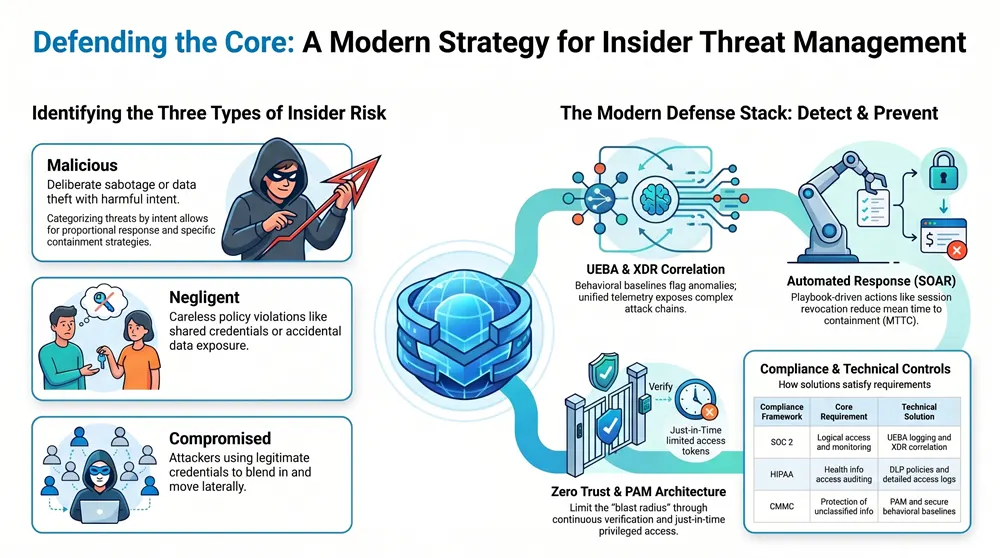
Insider threats start inside the perimeter—employees, contractors, partners or compromised credentials—and can inflict outsized damage to data, operations and reputation. This guide shows how modern insider threat programs combine endpoint, network, cloud and identity telemetry with behavioral analytics, automated response and governance controls to detect and stop those risks. You’ll learn to separate malicious, negligent and compromised activity, evaluate User and Entity Behavior Analytics (UEBA), see how Extended Detection and Response (XDR) links signals across domains, and weigh in-house versus managed SOC options.
We also cover prevention: Zero Trust, privileged access management (PAM), security awareness and data loss prevention (DLP), plus how controls map to SOC 2, HIPAA and CMMC. Practical examples, checklists and comparison tables help security leaders prioritize actions and measure risk reduction.
What Are Insider Threats and Why Are They Critical to Detect?

Insider threats are actions taken by trusted users or hijacked accounts that lead to data exposure, downtime or compliance failures. They’re uniquely dangerous because trusted access often sidesteps perimeter controls and shortens the attack chain. Effective detection depends on spotting deviations from established user baselines and correlating signals across endpoints, network, cloud and identity to generate high‑confidence alerts. Organizations that miss insider activity face rising costs for investigation, containment and regulatory penalties, and reputational damage grows the longer incidents persist. Framing the problem clearly helps teams choose analytics, containment and governance controls that limit exposure and speed remediation.
For response to be effective, teams must detect and categorize insider activity into practical, actionable groups.
What Are the Types of Insider Threats: Malicious, Negligent, and Compromised Accounts?
Malicious insiders deliberately abuse access to exfiltrate data, sabotage systems or assist external actors—look for abnormal bulk exports, privilege escalation, or unusual hours and targets. Negligent insiders create risk through careless habits: shared credentials, unmanaged credentials in documents, repeated policy violations or risky file sharing. Compromised accounts occur when attackers obtain legitimate credentials and blend in until telemetry correlation reveals lateral movement or abnormal cloud access. Each type needs different signals and responses: intent and sequence patterns for malicious actors, policy enforcement and training for negligence, and rapid cross‑domain anomaly correlation for compromised accounts.
Early detection combines behavioral baselines with contextual enrichment so analysts can infer intent and apply proportional containment.
What Is the Impact and Cost of Insider Threats on Organizations?
Insider incidents carry direct costs—forensics, remediation, notifications and potential fines—and indirect costs such as lost customers and operational disruption. Those costs escalate with longer dwell time, so reducing time to containment shrinks investigation scope and legal risk. Boards increasingly demand continuous monitoring, behavioral analytics and fast isolation because these measures materially lower incident impact and executive exposure. Building a clear cost‑benefit map means linking likely incident paths to containment SLAs and expected reductions in false positives and dwell time.
Quantifying value from detection investments requires realistic scenarios, containment targets and projected decreases in investigation effort.
How Does User Behavior Analytics Enhance Insider Threat Detection?
User and Entity Behavior Analytics (UEBA) builds statistical baselines of normal activity and highlights deviations that indicate risk. By ingesting endpoint telemetry, network flows, cloud logs and identity data, UEBA applies machine learning to score anomalies and group correlated events that single signals would miss. The result: higher‑confidence alerts that cut time spent on low‑value triage and speed response for real insider incidents—examples include off‑hours file access, bulk exports from privileged accounts, or geographically inconsistent authentications.
- UEBA detects risk by baselining actions across systems and flagging meaningful deviations.
- UEBA raises signal quality by correlating anomalies across telemetry sources and reducing noise.
- UEBA helps prioritize analyst work so teams remediate the highest‑risk insider activity first.
These capabilities make UEBA a core element of a modern insider threat program and a natural lead into AI‑driven behavior models.
How Does AI-Driven UEBA Identify Anomalous User Activities?
AI‑driven UEBA consumes endpoint telemetry, application logs, cloud access events and authentication records to create multidimensional baselines for users and devices. Models learn typical sequences and volumes over a baseline period, update continuously, and assign anomaly scores when activity diverges in frequency, order or resource access. Detectable indicators include lateral movement, unusual data aggregation, or unexpected third‑party integrations; each event is weighted by asset criticality and privilege level to cut false positives. Where models face cold‑start or edge cases, techniques like peer‑group modeling and human‑in‑the‑loop tuning keep precision high.
Clear anomaly scoring and controls for false positives are essential for reducing SOC alert fatigue.
What Are the Benefits of UEBA in Reducing False Positives and Alert Fatigue?
UEBA lowers false positives by aggregating low‑confidence signals into contextual incidents with clear remediation paths, improving SOC throughput and morale. By correlating behaviors—login patterns, file transfers and network access—UEBA surfaces alerts that represent real risk and filters routine operational noise. The operational wins include fewer escalations, faster mean time to detect, and triage queues prioritized by business impact. Those gains free analysts for threat hunting and remediation, creating feedback that refines detection models and further reduces alert volume.
Cutting noise with UEBA also boosts the effectiveness of XDR platforms that act on correlated insider indicators.
What Are the Key Features of XDR for Insider Threat Prevention?
Extended Detection and Response (XDR) centralizes endpoint, network, cloud and identity telemetry to enable cross‑domain correlation, enhanced UEBA scoring and automated containment workflows—core capabilities for insider threat prevention. XDR unifies logs into coherent incidents, supports retrospective analysis across historical data, and triggers SOAR playbooks to execute containment with minimal manual steps. Important XDR features for insider risk are integrated UEBA, DLP integration for data exfiltration detection, automated incident response (isolation, session termination) and retroactive log review to reconstruct timelines. Together, these shorten detection‑to‑containment windows and increase analyst confidence.
ShieldWatch XDR demonstrates these capabilities by combining advanced automation, agentic AI and a human‑led 24/7 SOC to detect and contain faster. The platform unifies endpoints, network, cloud and identity telemetry, supports retroactive log analysis to surface missed events, and lowers alert fatigue with ML‑driven correlation. When evaluating XDR, match UEBA, DLP integration, SOAR playbooks and retrospective analysis to your insider use cases before choosing a vendor.
How Does XDR Unify Endpoint, Network, Cloud, and Identity Data for Detection?
XDR ingests telemetry from diverse sources and normalizes events into a common schema so correlation engines can link actions across domains and expose complex insider attack chains. This lets teams detect sequences like credential misuse followed by anomalous cloud storage access and lateral host movement—patterns a single monitoring domain would miss. Normalization keeps context—user identity, asset risk, application access—so UEBA and rule engines can assign meaningful scores and launch appropriate playbooks. The unified view also supports forensic reconstruction and retroactive hunting for slowly developing insider incidents.
A typical cross‑domain example is a privileged credential used from an unexpected location followed by bulk data access—XDR correlates those signals and elevates the incident for immediate containment.
How Do Automated Incident Response and Rapid Containment Work in XDR?
Automated incident response uses SOAR playbooks to map detection signals to sequenced containment steps—isolating endpoints, revoking sessions or quarantining files—so analysts focus on validation and escalation instead of repetitive tasks. Playbooks trigger on high‑confidence correlated incidents, enrich context, assess impact and then apply containment aligned to policy and business tiers. These workflows shorten mean time to containment and shrink the window for data exfiltration or damage. Continuous feedback from playbook outcomes refines detection thresholds and containment actions, improving automation precision and resilience.
Reliable automation depends on accurate detection and policy alignment; integration testing and phased rollouts are recommended before full enforcement.
Which Managed Insider Threat Services Support Effective Detection and Prevention?

Managed offerings—SOC as a Service (SOCaaS) and Managed XDR—deliver 24/7 monitoring, threat hunting and incident response to augment internal teams or provide full operational coverage for organizations without a mature SOC. These services ingest telemetry, run UEBA and XDR analytics, validate incidents and provide reporting and compliance support. Models range from co‑managed (your team retains tuning control) to fully managed (end‑to‑end service). Choose a model based on maturity, budget, SLA needs, regulatory requirements and expected time‑to‑verdict and containment performance.
ShieldWatch provides Managed XDR and 24/7 SOC services that pair automation with human analysts and threat hunters, delivering rapid containment and co‑managed options. Our deployments emphasize quick time‑to‑value, retroactive analysis and reduced alert fatigue through ML and threat intelligence correlation. When assessing providers, confirm metrics—time‑to‑verdict, containment speed and false‑positive reduction—match your risk and compliance needs.
What Is SOC as a Service and Its Role in Insider Threat Management?
SOC as a Service centralizes security operations—continuous monitoring, triage and escalation—through a managed provider, ideal for organizations without a staffed SOC. SOCaaS teams consume XDR and UEBA telemetry, apply correlation and enrichment, and follow documented escalation paths to contain insider incidents or hand off actions to internal teams. Benefits include predictable coverage, access to experienced analysts and improved compliance reporting. SOCaaS can accelerate maturity by introducing playbooks and detection engineering that can be co‑managed for long‑term capability building.
When evaluating SOCaaS, look for integration flexibility, transparent playbooks and clear mapping of incidents to business impact.
How Does Threat Hunting and Incident Response Enhance Insider Risk Mitigation?
Threat hunting proactively searches telemetry for subtle insider indicators that automated systems may miss, using hypotheses anchored in attacker techniques and organizational context. Hunters examine historical logs, endpoint artifacts and identity signals to uncover misuse, often reducing dwell time by surfacing incidents earlier. Incident response then contains and remediates—collecting forensics, resetting credentials and changing processes—while documenting lessons that update detection rules and governance. Combined, hunting and response turn insights into durable controls that lower future insider risk.
Proactive hunting and structured response also feed detection models, improving precision and enabling faster automated actions.
What Strategies and Technologies Prevent Insider Attacks Beyond Detection?
Prevention lowers the chance and impact of insider incidents by pairing architectural controls, identity governance, policy enforcement and people‑centered programs. Core measures include Zero Trust to enforce least privilege and continuous verification, PAM for privileged account controls, DLP to stop sensitive exfiltration, and focused security awareness to reduce negligent behavior. Integrations—DLP inside XDR, PAM tied to identity providers—turn controls into operational workflows, while policy, access reviews and data classification sustain effectiveness. Layering these controls creates a practical barrier against both malicious and careless insiders.
- Zero Trust limits lateral movement and privilege abuse through microsegmentation and conditional access.
- PAM enforces just‑in‑time access, records sessions and provides auditable controls over privileged activity.
- DLP applies content‑aware policies to block or flag unauthorized data movement.
Used together, these layers significantly reduce the risk and impact of insider incidents.
How Does Zero Trust Architecture Reduce Insider Risk?
Zero Trust removes implicit trust and requires continuous verification of identity, device posture and access intent before granting resources, shrinking the blast radius of compromised credentials. Key controls include microsegmentation to contain lateral movement, conditional access tied to device and location risk, and continuous session evaluation. A practical Zero Trust rollout follows a phased roadmap: identify critical assets, apply least‑privilege access, instrument telemetry for continuous assessment and automate enforcement through policy engines integrated with XDR/SOAR. Expected benefits are fewer successful lateral attacks, faster detection of anomalous sessions and clearer audit trails for investigations.
Adopt Zero Trust incrementally and align it with business priorities to limit operational friction.
What Role Do Security Awareness Training and Privileged Access Management Play?
Security awareness training reduces negligent incidents by teaching staff to spot phishing, handle data safely and follow policy; metrics like simulated‑phish click rates and policy violation trends measure progress. Privileged Access Management (PAM) limits exposure with just‑in‑time elevation, session isolation and credential vaulting while producing forensic records of administrative actions. Together, training and PAM address both human behavior and access controls: training lowers risky actions, and PAM reduces impact when issues occur. Effective programs combine recurring training, role‑based access reviews and PAM audits to show continuous improvement and measurable risk reduction.
Aligning behavioral metrics with technical enforcement creates resilient defenses against negligent and malicious insiders alike.
How Does Compliance and Risk Management Relate to Insider Threat Prevention?
Compliance frameworks demand controls that mitigate insider risk—access controls, logging, monitoring and incident response—so aligning detection and prevention with SOC 2, HIPAA and CMMC eases audit readiness and risk reporting. Risk management links business impact to control design, prioritizing protections for regulated or mission‑critical assets and guiding investments in UEBA, XDR, DLP and PAM. Continuous monitoring, clear audit trails and documented response processes satisfy both compliance evidence needs and practical insider mitigation. Mapping technical controls to framework requirements helps security leaders allocate resources and demonstrate due diligence to auditors and stakeholders.
The table above maps common frameworks to representative requirements and shows how technology and process meet those obligations.
Which Compliance Frameworks Address Insider Threats: SOC 2, HIPAA, CMMC?
SOC 2 requires logical access controls, monitoring and incident response evidence that help detect and prevent insider misuse. HIPAA mandates safeguards for protected health information—access controls, audit trails and breach notifications—that overlap directly with insider controls. CMMC focuses on protecting controlled unclassified information through access management, logging and continuous monitoring. Mapping these obligations to UEBA, DLP and PAM gives auditors concrete evidence and helps teams prioritize controls by compliance and risk impact.
Aligning controls with framework evidence also strengthens overall security posture and reduces audit friction.
How Does Data Governance Support Insider Risk Reduction?
Data governance lowers insider risk by classifying data sensitivity, enforcing retention and access rules, and enabling targeted DLP where the highest‑value assets live. Practical steps include regular access reviews, data tagging to drive policy enforcement and automated workflows that block or quarantine risky transfers. Operational checklists—mandatory classification at creation, quarterly access attestations and DLP tuning—keep controls effective over time. Strong governance supplies the metadata UEBA and XDR need to prioritize alerts so incidents involving sensitive assets get faster, higher‑priority response.
Tight integration between governance, monitoring and response ensures prevention and detection work in concert to reduce insider incidents.
How Does Data Governance Support Insider Risk Reduction?
Data governance reduces insider risk by classifying sensitive assets, enforcing access and retention policies, and targeting DLP where it matters most. Routine governance tasks—periodic access reviews, consistent data tagging and automated enforcement workflows—help prevent risky transfers and simplify investigations. Practical controls like mandatory classification at data creation, scheduled access attestations and ongoing DLP policy tuning maintain effectiveness. This contextual metadata enables UEBA and XDR to prioritize incidents that touch high‑value data for faster containment.
When governance, monitoring and response are integrated, prevention and detection become mutually reinforcing.
Frequently Asked Questions
Conclusion
Detecting and preventing insider threats requires a blend of telemetry, behavioral analytics, automated containment and governance. UEBA and XDR give teams the cross‑domain visibility and automation needed to shorten dwell time, while Zero Trust, PAM, DLP and training reduce the likelihood and impact of incidents. Start with prioritized use cases, measurable SLAs and a phased rollout that pairs automation with human oversight. If you’re ready to strengthen insider risk controls, explore ShieldWatch’s solutions designed for fast deployment, continuous monitoring and measurable outcomes.
https://shorturl.fm/YYODV
https://shorturl.fm/SFo6n
https://shorturl.fm/dE3by
https://shorturl.fm/emcvG
https://shorturl.fm/BqhM0
https://shorturl.fm/27JoU
https://shorturl.fm/r1KFB
https://shorturl.fm/sP6xe
https://shorturl.fm/WjSt8
https://shorturl.fm/CgIzu
https://shorturl.fm/wtgzf
https://shorturl.fm/Fcmx9
https://shorturl.fm/A93R7
https://shorturl.fm/VvEYK
https://shorturl.fm/vTPXC
https://shorturl.fm/xTTUb
https://shorturl.fm/8NXF6
https://shorturl.fm/Yqu6v
https://shorturl.fm/7a9Bb
https://shorturl.fm/29PGf
https://shorturl.fm/Nj6Wh
https://shorturl.fm/9vPT7
https://shorturl.fm/Ipg1X
https://shorturl.fm/xtQVR
https://shorturl.fm/AJZm5
https://shorturl.fm/DzuS5
https://shorturl.fm/cDRC8
https://shorturl.fm/pxIjx
https://shorturl.fm/uxYOc
https://shorturl.fm/8Wlsq
https://shorturl.fm/qEeKm
https://shorturl.fm/WBcg0
https://shorturl.fm/cCZoi
https://shorturl.fm/GFVnn
https://shorturl.fm/7KeMg
https://shorturl.fm/ZWgyd
https://shorturl.fm/Aurec
https://shorturl.fm/WiK6p
https://shorturl.fm/wLJoV
https://shorturl.fm/XIDnx
https://shorturl.fm/crYy7
https://shorturl.fm/WGGEh
https://shorturl.fm/Zlwcu
https://shorturl.fm/AflrT
https://shorturl.fm/gp1vH
https://shorturl.fm/ryAwC
https://shorturl.fm/tqNML
https://shorturl.fm/FR9pG
https://shorturl.fm/HDJ98
https://shorturl.fm/tpBoX
https://shorturl.fm/6xIjG
https://shorturl.fm/Iq7XN
https://shorturl.fm/oUDd5
https://shorturl.fm/SFFMC
https://shorturl.fm/MlJTT
https://shorturl.fm/uOnAk
https://shorturl.fm/gtfQ7
https://shorturl.fm/xVygt
https://shorturl.fm/iWwpW
https://shorturl.fm/hJvPJ
https://shorturl.fm/BR1fe
https://shorturl.fm/Qwtx4
wish you all the best
https://shorturl.fm/4LoU6
https://shorturl.fm/oZhrA
https://shorturl.fm/3Jq9y
https://shorturl.fm/48sif
https://shorturl.fm/oI9pb
https://shorturl.fm/Qibe0
https://shorturl.fm/cQcIt
https://shorturl.fm/WdqFb
https://shorturl.fm/tMtWD
https://shorturl.fm/FO5Zk
https://shorturl.fm/XPB8t
https://shorturl.fm/G1EIs
https://shorturl.fm/PUZ2W
https://shorturl.fm/1CoVT
https://shorturl.fm/xuRck
https://shorturl.fm/hwbfd
https://shorturl.fm/vWQf5
https://shorturl.fm/MXRLY
https://shorturl.fm/hOeoA
https://shorturl.fm/1M7eG
https://shorturl.fm/AdbkU
https://shorturl.fm/j3paL
https://shorturl.fm/R7cfV
https://shorturl.fm/ilYfi
https://shorturl.fm/m91iZ
https://shorturl.fm/25hBo
https://shorturl.fm/fUE5p
https://shorturl.fm/vW9Aq
https://shorturl.fm/Io6MJ
https://shorturl.fm/zmtws
https://shorturl.fm/XbsOx
https://shorturl.fm/x5i2m
https://shorturl.fm/eanPz
https://shorturl.fm/xBwVT
https://shorturl.fm/FjCcN
https://shorturl.fm/PwOUc
https://shorturl.fm/whqNw
https://shorturl.fm/0n4yS
https://shorturl.fm/vw9ZS
https://shorturl.fm/OAkRr
https://shorturl.fm/hZIAE
https://shorturl.fm/lDoOf
https://shorturl.fm/fpgFo
https://shorturl.fm/ZwOBB
https://shorturl.fm/xFeDs
https://shorturl.fm/zRAv1
https://shorturl.fm/b5A6L
https://shorturl.fm/keWRQ
https://shorturl.fm/rdtya
https://shorturl.fm/MquL3
https://shorturl.fm/PEh97
https://shorturl.fm/HXZYw
https://shorturl.fm/bYr1L
https://shorturl.fm/Tuvkl
https://shorturl.fm/xIDRe
https://shorturl.fm/JZbBu
https://shorturl.fm/Urhin
https://shorturl.fm/wcYek
https://shorturl.fm/GdFet
https://shorturl.fm/bcEfq
https://shorturl.fm/Gj2u9
https://shorturl.fm/repNj
https://shorturl.fm/YczFd
https://shorturl.fm/uoXws
https://shorturl.fm/ZjNEu
https://shorturl.fm/p18O7
https://shorturl.fm/MKU5j
https://shorturl.fm/MxoE5
https://shorturl.fm/mqPCE
https://shorturl.fm/tE0h3
https://shorturl.fm/XRocJ
https://shorturl.fm/u2JpF
https://shorturl.fm/QMDz8
https://shorturl.fm/uktKg
https://shorturl.fm/KvNG9
https://shorturl.fm/k1hSO
https://shorturl.fm/fNzJk
https://shorturl.fm/TkciG
https://shorturl.fm/EgWvc
https://shorturl.fm/RvtHl
https://shorturl.fm/MCSbr
https://shorturl.fm/rrInG
https://shorturl.fm/WjXns
https://shorturl.fm/LGoBC
https://shorturl.fm/q6TWR
https://shorturl.fm/n8Hok
https://shorturl.fm/q6TWR
https://shorturl.fm/HWqaa
https://shorturl.fm/57PRT
https://shorturl.fm/KNdoz
https://shorturl.fm/BzTaO
https://shorturl.fm/4q1fn
https://shorturl.fm/1J56u
https://shorturl.fm/gSJom
https://shorturl.fm/VQPym
https://shorturl.fm/iOIFP
https://shorturl.fm/WP6F7
https://shorturl.fm/vy1pS
https://shorturl.fm/SDVFt
https://shorturl.fm/iBOly
https://shorturl.fm/3oCH9
https://shorturl.fm/dfhVe
https://shorturl.fm/VL3H6
https://shorturl.fm/liwMW
https://shorturl.fm/7Gc4q
https://shorturl.fm/Ge1cV
https://shorturl.fm/txoe1
https://shorturl.fm/Bl0sH
https://shorturl.fm/8CUGY
https://shorturl.fm/SqhUo
https://shorturl.fm/5NdTc
https://shorturl.fm/GzIL6
Последние новинки музыки 2026 скачать бесплатно https://shorturl.fm/l9SWZ
https://shorturl.fm/b6c16
https://shorturl.fm/eF7o0
https://shorturl.fm/iA6hG
https://shorturl.fm/I8Cjy
https://shorturl.fm/cWCd3
https://shorturl.fm/sWSNW
https://shorturl.fm/3vgvu
https://shorturl.fm/d5Khs
https://shorturl.fm/fAOzU
https://shorturl.fm/9Qn0X
https://shorturl.fm/n6dI1
https://shorturl.fm/4MHS3
https://shorturl.fm/eRwLL
https://shorturl.fm/Q39KD
Новинки музыки 2026 скачать бесплатно https://shorturl.fm/pj0rJ
https://shorturl.fm/aC7Pa
https://shorturl.fm/jcp0V
Последние новинки музыки 2026 скачать бесплатно – https://shorturl.fm/rrdv9
Последние новинки музыки 2026 скачать бесплатно – https://shorturl.fm/rrdv9
https://shorturl.fm/vPVsu
https://shorturl.fm/Ts12O
https://shorturl.fm/SxTZ5
https://shorturl.fm/qd4Tq
https://shorturl.fm/YLiPW
https://shorturl.fm/02DMx
https://shorturl.fm/0omlp
https://is.gd/2esl83
https://is.gd/d7aUgB
https://shorturl.fm/LtJK8
https://shorturl.fm/qm6pL
https://shorturl.fm/GMLz1
https://shorturl.fm/Ghkii
https://shorturl.fm/1TpeJ
https://shorturl.fm/SuAMd
https://shorturl.fm/DnaYR
https://shorturl.fm/xmNBd
https://shorturl.fm/gdW0Q
https://shorturl.fm/ptXd7
https://shorturl.fm/KqzqX
https://shorturl.fm/il476
https://shorturl.fm/4VAVB
https://shorturl.fm/kkFmz
https://shorturl.fm/K6U9x
https://shorturl.fm/rgJrs
https://shorturl.fm/jZsIE
https://shorturl.fm/SgJ4A
https://shorturl.fm/2jdXs
https://shorturl.fm/8Valf
https://shorturl.fm/hizaw
Cybersecurity is a category that rewards credibility.
https://shorturl.fm/zqspi
https://shorturl.fm/eL8gt
https://shorturl.fm/4UXoa
https://shorturl.fm/Vw1Qd
https://shorturl.fm/filKy
https://shorturl.fm/7tpxH
https://shorturl.fm/9I4S0
https://shorturl.fm/3vykE
https://shorturl.fm/dQJLA
https://shorturl.fm/7jcQV
https://shorturl.fm/Qb61F
https://shorturl.fm/IcBYj
https://shorturl.fm/dQ4su
https://shorturl.fm/CrZOB
https://shorturl.fm/b3Uag
https://shorturl.fm/WH9gx
https://shorturl.fm/CHvVq
https://shorturl.fm/lPEf1
https://shorturl.fm/ZYUt0
https://shorturl.fm/dfk58
https://shorturl.fm/JLfCh
https://shorturl.fm/NLIkL
https://shorturl.fm/fyRIb
https://shorturl.fm/fyRIb
https://shorturl.fm/Vav6E
https://shorturl.fm/73FN8
https://shorturl.fm/vKDCo
https://shorturl.fm/cfrx7
https://shorturl.fm/afx5Z
https://shorturl.fm/FFCOG
https://shorturl.fm/ZIKK1
https://shorturl.fm/3xG65
https://shorturl.fm/jQMfV
https://shorturl.fm/XcyeU
https://shorturl.fm/ZMHmU
https://shorturl.fm/sK1ZY
https://shorturl.fm/GL6Iq
https://shorturl.fm/ELgGk
https://shorturl.fm/DCKwS
https://shorturl.fm/jafU9
https://shorturl.fm/fm7F7
https://shorturl.fm/8ZTmo
https://shorturl.fm/7MbO7
https://shorturl.fm/JWbqQ
https://shorturl.fm/m73JM
https://shorturl.fm/jXzx1
https://shorturl.fm/E60Xq
https://shorturl.fm/oISJZ
https://shorturl.fm/R2ztA
https://shorturl.fm/RwYCR
https://shorturl.fm/QsGsd
https://shorturl.fm/Ri06l
https://shorturl.fm/snfV4
https://shorturl.fm/7AYoG
https://shorturl.fm/4NePC
https://shorturl.fm/n3541
https://shorturl.fm/i0A6t
https://shorturl.fm/nIYdM
https://shorturl.fm/WH4si
https://shorturl.fm/GxN3K
https://shorturl.fm/K4pJQ
https://shorturl.fm/H12Ci
https://shorturl.fm/7Xays
https://shorturl.fm/cPWVj
https://shorturl.fm/1o8fP
https://shorturl.fm/IQZZX
https://shorturl.fm/h6jkV
https://shorturl.fm/zgobx
https://shorturl.fm/LJzPA
https://shorturl.fm/MFSEK
https://shorturl.fm/8onnu
https://shorturl.fm/SUczI
https://shorturl.fm/I5MDS
https://shorturl.fm/4GrQi
https://shorturl.fm/6pI13
https://shorturl.fm/JJfRM
https://shorturl.fm/1kRIF
https://shorturl.fm/HOZKI
https://shorturl.fm/8q7ko
https://shorturl.fm/xHPYB
https://shorturl.fm/ruEl4
https://shorturl.fm/rXooM
https://shorturl.fm/Y8JZA
https://shorturl.fm/jtTrU
https://shorturl.fm/PTgIX
https://shorturl.fm/wFfVW
https://shorturl.fm/gRBNo
https://shorturl.fm/2TyOD
https://shorturl.fm/ZWqyS
https://shorturl.fm/voUU5
https://shorturl.fm/0b6d6
https://shorturl.fm/iQhYP
https://shorturl.fm/q1Anl
https://shorturl.fm/CD3JR
https://shorturl.fm/Ley4Z
https://shorturl.fm/e2HCV
https://shorturl.fm/P1AYo
https://shorturl.fm/z77kP
https://shorturl.fm/CEYof
https://shorturl.fm/6giMK
https://shorturl.fm/o2Sqn
https://shorturl.fm/OjU91
https://shorturl.fm/QNo0q
https://shorturl.fm/Rnsdr
https://shorturl.fm/xgpWw
https://shorturl.fm/6lCDb
https://shorturl.fm/ArXvv
https://shorturl.fm/BlYyP
https://shorturl.fm/RpBuJ
https://shorturl.fm/sQ8E5
https://shorturl.fm/fcvHJ
https://shorturl.fm/8Wkmc
https://shorturl.fm/3l8Hf
https://shorturl.fm/szEli
https://shorturl.fm/fqu0x
https://shorturl.fm/j9CD2
https://shorturl.fm/JMvOs
https://shorturl.fm/G7f1U
https://shorturl.fm/VXmaR
https://shorturl.fm/dPUXr
https://shorturl.fm/abezF
https://shorturl.fm/1aR6U
https://shorturl.fm/xdksd
https://shorturl.fm/p0iyf
https://shorturl.fm/JuSW5
https://shorturl.fm/nLIcJ
https://shorturl.fm/YqfxX
https://shorturl.fm/qzu79
https://shorturl.fm/FFoyf
https://shorturl.fm/avpcW
https://shorturl.fm/Tltlb
https://shorturl.fm/7WlNi
https://shorturl.fm/yyXQu
https://shorturl.fm/rs7SF
https://shorturl.fm/ccvS9
https://shorturl.fm/akIEr
https://shorturl.fm/eSOQJ
https://shorturl.fm/NytXt
https://shorturl.fm/Qo7Xd
https://shorturl.fm/0UjlB
https://shorturl.fm/aCWlc
https://shorturl.fm/cz1HO
https://shorturl.fm/UAmQb