

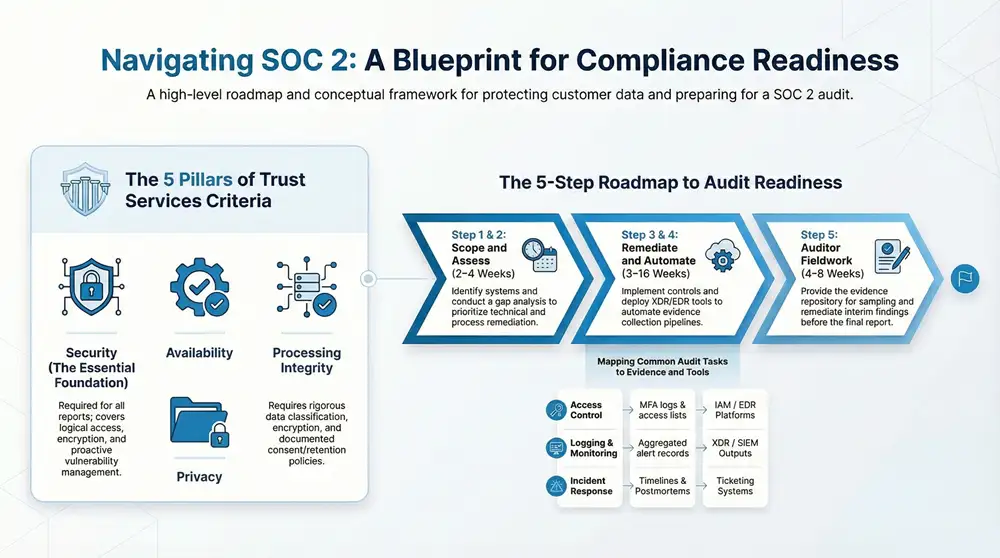
SOC 2 is the standard auditors use to verify how your organization protects customer data against operational risk. It ties the Trust Services Criteria to concrete controls and evidence so you can show auditors that your systems are secure and dependable. This guide breaks down what SOC 2 requires, how each Trust Services Criterion drives control choices, and the hands-on steps teams should take to prepare for Type I and Type II engagements while keeping compliance continuous. You’ll learn how to scope an audit, implement controls across Security, Availability, Processing Integrity, Confidentiality, and Privacy, and automate evidence collection to cut auditor friction.
We also cover how modern tooling—particularly XDR and EDR—and managed SOC offerings accelerate readiness and continuous monitoring. Finally, find practical checklists, evidence-to-audit-value (EAV) mappings, vendor evaluation pointers, and operational best practices to help you achieve and sustain SOC 2.
What Is SOC 2 Compliance and Why Is It Essential?
SOC 2 is an independent evaluation of your controls against the Trust Services Criteria that proves systems and processes protect customer data. At its core, SOC 2 is about control mapping: policies, procedures, and technical safeguards must produce logs, incident records, and artifacts auditors can review to confirm control effectiveness. Earning SOC 2 lowers vendor risk, satisfies contract requirements, and builds customer confidence by providing third‑party validation of your security posture. Teams preparing for SOC 2 usually concentrate on scoping the audit, implementing prioritized controls, and automating evidence pipelines so operational activity becomes auditable artifacts. Grasping these motivations helps teams plan realistic readiness work and audit execution.

Understanding the Trust Services Criteria in SOC 2
The Trust Services Criteria are five domains—Security, Availability, Processing Integrity, Confidentiality, and Privacy—that shape which controls you implement and what evidence auditors expect. Each criterion defines objectives auditors use to assess whether controls address relevant risks and whether evidence demonstrates sustained operation. Security demands logical access controls and monitoring; Availability centers on uptime and incident handling; Processing Integrity verifies correct system processing. These criteria translate business expectations into technical controls and auditable artifacts—logs, access reviews, and SLA records. Clear mappings from criteria to controls make evidence collection predictable and keep auditor scope focused.
Key Benefits of Achieving SOC 2 Compliance
SOC 2 delivers tangible business and operational advantages beyond a compliance checkbox. Organizations commonly see faster procurement cycles with security‑minded customers, clearer internal responsibilities for controls, and reduced breach exposure through formalized monitoring and remediation. SOC 2 also creates a repeatable framework for continuous improvement, helping teams prioritize fixes and invest in telemetry that becomes durable audit evidence. Together, these outcomes strengthen vendor credibility and differentiate you when competing for enterprise business.
- SOC 2 provides third‑party assurance that smooths vendor evaluations and procurement.
- Formalized controls speed detection and reduce mean time to remediation.
- Auditable evidence and reports back contractual and regulatory commitments.
Viewed this way, SOC 2 is a strategic program that improves operations as much as it meets audit requirements—so let’s move into the practical steps for readiness.
How to Prepare for a SOC 2 Audit Successfully
Preparation starts with scoping and a readiness assessment that distinguishes a Type I (point‑in‑time) from a Type II (period) report and aligns remediation timelines with auditor availability. Readiness relies on a complete inventory of systems, data flows, and current controls, followed by a gap analysis versus the Trust Services Criteria to prioritize technical and process work. Teams should centralize logging, automate evidence collection, and assign clear control owners so audits are efficient and verifiable. Practical readiness reduces auditor rework, shortens the path to a final report, and provides the operational foundation for the checklist below.
Step-by-Step SOC 2 Audit Preparation Checklist
The checklist below lists ordered actions, likely owners, and typical timelines to move from scoping to audit readiness. Lean on automation for evidence capture and assign accountable owners to cut manual effort and create consistent artifacts for auditors.
- Scope and Determine Report Type: Identify systems, user populations, and whether you need Type I or Type II; allow about 2–4 weeks for scoping and documentation.
- Conduct Readiness Assessment: Map current controls to the Trust Services Criteria and surface gaps; primary owners are the security lead and compliance owner.
- Implement or Remediate Controls: Focus on access control, logging, backups, and incident response; effort typically ranges from 2–12 weeks depending on gaps.
- Automate Evidence Collection: Set up centralized logging, retention, and reporting; include SIEM/XDR outputs as evidence—integrations often take 1–4 weeks.
- Engage Auditor and Run Interim Tests: Provide the evidence repository, schedule sampling, and remediate findings ahead of final testing; expect 4–8 weeks for auditor fieldwork.
This sequence turns audit requirements into executable tasks with clear owners and timelines. The table that follows maps common audit activities to evidence types, owners, and example tools so teams know what to collect.
Audit tasks below are concrete activities that produce the artifacts auditors need, along with typical owners and tools that generate those artifacts.
Common Challenges During SOC 2 Audits and How to Overcome Them
Teams frequently encounter evidence gaps, inconsistent logging, and coordination breakdowns between IT, security, and auditors. The cure is standardization and tooling alignment. Evidence gaps typically come from ad‑hoc logs or short retention; fix this by centralizing logs, enforcing retention, and naming conventions. Inconsistent log formats slow auditor review—standardize parsers and include contextual metadata. Coordination problems clear up when you assign an audit liaison to manage requests, timelines, and remediation tracking so auditors get consistent, contextual artifacts.
- Evidence gaps: Centralize logging and enforce retention so artifacts aren’t missing.
- Inconsistent logging: Normalize formats and attach contextual metadata for auditors.
- Cross‑team coordination: Appoint an audit liaison to own requests and timelines.
Addressing these issues early shifts effort from frantic evidence searches to proactive delivery during fieldwork. Next, we map each Trust Services Criterion to controls and tools that produce the required artifacts.
What Are the Core Trust Services Criteria in SOC 2?
The Trust Services Criteria comprise five domains auditors assess—Security, Availability, Processing Integrity, Confidentiality, and Privacy—and each maps to concrete controls and evidence types you must implement and retain. Security is foundational and required for all reports, covering logical access, monitoring, and change management. Availability focuses on redundancy, backups, and SLA verification with evidence such as uptime metrics and restore tests. Processing Integrity targets correctness of system processing and uses validation checks, reconciliation reports, and transactional logs as proof. Confidentiality and Privacy demand data classification, encryption, and consent records. Mapping criteria to controls clarifies where XDR, EDR, and managed SOC services generate auditable evidence.
Security: Protecting Systems and Data
Security controls—access management, encryption, vulnerability management, and monitoring—work together to detect, prevent, and respond to threats. Access control evidence includes IAM policies, access review logs, and MFA enforcement; encryption evidence includes key‑management records and configuration snapshots. Monitoring artifacts—alerts, investigations, and remediation timelines—show detection mechanisms function as intended. EDR agents and endpoint telemetry produce audit‑quality artifacts, while change control and patch management records demonstrate proactive risk reduction. These security controls underpin other criteria like Confidentiality and Processing Integrity.
Availability, Processing Integrity, Confidentiality, and Privacy Explained
Availability relies on redundancy, capacity planning, and verified backups to meet SLAs—evidence includes uptime dashboards and restore test results. Processing Integrity ensures systems process data accurately and completely and uses validation tests, reconciliation reports, and transaction logs as proof. Confidentiality protects sensitive information through encryption, role‑based access, and data classification, with access reviews and DLP alerts as evidence. Privacy requires a documented data inventory, consent and retention policies, and incident records tied to personal data. Together, these criteria require operational controls that produce verifiable artifacts and continuous monitoring to show sustained effectiveness.
- Availability evidence: Uptime dashboards, backup/restore logs, SLA documentation.
- Processing integrity evidence: Transaction logs, validation test reports, reconciliation records.
- Confidentiality & privacy evidence: Encryption configurations, access reviews, data inventory documents.
These artifacts connect technical implementation to auditor expectations and form the evidence trail auditors need to evaluate control effectiveness.
How Does SOC 2 XDR Integration Enhance Compliance?
XDR (Extended Detection and Response) strengthens SOC 2 readiness by aggregating telemetry from endpoints, network, and cloud to produce correlated alerts, incident timelines, and retention‑ready artifacts auditors can review. The value is correlation and enrichment: XDR centralizes logs, links signals, and builds incident packages with timelines, root‑cause analysis, and remediation actions. That yields searchable, repeatable evidence for Security and Processing Integrity criteria and speeds up evidence collection during audits. When evaluating XDR for SOC 2, prioritize log retention, forensic export capabilities, ticketing integrations, and automated reporting that maps outputs to the Trust Services Criteria.
Role of Extended Detection and Response in SOC 2 Compliance
XDR contributes detection, investigation, and response workflows that map directly to SOC 2 evidence needs by producing alerts, enriched incident reports, and forensic artifacts suitable for auditors. Typical outputs include correlated alert records, incident timelines with actor/action metadata, and remediation tickets tied to root‑cause findings; these items align with auditors’ expectations for demonstrable detection and response. Integrations with SIEM and ticketing systems ensure alerts become tracked remediation activities and long‑term evidence. XDR is therefore both operational—raising security maturity—and evidentiary—creating reliable artifacts that show controls are active and effective.
Benefits of Managed SOC for Streamlined Compliance
A managed SOC provides continuous monitoring, mature playbooks, and evidence retention practices that reduce internal overhead and produce consistent audit artifacts. Managed services deliver 24/7 detection, incident validation, and forensic packaging that translate into structured evidence—incident timelines, remediation records, and regular reporting—minimizing manual work to produce artifacts. For organizations without a mature in‑house SOC, managed SOC accelerates readiness by operationalizing controls and producing demonstrable processes auditors can evaluate. Choosing a managed SOC typically improves coverage and creates repeatable evidence pipelines aligned with the Trust Services Criteria.
- Operational benefit: Offloads evidence collection and retention to a dedicated team.
- Evidence benefit: Produces standardized incident packages aligned with auditor needs.
- Decision checklist: Coverage hours, playbook maturity, integration capabilities, and evidence exports.
These outcomes make managed SOC an attractive option for teams aiming to shorten time‑to‑readiness and sustain continuous assurance. See the earlier EAV mappings for examples of how managed detection and XDR outputs tie to compliance tasks.
What Are Best Practices for Maintaining Ongoing SOC 2 Compliance?

Maintaining SOC 2 demands continuous monitoring, routine risk assessments, regular policy updates, and documented training programs that prove controls are enforced and improved. The maintenance model pairs automation with governance: telemetry and retention automate the evidence pipeline while governance practices—risk registers, control owners, and review cycles—keep controls aligned with business risk. Measure KPIs like MTTR and detection coverage, monitor evidence retention compliance, and run tabletop exercises to validate response plans. Together, these practices keep you audit‑ready and make compliance part of normal operations instead of an annual scramble.
Continuous Monitoring and Risk Management Strategies
Continuous monitoring turns control verification into measurable activity—metrics, alerts, and retention policies feed the evidence repository automatically. Key metrics include MTTR, alert‑to‑incident conversion rate, and detection coverage. Retention policies must match auditor expectations and be defensible with documented schedules and archival processes. Regular risk reviews—quarterly or semi‑annual—reprioritize controls and close gaps before they’re tested in an audit. XDR, EDR, and managed SOC providers help deliver consistent telemetry, repeatable playbooks, and forensic exports that plug into the evidence lifecycle.
Employee Training and Policy Updates for Compliance Sustainability
Sustaining controls relies on role‑based training, recurring tabletop exercises, and a documented policy lifecycle that records reviews, approvals, and version history for auditors. Training should match control owners’ responsibilities—IT on configurations and backups, security on detection and response, privacy on data inventory and consent—and be tracked with attendance and assessment records. Tabletop exercises simulate incidents to validate procedures and produce after‑action reports that show continual improvement. Policy updates should follow a set cadence with documented approvals and change logs so auditors can trace governance activity and confirm oversight.
- Training types: Role‑based technical sessions, executive briefings, and incident‑response drills.
- Frequency: Quarterly technical refreshers, annual full program reviews, and ad‑hoc exercises after major changes.
- Documentation: Attendance records, assessment results, and approved policy versions.
Embedding these practices into daily operations converts compliance from a one‑time project into an ongoing capability that continuously yields SOC 2 evidence. Below, we highlight how an enterprise partner can support these practices while you retain governance ownership.
Enterprise teams evaluating integrated support often look for partners combining advanced detection tooling with managed services. ShieldWatch is an enterprise‑grade cybersecurity platform offering XDR, EDR, SOC, and managed threat detection and response for mid‑market and enterprise organizations, delivered directly and through MSP and channel partners. That mix helps teams accelerate evidence collection, sustain continuous monitoring, and standardize incident playbooks while keeping internal governance and control ownership.
When evaluating partners, prioritize platforms and service models that provide telemetry exports suitable for audits and operational alignment with your control owners to ensure long‑term compliance sustainability.
Frequently Asked Questions
Conclusion
SOC 2 strengthens your security posture and gives customers confidence through independent validation of your data protection practices. By applying the Trust Services Criteria pragmatically, you can streamline audits, reduce operational risk, and make compliance a repeatable, sustainable capability. If you need help, our managed SOC and detection tools are designed to accelerate readiness and simplify evidence collection without replacing your governance. Start optimizing your SOC 2 program today and give your organization a clear, defensible path to continuous compliance.
Earn passive income this month—become an affiliate partner and get paid!
Partner with us for generous payouts—sign up today!
Drive sales, earn commissions—apply now!
Join our affiliate community and maximize your profits!
Partner with us and enjoy recurring commission payouts!
Get paid for every referral—sign up for our affiliate program now!
Get started instantly—earn on every referral you make!
Monetize your traffic instantly—enroll in our affiliate network!
Share our products and watch your earnings grow—join our affiliate program!
Become our partner now and start turning referrals into revenue!