

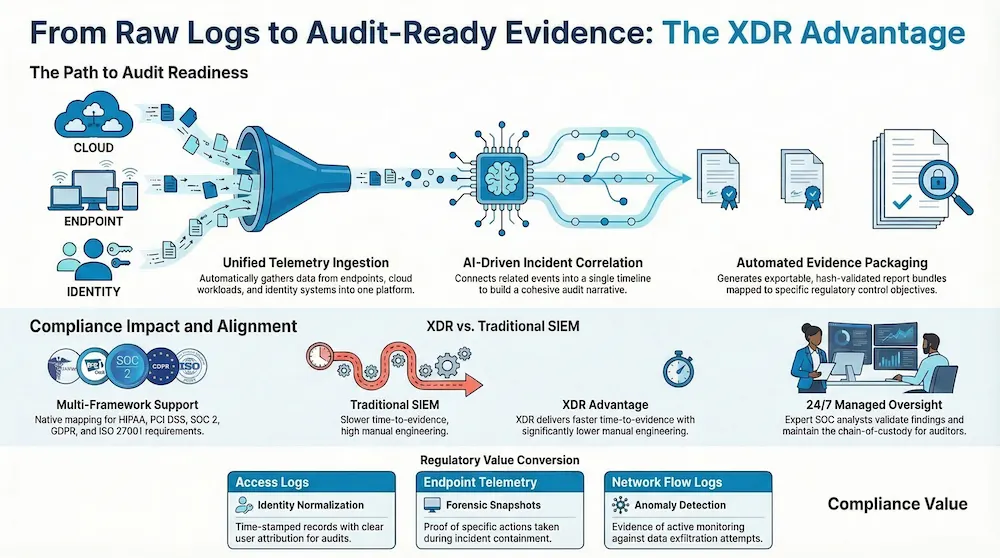
Extended detection and response (XDR) brings telemetry, detection, and automated response together across endpoints, network, cloud, and identity systems to make compliance simpler and faster. By correlating cross-domain data and applying AI-driven analytics, XDR shortens the time and effort needed to create audit-ready evidence, helping compliance teams and executives cut audit risk and meet breach-notification deadlines. This article walks through how XDR supports compliance workflows, what creates defensible audit trails, and practical mappings to common frameworks like HIPAA and PCI DSS.
You’ll learn how continuous monitoring, centralized visibility, and automated reporting lower manual evidence collection, how managed XDR shifts operational responsibilities, and how to evaluate XDR versus traditional SIEM. The sections that follow cover definitions and capabilities, real-time monitoring mechanics, automated reporting and audit-trail examples (including structured EAV mappings), framework-specific control mappings, managed service benefits, and a comparison with conventional SIEM to guide procurement and deployment decisions.
What Is XDR and How Does It Support Regulatory Compliance?
XDR (extended detection and response) is a platform approach that gathers telemetry from endpoints, networks, cloud workloads, and identity systems to detect, investigate, and remediate threats while producing audit-quality evidence. Unified ingestion, correlation, and context enrichment link events to assets, users, and policies—turning raw logs into compliance artifacts that show controls worked and incidents were handled. The key benefits are faster time-to-evidence and clearer provenance for auditors, which helps meet breach-notification windows and evidence requests. Below are the core compliance capabilities XDR delivers that align with regulator expectations.

XDR supplies the core compliance capabilities auditors commonly ask for:
- Unified telemetry ingestion across domains so investigations pull together correlated evidence.
- Automated incident correlation and context enrichment to prioritize compliance-impacting events and cut noise.
- Policy-mapped reporting and retention controls that generate exportable evidence packages for audits.
These capabilities show how organizations move from scattered logs to coherent, audit-ready narratives. The next section explains how AI and a human SOC work together to operationalize these features for compliance assurance.
How Does ShieldWatch XDR Integrate AI and SOC for Compliance?
ShieldWatch XDR pairs AI analytics with continuous SOC oversight to triage events, reduce false positives, and validate audit evidence—combining automation with human judgment. Machine models do initial correlation and scoring to surface compliance-relevant incidents quickly; SOC analysts then investigate, annotate, and preserve chain-of-custody to add context auditors expect. This AI + SOC model shortens mean time to detect and mean time to evidence: machines accelerate triage, people confirm intent and document findings. The result is investigator-ready artifacts with metadata and reviewer notes that speed regulatory responses and clarify evidence trails for auditors.
Which Compliance Frameworks Does XDR Support?
XDR platforms typically cover the controls and evidence types required by frameworks like SOC 2, HIPAA, PCI DSS, GDPR, CMMC 2.0, and ISO 27001. By collecting and normalizing logs, monitoring access controls, and automating policy-driven alerts, XDR maps common telemetry—access logs, configuration changes, endpoint events, and network flows—to control families such as access management, detection and response, and logging and monitoring. Teams can use XDR outputs to respond to requests for login histories, incident reports, and retention proofs, cutting manual work during assessments. For deeper alignment, framework-specific pages and templates translate XDR artifacts into auditor-ready checklists.
How Does XDR Improve Real-Time Compliance Monitoring?
Real-time compliance monitoring with XDR depends on continuous telemetry ingestion, cross-domain correlation, context enrichment, and automated alerting. Together these detect policy deviations quickly while preserving audit evidence. By ingesting data from endpoints, network sensors, cloud services, and identity systems continuously, XDR builds a runtime view that removes blind spots and flags suspicious access or policy violations immediately. Correlation binds related events—like an unauthorized login followed by unusual data transfer—into a single incident timeline, speeding containment and creating a cohesive audit artifact. The outcome is stronger regulatory oversight through shorter detection windows and more defensible incident narratives.
Real-time mechanisms that power compliance monitoring include:
- Continuous telemetry ingestion from endpoints, network, cloud, and identity for broad visibility.
- Correlation and context enrichment that connect events to users, assets, and policies for accurate prioritization.
- Automated alerts and policy-triggered containment to reduce windows of potential noncompliance.
These mechanisms ensure compliance teams get prioritized, contextual alerts. The next subsection outlines the specific compliance benefits of continuous detection, including notification timelines and audit readiness.
What Are the Benefits of Continuous Threat Detection for Compliance?
Continuous threat detection shortens the gap between an incident and its discovery, helping organizations meet regulatory breach-notification requirements and lowering the chance of prolonged exposure. Faster detection provides clearer timelines and provenance for forensic work, enabling timely notices to regulators, customers, or partners under frameworks like HIPAA or GDPR. Contextual enrichment also reduces false positives, cutting audit noise and letting analysts focus on high-impact events. Together, speed and context produce defensible forensic artifacts auditors can review with confidence, improving both security operations and compliance posture.
How Does Centralized Data Visibility Enhance Regulatory Oversight?
Centralized visibility brings logs and telemetry into a single investigative surface so compliance officers can find evidence fast, apply consistent retention rules, and run cross-domain queries that used to require manual collation. When endpoint, cloud, and identity data are normalized and tagged with asset and user metadata, auditors can trace activity across systems without stitching together separate reports. That unified view also enables automated reporting using pre-defined filters and templates that output control-mapped exports for assessors. Centralized visibility reduces blind spots, speeds evidence retrieval, and makes ad-hoc auditor requests practical—strengthening overall oversight.
How Does ShieldWatch XDR Automate Compliance Reporting and Audit Trails?

XDR automates reporting and audit trails with customizable report templates, scheduled exports, immutable logs, and integration hooks for GRC and ticketing systems so evidence collection becomes repeatable and auditable. ShieldWatch XDR includes policy-mapped report templates and orchestration that create exportable evidence packages, while retention controls and append-only logging preserve provenance. Automating these workflows cuts manual assembly, speeds auditor responses, and standardizes incident documentation across the organization. The list below highlights the reporting features that simplify evidence collection and auditing.
Key reporting features that streamline evidence collection include:
- Pre-built compliance report templates mapped to common frameworks to reduce time assembling control evidence.
- Exportable audit packages that bundle logs, alerts, and investigation notes into a single artifact for assessors.
- Role-based access and scheduled reporting to deliver consistent evidence to compliance stakeholders and auditors.
Before the EAV table, it helps to know which data sources typically produce audit artifacts and how ShieldWatch maps them to compliance attributes and practical value for assessment teams.
This mapping shows how ShieldWatch XDR converts raw logs into audit-ready evidence, cutting manual search and meeting regulatory expectations for provenance and retention.
Automated audit-trail practices in XDR also include immutable logging, hashed timestamps, and exportable investigation packages, which strengthen the defensibility of findings. ShieldWatch’s orchestration and integrations reduce hand-offs and ensure evidence packages include both machine-generated logs and analyst annotations—items auditors commonly request during reviews.
What Reporting Features Streamline Evidence Collection?
Reporting features that speed evidence collection focus on templates, export formats, scheduling, and role-based controls so only authorized users produce and access audit artifacts. Template-driven reports map incidents to control statements, making it straightforward to show detection and response controls operated as intended during an assessment. Exportable formats (compressed packages, standardized logs, and investigator notes) let compliance teams hand auditors complete bundles without manual compilation. Role-based controls preserve chain-of-custody and make the reporting process repeatable and auditable.
How Are Audit Trails Maintained for Regulatory Audits?
Audit trails in XDR are preserved through technical controls—append-only logging, hashing, and timestamping—and administrative controls like RBAC, review logs, and documented retention policies aligned with regulations. Technical measures protect log integrity and provenance; administrative steps define who approves exports and how long artifacts are kept. Together they give auditors both the evidence and the demonstrable controls showing that evidence was protected and unaltered. Clear retention and export procedures mapped to applicable rules ensure evidence is available and investigations remain defensible.
How Does XDR Address Specific Compliance Frameworks Like HIPAA and PCI DSS?
XDR addresses framework-specific needs by mapping platform capabilities to control objectives—access logging, monitoring, detection, and response—and producing evidence that aligns with assessors’ expectations for HIPAA and PCI DSS. For HIPAA, XDR focuses on activity logging for PHI access, breach detection, and timely incident reporting. For PCI DSS, the emphasis is on network segmentation monitoring, cardholder data access detection, and log retention. The table below shows practical mappings from regulatory requirements to XDR features and the evidence produced for auditors.
Mapping capabilities to control objectives helps compliance officers assemble clear evidence packages and supports assessors in validating control operation.
Practical recommendations for implementing XDR controls for framework compliance:
- Map control families to telemetry sources so each auditor request has a clear data owner and collection method.
- Automate control evidence exports so assessors receive consistent, repeatable artifacts.
- Document retention and hashing procedures to show log integrity and chain-of-custody.
These steps naturally lead into examples of how ShieldWatch XDR supports HIPAA and PCI responsibilities.
How Does ShieldWatch XDR Facilitate HIPAA Compliance?
ShieldWatch XDR helps meet HIPAA obligations by collecting and normalizing access logs tied to user identities, alerting on anomalous PHI access, and producing exportable incident timelines for breach investigations and notifications. Continuous detection plus analyst-validated incident records let organizations show timely identification and response—core to HIPAA breach rules. For example, ShieldWatch can surface an unauthorized PHI access event, attach endpoint and network evidence, and generate a packaged report documenting containment steps and investigator commentary suitable for audits—reducing manual effort for compliance teams.
What Features Support PCI DSS Compliance Monitoring?
For PCI DSS, relevant XDR capabilities include network segmentation monitoring, detection of cardholder-data access attempts, and retention of detailed transaction-related logs—each supporting assessors’ verification of cardholder data controls. ShieldWatch XDR’s cross-domain correlation can link a suspicious endpoint process to a network flow that tried to access cardholder data, producing a single incident timeline for investigators. Automated reports and exported evidence packages demonstrate segmentation enforcement and record access attempts plus remediation steps, simplifying assessor reviews and shortening validation time.
What Are the Advantages of Managed XDR Services for Compliance Monitoring?
Managed XDR bundles platform capabilities with 24/7 SOC expertise, playbook-driven operations, and documented incident processes that lift continuous monitoring burdens and improve audit readiness. Organizations without in-house security ops gain consistent coverage, documented SLAs, and standardized evidence handling aligned with regulatory expectations. Primary compliance advantages include continuous detection coverage, repeatable evidence collection practices, and faster containment via predefined orchestration. The list below summarizes how managed XDR translates into compliance outcomes.
Managed XDR services provide the following compliance advantages:
- Continuous 24/7 monitoring that covers detection windows regulators expect.
- Documented incident response playbooks and logs auditors can review for procedural adherence.
- Evidence handoffs and packaged exports performed by SOC analysts to reduce internal burden.
These managed functions align with ShieldWatch’s managed SOC capabilities and hyper-automation features, discussed next.
How Does 24/7 SOC Expertise Enhance Compliance Assurance?
Around-the-clock SOC expertise strengthens compliance by ensuring incidents are detected, investigated, and documented regardless of time or staffing. SOC analysts follow defined procedures, annotate timelines with contextual judgment, and produce exportable artifacts auditors request—establishing chain-of-custody and consistent operational discipline. This human layer validates high-priority incidents and ensures evidence packages include investigator commentary and remediation steps. Organizations using managed SOCs gain predictable evidence quality and documented workflows that improve compliance posture.
What Role Does Hyper-Automation Play in Reducing Alert Fatigue?
Hyper-automation cuts alert fatigue using pre-built SOAR workflows, ML-driven prioritization, and automated evidence collection that triage low-value alerts and surface compliance-impacting incidents. Workflows enrich alerts with relevant logs, attach forensic snapshots, and create investigation tickets with mapped control references—speeding response and audit preparation. By reducing false positives and standardizing remediation, automation keeps SOC focus on incidents that matter for compliance, raising efficiency and the quality of evidence handed to auditors. These efficiencies also shorten investigation cycles and speed production of audit-ready artifacts.
How Does ShieldWatch XDR Compare to Traditional SIEM Solutions for Compliance?
XDR and traditional SIEM differ in automation, correlation, and operational workload. XDR emphasizes cross-domain correlation and built-in response workflows; many SIEMs focus on aggregation and need extra orchestration to reach the same outcomes. In practice, XDR shortens time-to-evidence through integrated detection and response, while SIEMs offer flexible ingestion and longer-term retention but usually require more engineering to deliver audit-ready artifacts. The table below summarizes the compliance impacts of each solution type.
This comparison helps teams decide between a unified XDR platform, a traditional SIEM, or a hybrid approach based on priorities around automation, retention, and operational resources.
Key differences compliance teams should evaluate during procurement:
- Detection and correlation: XDR includes native cross-domain correlation; SIEMs often need additional engineering.
- Automation and playbooks: XDR typically ships with pre-built workflows; SIEMs may require separate SOAR integration.
- Time-to-evidence: XDR reduces manual evidence assembly via integrated artifacts; SIEMs provide logs but demand more analyst effort.
These distinctions feed into the decision framework that follows, explaining why an organization might select ShieldWatch XDR for compliance monitoring.
What Are the Key Differences Between XDR and SIEM in Compliance Reporting?
The main compliance-related difference is how each platform turns raw data into audit artifacts. XDR automates correlation and delivers investigation-ready timelines; SIEM aggregates events and leaves narrative-building to analysts or separate tools. XDR’s integrated approach shortens the path from detection to packaged evidence, lowering manual work and the chance of missed context at audit time. SIEMs offer flexible ingestion and archival options some organizations require, but they often need orchestration to match XDR’s automated reporting. Procurement should weigh automation versus retention needs and consider hybrid models where both capabilities are required.
Why Choose ShieldWatch XDR Over Other Compliance Monitoring Tools?
ShieldWatch XDR stands out with an integrated AI + SOC model, built-in compliance readiness for standards like SOC 2, HIPAA, CMMC 2.0, and ISO 27001, fast deployment with retroactive log analysis, and deep SOAR-driven automation—features that reduce audit labor and speed evidence production. Evaluation should focus on coverage across endpoints, cloud, and identity; included automation and report templates; exportable control-mapped reports; and available managed services for continuous oversight. For teams that need rapid operational value and defensible compliance artifacts, ShieldWatch’s unified platform and managed SOC offer a practical route to improved audit readiness with minimal internal lift.
For procurement teams, use this short evaluation checklist to compare providers:
- Coverage: Does the solution ingest endpoint, network, cloud, and identity telemetry?
- Automation: Are pre-built SOAR workflows and report templates included?
- Evidence export: Can the platform produce hash-validated, investigator-annotated packages?
- Managed services: Is 24/7 SOC support available to handle evidence collection and incident handoffs?
Frequently Asked Questions
Conclusion
Adopting XDR strengthens compliance monitoring by automating evidence collection and giving real-time visibility across endpoints, network, cloud, and identity. That unified approach reduces manual audit work and helps organizations respond more quickly to regulatory demands. With ShieldWatch XDR, compliance teams get practical tools to streamline evidence collection, speed investigations, and deliver defensible artifacts to auditors. Learn how our platform can simplify your compliance processes and improve audit readiness today.
Share our link, earn real money—signup for our affiliate program!
Unlock exclusive affiliate perks—register now!
Join forces with us and profit from every click!
Share your unique link and cash in—join now!
Refer friends and colleagues—get paid for every signup!
https://shorturl.fm/pFZPr