

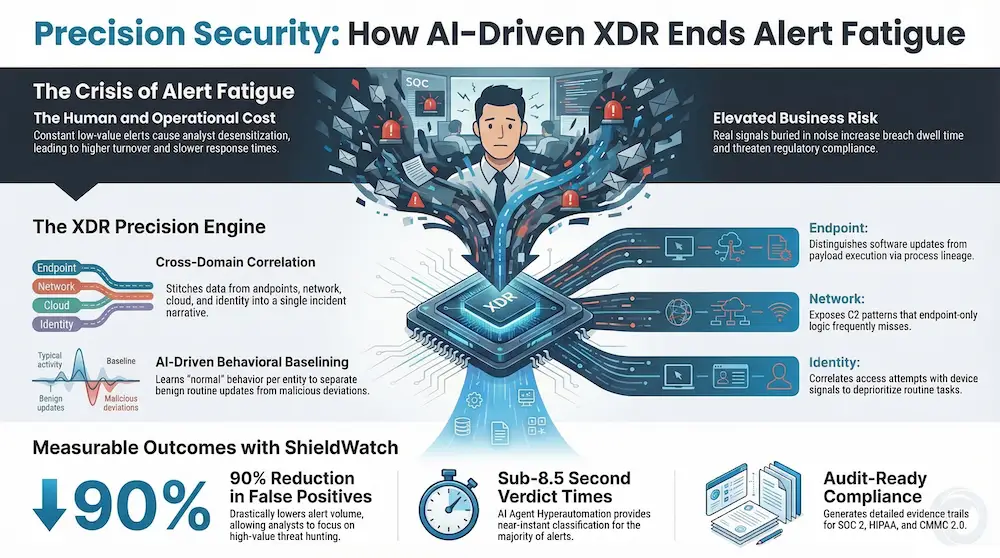
How XDR Cuts False Positives to Deliver More Accurate, Actionable Threat Alerts with AI
XDR (Extended Detection and Response) reduces false positives by correlating telemetry across domains, applying AI-driven behavioral analysis, and automating repeatable response steps so SOC teams receive higher‑fidelity alerts and can decide faster. This article breaks down why false positives happen, how centralized correlation and behavioral models separate benign activity from real threats, and which operational practices lower alert noise while improving mean time to detection. You’ll get practical, production-ready mechanisms—cross-source correlation, AI/ML baselining, contextual enrichment, and continual learning—that raise alert quality and reduce analyst fatigue.

We also translate those concepts into platform and managed‑service considerations so technical and executive readers can evaluate solutions that actually lower false positives. Sections cover alert fatigue and business impact; how XDR improves detection accuracy (with a telemetry EAV table); what sets ShieldWatch XDR apart; automated containment and compliance (with capability EAV table); measurable outcomes and headline metrics; and a practical comparison to legacy SIEM and EDR approaches to guide procurement and operations choices.
What Is Alert Fatigue and How Does It Impact SOC Teams?
Alert fatigue is the gradual desensitization of analysts caused by a steady stream of low‑value alerts that demand triage but rarely indicate real compromise. Excess noise consumes cognitive bandwidth and triage cycles, lengthening queues and increasing mean time to respond for genuine incidents. Left unchecked, alert fatigue leads to higher analyst turnover, slower response, and an elevated risk that true breaches go unnoticed because real signals are buried in noise. Recognizing the operational and business consequences of alert fatigue is the first step in choosing detection architectures—like XDR—that emphasize contextualized, high‑confidence signals. The next subsection explains how false positives create that noise and erode analyst trust, increasing enterprise risk and compliance exposure.
How Do False Positives Contribute to Alert Fatigue?
False positives happen when legitimate activity matches a detection rule or statistical threshold, producing alerts that require investigation but aren’t malicious. Common examples include administrative scripts or routine software updates generating endpoint telemetry that triggers signature or heuristic rules. When analysts repeatedly close harmless alerts, they begin to deprioritize similar signals—raising the chance that a subtle, real threat will be missed. Effective mitigation focuses on reducing single‑source triggers and enriching signals with cross‑domain context; the following section shows how centralized correlation helps disambiguate these cases.
What Are the Business Risks of Alert Fatigue?
Alert fatigue increases measurable business risk: longer dwell time for undetected breaches, missed regulatory deadlines from delayed reporting, and reputational damage when incidents escalate before containment. Financial impacts appear both directly—in incident remediation—and indirectly, through SOC staff churn and increased reliance on external vendors to cover capability gaps. At the board level, persistent alert noise weakens confidence in controls and can raise insurance costs or regulatory scrutiny if response SLAs slip. The section that follows explains how XDR’s core mechanisms—centralized correlation, behavioral analytics, and continuous learning—address these operational and business risks directly.
How Does XDR Improve Threat Detection Accuracy to Reduce False Positives?
XDR raises detection accuracy by ingesting telemetry from endpoints, networks, cloud workloads, and identity systems, then applying behavioral baselining and contextual enrichment so alerts surface only when cross‑source evidence indicates real risk. The core mechanisms are: (1) centralized correlation to filter single‑source anomalies; (2) AI/ML behavioral baselining to separate normal variation from suspicious deviations; (3) threat intelligence and historical context to enrich signals; and (4) feedback‑driven continuous learning to reduce repeat false alerts. Together, these approaches move teams away from brittle, rule‑only detection toward scored, explainable alerts analysts can trust. Below is a concise mapping of telemetry domains, the attributes they contribute, and how each reduces false positives when combined in an XDR pipeline.
This mapping demonstrates how multi‑domain enrichment creates the context that disambiguates alerts and reduces noise. Next, we explain how centralized correlation fits into detection flows and why it matters for analyst trust.
How Does Centralized Data Correlation Enhance Detection?
Centralized correlation stitches events across domains into a single incident narrative, turning separate low‑fidelity signals into higher‑confidence detections by requiring corroboration before severity increases. For example, a suspicious process on an endpoint plus unusual network connections and an anomalous login form a compound signal far less likely to be a false positive than any lone indicator. Correlation engines use rules, temporal sequencing, and entity linking to assemble explainable context—reducing the number of alerts that reach analysts and enabling scored alerts with clear evidence for faster triage and supervised feedback.
What Role Do AI and Machine Learning Play in Behavioral Analysis?
AI and ML build behavioral baselines and anomaly scores that separate unusual-but-benign changes from truly suspicious deviations. Models learn normal behavior per entity—user, host, application—so anomalies are judged against personalized baselines rather than one‑size‑fits‑all heuristics, reducing false positives in diverse environments. Equally important are explainability features and analyst feedback loops that retrain and tune models, keeping automated scoring interpretable and adjustable. The earlier section on correlation and the platform differentiation that follows show how these models integrate with automation and human review to preserve alert fidelity.
With those mechanisms in mind, it helps to look at platform capabilities that run them in production. ShieldWatch XDR pairs these technical approaches with automation and managed SOC expertise to operationalize low‑noise detection and fast response.
What Makes ShieldWatch XDR Unique in Reducing False Positives?
ShieldWatch XDR is built to keep alerts meaningful: we combine AI Agent Hyperautomation with 24/7 human‑AI collaboration to cut false positives and speed validated response. Our platform couples autonomous agents, continuous model tuning, and an always‑on SOC overlay so alert fidelity stays high while delivering measurable operational metrics. Key differentiators include AI Agent Hyperautomation for autonomous triage, a managed 24/7 SOC for human validation and escalation, sub‑8.5 second average verdict times for many alerts, and containment actions that execute within minutes for high‑confidence incidents. The platform emphasizes context‑rich, explainable alerts and rapid historical analysis so analysts and stakeholders can rely on the signal; the next subsections describe agent workflows and the human‑AI collaboration that produce those results.

How Does AI Agent Hyperautomation Enable Autonomous Alert Triage?
AI Agent Hyperautomation runs multi‑step agent workflows that triage alerts autonomously: agents gather enrichment data, apply scoring logic, and execute safe, reversible playbook steps when confidence thresholds are met. They collect evidence—process metadata, network context, identity links—and enrich alerts with threat intelligence and historical logs to raise or lower severity before human review. If confidence is insufficient, agents escalate a packaged incident narrative to analysts rather than a raw alert, cutting triage time and keeping noisy alerts from consuming human effort. This autonomous‑first pattern reduces volume while preserving governance and a full audit trail for any automated action.
How Does Human-AI Collaboration in the 24/7 SOC Enhance Response?
Human‑AI collaboration pairs automated agents with a continuous SOC that validates high‑risk cases, feeds model improvements, and governs escalation thresholds for explainability and auditability. AI handles routine triage and enrichment; humans adjudicate ambiguous or impactful incidents and provide feedback that refines agent decision criteria. The 24/7 SOC overlay also supports rapid escalation paths and incident handoffs, ensuring containment steps are reviewed for operational impact and compliance. This collaborative loop preserves speed without sacrificing judgment and drives continual reduction in false positives through supervised learning and operational tuning.
How Does ShieldWatch XDR Support Rapid Incident Response and Compliance?
ShieldWatch XDR accelerates response with SOAR‑driven playbooks, automated containment actions, and end‑to‑end audit trails that satisfy compliance evidence needs while minimizing disruptive false‑positive remediation. Automated playbooks orchestrate containment—endpoint isolation, network flow blocking, credential revocation—based on confidence scores and policy gates to balance safety and speed. The platform includes comprehensive logging and reporting aligned to SOC 2, HIPAA, and CMMC 2.0 control objectives so auditors can review detection rationale, actions taken, and incident timelines. The table below summarizes automated capabilities, typical outcomes, and compliance benefits to show how automation supports response SLAs and regulatory requirements.
What Are the Automated Containment Capabilities of ShieldWatch XDR?
ShieldWatch XDR supports containment actions—endpoint isolation, network flow blocking, credential revocation—executed under policy guardrails and escalation workflows to prevent disruptive false‑positive remediation. Each action is gated by confidence thresholds and reversible controls, and agents can run non‑disruptive evidence collection steps before hard containment when confidence is marginal. Typical timelines run from seconds for automated evidence collection to minutes for containment on high‑confidence incidents, enabling rapid mitigation while governance logs and role‑based approvals give analysts the controls they need to tune thresholds and reduce erroneous containment over time.
How Does ShieldWatch XDR Facilitate Compliance with SOC 2, HIPAA, and CMMC 2.0?
ShieldWatch XDR supports compliance with detailed audit trails, structured incident reports, and role‑based access logs that map to control objectives in SOC 2, HIPAA, and CMMC 2.0. Detection narratives include evidence links, decision criteria, and timestamps for every automated or human action, making it straightforward to demonstrate procedural adherence during audits. Our historical analysis capability—reprocessing up to 90 days of logs at deployment—builds retrospective evidence for control assessments and aids forensic investigations. Together, these features reduce compliance risk and improve the quality of evidence available to auditors while keeping operations efficient.
What Are the Quantifiable Benefits of Using ShieldWatch XDR for False Positive Reduction?
Customers using ShieldWatch XDR report measurable gains in alert fidelity, SOC efficiency, and response speed that clarify the business case for XDR. Headline metrics include up to 90% reduction in false positives, sub‑8.5 second average verdict times for many alerts, and containment actions executed within minutes for high‑confidence incidents—results driven by AI Agent Hyperautomation, centralized correlation, and 24/7 SOC validation. Operational benefits include fewer analyst hours tied up in low‑value triage, lower MTTR, and more analyst focus on high‑value detection and hunting. Below are key outcomes organizations should expect when adopting a platform with ShieldWatch‑style capabilities.
- Up to 90% reduction in false positives: Dramatically lowers alert volume and triage workload.
- Sub‑8.5 second average verdict times: Faster automated classification for many alerts.
- Containment within minutes for high‑confidence incidents: Shorter exposure windows and reduced dwell time.
- Reduced analyst hours and lower alert fatigue: Better use of human capital and improved retention.
How Has ShieldWatch Achieved Up to 90% Reduction in False Positives?
We achieve that scale of reduction through a combined approach: multi‑domain correlation to filter single‑source noise, AI Agent Hyperautomation that triages and enriches alerts before human review, and continuous SOC‑led model tuning to eliminate recurring false triggers. Measurements use before/after baselines—comparing alert volumes and validated incident counts over matched operational windows—while controlling for environmental changes and tuning activity. ShieldWatch’s immediate ingestion and analysis of up to 90 days of historical logs at deployment jumpstarts model calibration, enabling rapid pruning of repeat false alerts. These methods show why integrated automation plus human oversight produces large, verifiable reductions in noisy alerts.
What Is the Impact on SOC Efficiency and Alert Fatigue?
Fewer false positives mean less time spent on low‑value triage, more analyst hours for investigation and threat hunting, and lower burnout from reduced cognitive load. Typical outcomes include measurable drops in weekly triage hours per analyst, faster MTTR, and a larger share of analyst time devoted to proactive security work and tuning. These gains strengthen security posture while lowering operational costs tied to overtime, escalations, and outsourcing. The next section compares XDR’s unified approach with traditional SIEM and EDR to help teams decide how to evolve their toolchain.
How Does XDR Compare to Traditional SIEM and EDR Solutions in False Positive Reduction?
XDR moves beyond siloed SIEM and EDR by combining telemetry, analytics, and automated response into a unified platform that lowers false positives through context‑rich correlation and automation instead of isolated, static rules. SIEMs are strong at log aggregation and compliance reporting but often depend on manual tuning and lack native automation, which drives high alert volumes. EDR provides deep endpoint visibility but can’t by itself correlate network, cloud, and identity signals needed to disambiguate benign anomalies. The table below summarizes relative strengths and limitations with respect to false‑positive reduction.
What Are the Limitations of SIEM and EDR in Managing Alerts?
SIEM deployments often produce high alert volumes from rule‑based detections that demand constant tuning and usually lack automated containment, creating sustained analyst workload. EDR tools deliver rich endpoint detail but can’t by themselves determine whether a suspicious process is part of a coordinated network or identity‑based attack, which leads to misclassification. These solutions remain valuable when integrated, but running them in isolation leaves gaps in correlation and orchestration that generate false positives. Adopting or augmenting with an XDR approach that unifies domains and adds automated triage closes those gaps and improves alert fidelity.
How Does ShieldWatch XDR Provide a Unified and Automated Security Platform?
ShieldWatch XDR ingests data across endpoints, network, cloud, and identity and layers AI‑driven correlation, SOAR playbooks, and a managed 24/7 SOC to validate and act on high‑fidelity alerts. The architecture blends SIEM‑style logging, EDR telemetry, SOAR automation, and threat intelligence into a single operational workflow so alerts carry evidence before they need human attention. Autonomous agents plus human validation reduce false positives and shorten the path to containment, giving organizations an operationally mature alternative to siloed tooling. For teams evaluating upgrades, this unified, automated model aligns technical capability with SOC readiness and compliance support.
Frequently Asked Questions
Conclusion
Deploying XDR meaningfully improves detection accuracy and slashes false positives, delivering immediate operational gains for SOC teams. With AI‑driven correlation and automated response, teams can trust their alerts, focus on real threats, and reduce alert fatigue—all while supporting compliance goals. Learn how ShieldWatch XDR can sharpen your security operations and start reducing noisy alerts today.
Refer and earn up to 50% commission—join now!
Monetize your traffic instantly—enroll in our affiliate network!
https://shorturl.fm/eXtGr
https://shorturl.fm/IokWG
https://shorturl.fm/Liqod