

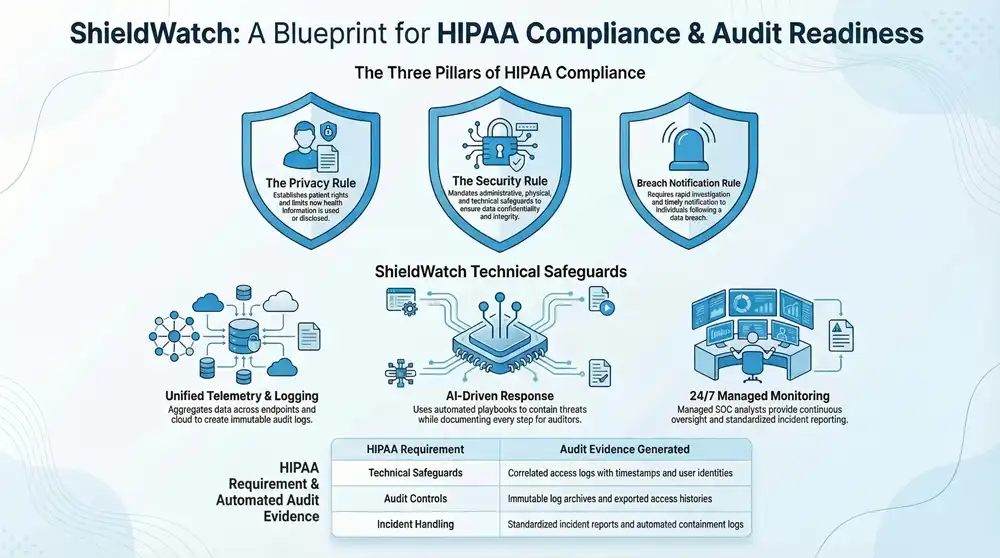
As patient records move through EHRs, cloud platforms, and connected devices, cyber risk rises—and so do HIPAA obligations to safeguard PHI and ePHI. This guide lays out what HIPAA requires, how technical and operational safeguards work together to lower regulatory and clinical risk, and why integrated detection and response are essential to modern compliance.
You’ll get a clear summary of the three core HIPAA rules, practical controls to protect ePHI, audit preparation steps, and where advanced XDR, managed SOC, and AI-driven automation belong in a defensible security program. We map controls to audit artifacts, prioritize healthcare best practices, and give a stepwise approach to continuous compliance and vendor oversight. By the end, you’ll have an actionable framework to reduce breach risk, stay audit-ready, and use enterprise monitoring and automation to protect patient data.
What Are the Core HIPAA Rules for Healthcare Data Protection?

HIPAA is built on three core rules that set legal duties, technical safeguards, and notification requirements for protected health information. Together they require administrative processes and technical controls so covered entities and business associates can prevent unauthorized access, detect incidents, and notify affected parties on time. Grasping these three pillars is essential for drafting policy, choosing controls, and assembling the evidence auditors expect. The sections that follow define each rule and show how they translate into concrete controls and the artifacts organizations must maintain for compliance.
What Is the HIPAA Privacy Rule and How Does It Protect PHI?
The Privacy Rule limits when PHI can be used or disclosed and establishes patient rights—access, amendment, and accounting of disclosures. Covered entities must formalize practices like a notice of privacy practices, access-request workflows, and minimum-necessary principles so privacy is enforced across people and processes. Technical controls—access controls, audit logging, and role-based separation—support these policies by ensuring only authorized staff view PHI and by producing records for patient requests and audits. Clear policy documentation plus regular access reviews tie privacy governance to technical enforcement in ongoing compliance work.
How Do the HIPAA Security and Breach Notification Rules Ensure ePHI Safety?
The Security Rule requires administrative, physical, and technical safeguards to protect the confidentiality, integrity, and availability of ePHI. The Breach Notification Rule defines timelines and content for alerts after an impermissible disclosure. Administrative safeguards include risk analysis and workforce training; physical safeguards cover device and facility protections; technical safeguards require access control, encryption where appropriate, integrity checks, and audit logs. Breach response must include rapid detection, investigation and risk assessment, and timely notifications to individuals and regulators, with documentation kept for audit. When preventive controls are combined with clear incident timelines and documented remediation, organizations create the evidence auditors review.
How Does ShieldWatch XDR Enhance HIPAA Compliance for Healthcare Organizations?
ShieldWatch XDR unifies telemetry from endpoints, cloud workloads, network sensors, and identity systems to detect threats that could expose ePHI and to generate audit-grade artifacts that meet HIPAA technical safeguard requirements. By aggregating logs and adding identity and asset context, XDR improves detection of lateral movement, privilege abuse, and anomalous access to ePHI stores. Continuous monitoring and automated playbooks produce traceable incident timelines and containment actions that meet breach-investigation and reporting expectations. Below we map common XDR features to HIPAA technical safeguards and show how product outputs translate into evidence for auditors.
The following table maps ShieldWatch XDR capabilities to HIPAA technical safeguard categories and the kinds of artifacts organizations can expect to generate for compliance evidence.
This mapping shows how integrated detection and logging turn security operations outputs into compliance artifacts. The next section describes the technical safeguards ShieldWatch XDR delivers to secure ePHI.
What Technical Safeguards Does ShieldWatch XDR Provide for ePHI Security?
ShieldWatch XDR collects telemetry across endpoints, cloud workloads, networks, and identity sources to enforce the technical safeguards required by the HIPAA Security Rule—most notably robust audit controls and continuous access monitoring. Secure log collection and retention create immutable evidence stores auditors can review to verify access and integrity, while detection rules surface unauthorized access attempts and privilege misuse early. Integration with encryption and identity providers lets XDR validate that data-at-rest and data-in-transit protections are active and that MFA and least-privilege policies are in place. These capabilities deliver the incident logs, access reports, and remediation records that align technical implementation with HIPAA expectations.
How Does ShieldWatch’s Managed SOC Deliver 24/7 HIPAA Compliance Monitoring?
Our Managed SOC combines 24/7 telemetry coverage with experienced analysts and playbooks to detect, triage, and contain incidents that affect ePHI—while producing consistent documentation for compliance. The workflow typically follows telemetry ingestion, alert enrichment, analyst triage, automated SOAR playbook execution, containment, and post-incident reporting—each step generating artifacts for breach investigations and remediation evidence. Measurable outcomes include reduced mean time to detect and respond, continuous monitoring coverage, and standardized incident reports that satisfy regulators. For healthcare teams with limited SOC capacity, a managed SOC delivers operational continuity and the documented evidence trails needed for audit readiness so clinicians can focus on patient care.
What Are the Best Practices for Healthcare Patient Data Protection and ePHI Security?
Protecting ePHI requires a prioritized blend of technical and operational controls across people, processes, and technology. Successful programs start with a complete asset inventory and risk assessment, then apply layered defenses—identity protection, encryption, endpoint hardening, and continuous monitoring—to detect deviations from expected behavior. Employee training, least-privilege policies, and tested incident response plans close the loop between prevention and recovery. The list below highlights the high-impact practices healthcare organizations should prioritize to align controls with HIPAA requirements and organizational risk tolerance.
Top 7 best practices for protecting patient data and achieving HIPAA alignment:
- Keep a complete inventory of systems, data flows, and ePHI repositories so controls target the highest-risk assets.
- Enforce multi-factor authentication and least-privilege access to reduce credential-based compromise.
- Encrypt ePHI at rest and in transit, and verify key-management practices.
- Run continuous monitoring across endpoints, cloud, network, and identity to detect anomalies early.
- Maintain robust endpoint protection and timely patch management to shrink exploit windows.
- Use data loss prevention and classification to limit unauthorized exfiltration of PHI.
- Deliver regular employee training and simulated phishing to lower human risk.
Prioritizing these controls builds a defensible baseline. Below we explain the threats that make these practices necessary and how to operationalize them.
The following table contrasts specific controls with implementation examples and shows how XDR and managed detection integrate with each control in practice.
Which Cybersecurity Threats Pose the Greatest Risk to Healthcare Data?
Healthcare organizations face several high-impact threats: ransomware, phishing and credential theft, insider misuse, supply-chain compromise, and cloud misconfigurations. Ransomware can deny access to critical records; phishing steals credentials used for lateral movement and exfiltration; insiders—malicious or accidental—may access sensitive records inappropriately. Understanding these threats helps prioritize controls such as EDR, identity analytics, and continuous monitoring to detect precursors and contain incidents before they cause broad harm.
How Can Cloud, Endpoint, and Network Security Improve HIPAA Compliance?
Visibility across cloud, endpoint, and network layers is essential because ePHI can traverse multiple environments with different controls. Cloud posture management catches misconfigurations that expose storage or APIs holding ePHI; endpoint telemetry tracks local access to PHI-bearing apps and devices; network segmentation and anomaly detection limit lateral movement and help isolate compromised segments. When these telemetry sources feed a unified XDR platform, security teams can correlate events across domains for faster, more accurate detection and comprehensive audit evidence.
How Can Healthcare Organizations Prepare for HIPAA Audits and Continuous Compliance?
Audit readiness comes from systematic documentation, evidence collection, and continuous validation of controls so organizations can demonstrate ongoing compliance, not one-off fixes. Core activities include maintaining current policies and procedures, conducting and documenting risk assessments with remediation plans, preserving access logs and incident reports, and keeping signed BAAs for vendors handling ePHI. Regular testing—tabletop exercises, control validations, and monitoring of control effectiveness—keeps artifacts refreshable and accurate. The subsections below cover required documentation and how continuous monitoring supports ongoing audit readiness.
An actionable, stepwise checklist helps teams organize audit preparation and continuous compliance activities.
- Document policies, procedures, and role-based responsibilities for PHI handling.
- Conduct and document risk assessments and track remediation.
- Implement continuous monitoring and retain audit logs and incident timelines.
- Produce regular compliance reports and be ready to export evidence on demand.
Following this sequence turns compliance from a point-in-time effort into an operational practice, enabling fast responses to auditor requests and regulatory inquiries.
The table below maps common HIPAA audit requirements to evidence artifacts and explains how managed monitoring supports each item for practical audit readiness.
What Documentation and Reporting Are Required for Successful HIPAA Audits?
Auditors commonly request: the most recent risk assessment and remediation plan, written policies and procedures, access logs and audit trails for systems that store ePHI, training records, and signed BAAs with business associates. Each item should be time-stamped, version-controlled, and retained per retention policy so auditors can confirm both existence and continuity of controls. Incident reports must include detection timestamps, investigation notes, containment actions, and post-incident remediation steps—showing the organization can detect and respond in line with breach-notification rules. An indexed evidence repository and automated export capability make auditor requests faster to satisfy.
How Does Continuous Monitoring with ShieldWatch Support Ongoing Compliance?
Continuous monitoring with ShieldWatch supplies scheduled and on-demand reports, immutable log retention, and alerts that feed directly into audit evidence and control testing—cutting the manual effort to assemble artifacts. Dashboards surface key metrics—authentication anomalies, unpatched endpoints, containment timelines—while automated exports provide incident timelines and access histories for auditor review. Managed SOC analysts add incident narratives and documented containment actions that strengthen the evidentiary chain for investigations. Embedding monitoring outputs into compliance workflows shortens audit prep cycles and keeps control validation demonstrable and ongoing.
What Role Does AI and Automation Play in Protecting Patient Data Under HIPAA?

AI and automation improve detection accuracy, reduce alert fatigue, and speed incident response—helping organizations meet HIPAA obligations to protect ePHI and respond to incidents. Machine learning and behavior analytics surface subtle anomalies that signature-based tools miss, and automation runs validated playbooks to contain threats quickly while preserving forensic artifacts. Governance around AI—model validation, explainability, and audit logging of automated actions—is essential so automated decisions remain reviewable and aligned with compliance requirements. The sections below show how agentic AI and automation apply in a HIPAA context and the benefits they deliver.
How Does ShieldWatch Use AI to Reduce Alert Fatigue and Accelerate Incident Response?
ShieldWatch applies AI-driven triage and hyperautomation to prioritize high-confidence incidents and cut noise so analysts can focus on what threatens ePHI. Models correlate signals from endpoints, cloud workloads, network sensors, and identity telemetry to surface incidents with clear risk to patient data while suppressing low-value alerts—reducing analyst workload and mean time to respond. Automated SOAR playbooks then carry out validated containment actions—isolating an endpoint or blocking a suspicious session—while logging every step to preserve the audit trail. This blend of intelligent triage and automated containment speeds response without sacrificing explainability and produces the documented artifacts auditors expect.
What Are the Benefits of AI-Driven Threat Detection for Healthcare Cybersecurity?
AI-driven detection broadens coverage for coordinated, multi-stage attacks and uncommon threat patterns that target healthcare systems, increasing the chance of catching breaches that single-domain tools miss. Operationally, AI reduces false positives and ranks threats that pose real risk to ePHI, enabling small security teams to sustain coverage against sophisticated adversaries. Cost savings come from less manual triage and faster containment, while governance controls keep model outputs traceable for compliance. Combined, AI detection and automation create a scalable security posture that supports HIPAA’s expectation of reasonable, appropriate safeguards for patient data.
How Do Business Associate Agreements and Risk Management Support HIPAA Compliance?
Business Associate Agreements (BAAs) and structured risk management are the foundation for assigning responsibilities, setting security expectations, and ensuring vendors that handle ePHI meet comparable safeguards. A strong BAA includes clauses for security, breach-notification timelines, audit rights, and subcontractor responsibilities; organizations must run vendor risk assessments and maintain oversight to confirm contractual obligations are met. Continuous monitoring of vendor telemetry and including third-party incident histories in risk scoring gives teams confidence that external dependencies are managed. The following sections explain critical BAA elements and how ShieldWatch monitoring supports vendor oversight and risk tracking.
Why Are BAAs Critical for Healthcare Data Protection and Compliance?
BAAs legally require business associates to protect ePHI and to notify covered entities of breaches per HIPAA rules, making them central to vendor governance and compliance evidence. Key clauses cover required security safeguards, breach notification procedures and timelines, audit and inspection rights, and subcontractor responsibilities. Negotiation often focuses on data access limits, incident-reporting cadence, and proof of technical controls; organizations should demand demonstrable controls and periodic attestations. Strong BAAs, paired with active vendor monitoring, prevent outsourced functions from becoming blind spots in overall compliance posture.
How Does ShieldWatch Assist in HIPAA Risk Assessments and Management?
ShieldWatch supplies telemetry, incident histories, and compliance reporting that feed directly into risk assessments and remediation tracking, helping organizations quantify and prioritize ePHI-related vulnerabilities. Sensor data and historical incident logs inform risk scoring by showing exposure patterns, event frequency, and time-to-contain metrics; scheduled compliance reports document ongoing control effectiveness. These outputs reduce the manual effort of evidence collection for audits and support remediation tracking with timestamps and status updates. Integrating ShieldWatch monitoring into vendor oversight and risk-management processes strengthens the evidentiary basis for decisions and shows continuous control validation to auditors and stakeholders.
Frequently Asked Questions
What is the significance of Business Associate Agreements (BAAs) in HIPAA compliance?
BAAs are essential because they legally bind third-party vendors to protect ePHI and to report breaches to covered entities. They specify security requirements, breach-notification timelines, and audit rights so vendors meet equivalent standards. Regular vendor assessments and monitoring ensure BAAs aren’t just paperwork but an active part of your compliance and risk posture.
How can healthcare organizations effectively train employees on HIPAA compliance?
Effective training combines role-based instruction on the Privacy, Security, and Breach Notification Rules with practical examples and simulated phishing exercises. Regular refreshers, tracked completion records, and scenario-based drills help staff apply policies in real situations and reduce human error that leads to breaches.
What role does risk assessment play in maintaining HIPAA compliance?
Risk assessment is critical: it identifies vulnerabilities tied to ePHI, helps prioritize controls, and drives remediation plans. Regular assessments keep organizations proactive against emerging threats and provide documented evidence—risk reports and remediation tracking—that auditors expect to see.
How does continuous monitoring contribute to HIPAA compliance?
Continuous monitoring gives real-time visibility into ePHI security by tracking access logs, detecting anomalies, and alerting on suspicious activity. This proactive approach supports quicker response, simplifies evidence collection for audits, and helps ensure controls remain effective between formal reviews.
What are the consequences of non-compliance with HIPAA regulations?
Non-compliance can lead to significant fines, legal exposure, and reputational harm. HHS can impose civil penalties that range widely based on severity, and willful violations can bring criminal liability. Beyond financial impact, breaches erode patient trust and can disrupt care—making HIPAA compliance essential.
How can healthcare organizations leverage technology to enhance HIPAA compliance?
Technology—XDR, EDR, DLP, identity platforms, and automated compliance tooling—provides unified visibility, faster detection, and streamlined evidence collection. Automation reduces manual reporting work, while integrated telemetry across endpoints, cloud, and network helps teams detect and respond to threats that could expose ePHI.
Conclusion
Robust HIPAA compliance isn’t optional—it’s a core part of protecting patients and sustaining trust. ShieldWatch XDR and managed SOC services help healthcare organizations strengthen their security posture, simplify compliance workflows, and stay audit-ready. Continuous monitoring and AI-driven automation add speed and scale to detection and response, preserving evidence and reducing risk. To move from checklist to operational confidence, explore how our HIPAA compliance solutions can fit into your environment.
Share our products and watch your earnings grow—join our affiliate program!
Promote our products—get paid for every sale you generate!
Monetize your traffic instantly—enroll in our affiliate network!
Earn up to 40% commission per sale—join our affiliate program now!
Partner with us and enjoy high payouts—apply now!
Start earning instantly—become our affiliate and earn on every sale!
Start profiting from your network—sign up today!
Your audience, your profits—become an affiliate today!
Promote our products and earn real money—apply today!
https://shorturl.fm/dc2pw
https://shorturl.fm/6zoln
https://shorturl.fm/iNcL0