


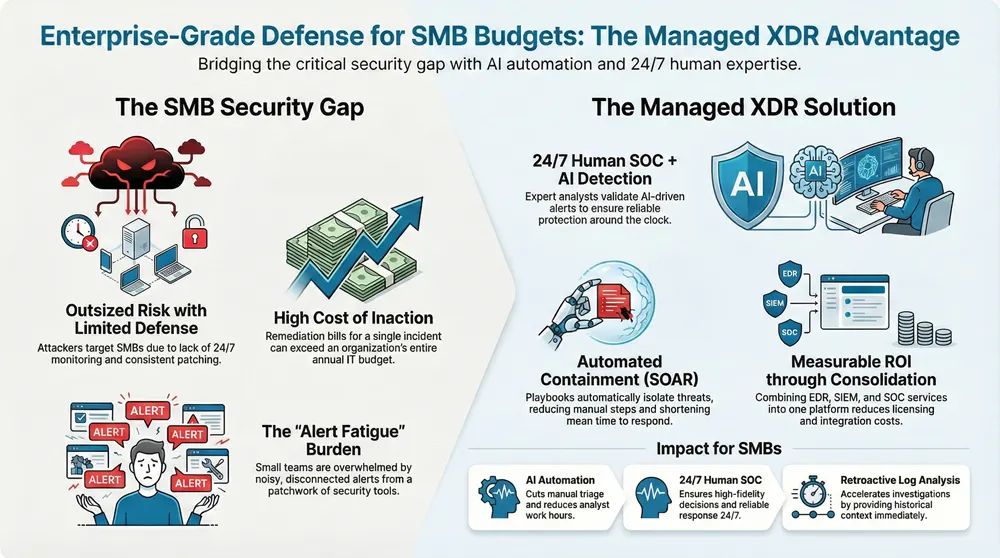
Affordable XDR combines extended detection and response technology with managed security operations so small and mid‑sized businesses get enterprise‑grade defense without building a full in‑house SOC. This guide breaks down what “affordable XDR” means for SMBs, how managed XDR is delivered, and why consolidation, AI‑driven detection, and continuous monitoring lower both risk and cost. You’ll learn why attackers favor SMBs, how managed XDR eases staffing and budget limits, which platform features matter most, and how compliance and ROI improve after adoption.
We also explain where ShieldWatch’s XDR fits—highlighting AI plus 24/7 human SOC coverage, fast onboarding, retroactive log analysis, and compliance support—while keeping the focus on practical decision criteria for SMB leaders. If you handle security for a small or growing organization, this resource will help you evaluate XDR options, prioritize features, and expect outcomes like quicker containment, fewer false positives, and simpler audit evidence collection.
Why Small and Mid‑Sized Businesses Need Affordable XDR

Affordable XDR gives limited teams cross‑layer visibility, automated response, and managed operations so they can detect and contain threats continuously. SMBs face outsized risk from ransomware, phishing, and supply‑chain attacks because attackers target weaker defenses; a single incident can cause major operational and financial damage. XDR pulls telemetry from endpoints, cloud services, and networks, correlates events to reduce noisy alerts, and runs playbooks to contain threats quickly—cutting dwell time and recovery cost. The sections that follow unpack the main threats SMBs face and the budget and staffing mechanisms by which XDR delivers measurable value, so leaders can choose an affordable managed XDR that fits their needs.
What cybersecurity challenges do SMBs face today?
SMBs operate in a concentrated threat landscape where social engineering, ransomware, phishing, and misconfigured cloud resources cause the bulk of incidents. Attackers increasingly target smaller organizations because many lack around‑the‑clock monitoring, consistent patching, and centralized telemetry for rapid detection. Consequences include downtime, data loss, reputational damage, and remediation bills that can exceed an annual IT budget—making prevention and fast response essential. Recognizing these threat patterns explains why detection, correlation, and managed response—the core functions of XDR—are critical for preserving business continuity and customer trust.
How XDR helps with tight budgets and small teams
XDR reduces cost and complexity by consolidating point tools, automating routine investigations, and providing outsourced SOC expertise so you don’t have to staff a large security team. Correlation and behavioral analytics filter out false positives before they reach analysts, and SOAR playbooks automate containment actions like isolation, terminating malicious processes, and blocking indicators. For SMBs this lowers total cost of ownership: fewer licenses, simpler integrations, and less analyst time compared with a patchwork of tools. Those operational savings are the basis for managed XDR packages that combine technology and expert coverage to give SMBs 24/7 protection without the overhead of building it themselves.
What Is Managed XDR and How It Helps Small Businesses
Managed XDR is a service that pairs extended detection and response technology with continuous human oversight, telemetry ingestion, and automated orchestration to detect and respond to threats across endpoints, network, and cloud. The service aggregates logs and events into a single security context, applies machine learning and threat intelligence to prioritize incidents, and uses SOAR playbooks plus analyst intervention to contain and remediate. For SMBs, managed XDR eases staffing pressure, shortens MTTR, and improves visibility across hybrid environments while delivering predictable operational costs. The sections below explain how managed XDR is delivered in practice and the core features small businesses should require when evaluating vendors.
How ShieldWatch delivers managed XDR for SMBs
ShieldWatch offers a managed XDR service that pairs autonomous, AI‑driven detection with a 24/7 human Security Operations Center for continuous monitoring and response. The ShieldWatch XDR platform combines SIEM‑style log ingestion and correlation with SOAR‑driven incident response and endpoint‑to‑cloud coverage, enabling fast deployment and retroactive log analysis so teams can investigate historical activity immediately after onboarding. This blend of machine learning and human review reduces false positives and speeds containment while keeping a single pane of glass for small security teams. When evaluating providers, consider how ShieldWatch’s mix of autonomous detection, SOC validation, and rapid onboarding maps to your need for quick time‑to‑value and simpler security operations.
Key features of affordable XDR for small businesses
An affordable XDR package should focus on a compact set of capabilities that deliver wide protection without creating unnecessary complexity or cost. Core features include AI‑driven detection to lower noise, managed 24/7 SOC monitoring for continuous coverage, SOAR automation for repeatable containment, unified telemetry across endpoints and cloud, and compliance‑ready reporting to support audits. The quick attribute‑to‑value table below helps SMB decision makers compare feature impact when prioritizing purchases.
Different XDR features translate to concrete SMB value in these ways:
This table shows how the right mix of managed services and automation delivers broad protection while keeping operational costs predictable. The next section compares these features to market expectations and explains how platform design choices affect affordability.
How ShieldWatch XDR Stacks Up for Mid‑Market Businesses
When comparing XDR platforms for mid‑market environments, focus on the balance between automation, human oversight, deployment speed, and compliance support—not just feature checklists. ShieldWatch centers on autonomous detection complemented by a 24/7 human SOC, rapid onboarding with retroactive log analysis, and a unified platform that spans endpoint to cloud telemetry—attributes that match SMB priorities for quick time‑to‑value and operational simplicity. A capability‑to‑impact comparison helps buyers see which platform traits will reduce analyst workload, lower integration effort, and improve response times.
Why ShieldWatch is a strong fit for SMBs
ShieldWatch positions its XDR around differentiators that directly improve SMB outcomes: agentic AI for automated detection, human SOC validation for high‑fidelity decisions, fast onboarding with retroactive logs to accelerate investigations, and multitenant delivery for MSPs and channel partners. Those capabilities mean fewer false positives, faster MTTR, and less tool sprawl for small teams that need enterprise controls without enterprise complexity. The capability‑to‑impact mapping below connects specific ShieldWatch features to SMB benefits.
This comparison shows the core decision: choose a platform whose design reduces operational burden while preserving enterprise‑grade detection and response. The next part explains how those choices make enterprise security affordable for SMBs.
How ShieldWatch brings enterprise controls to SMB budgets
Delivering enterprise‑grade security affordably depends on automation, multitenant delivery, and channel‑friendly packaging so per‑customer costs fall versus single‑tenant setups. Automation cuts repetitive analyst work and lowers human hours per incident, while a multitenant managed service creates economies of scale across many customers. Consolidating EDR, SIEM‑style ingestion, and SOAR into one managed platform also reduces integration and licensing overhead compared with running separate tools. Together, these elements explain how ShieldWatch and similar managed XDR providers offer enterprise capabilities at price points that fit SMB budgets.
How ShieldWatch Uses AI and Automation to Improve SMB Security
AI and automation boost detection accuracy and speed by correlating different telemetry types, applying behavior‑based analytics, and running playbooks that remove repetitive manual steps. Machine learning highlights anomalous activity across endpoints and cloud services, threat intelligence adds context to alerts, and SOAR automates containment for known patterns—letting small teams handle more telemetry with confidence. Below we look at AI’s technical role and the practical ways automation reduces alert fatigue and raises operational efficiency for SMBs.
What AI contributes to detection and response
AI in XDR performs behavioral analytics, ties together disparate data sources, and enriches alerts with threat intelligence to catch suspicious sequences that single‑source tools miss. By linking events—say, a suspicious process followed by unusual network traffic—AI creates higher‑fidelity alerts that surface true incidents and cut false positives, speeding investigations. Human analysts then validate and refine AI findings, keeping a human‑in‑the‑loop balance that blends speed with contextual judgment and builds confidence in automated actions.
How automation cuts alert fatigue and improves efficiency
Automation triages, enriches, and remediates routine incidents through SOAR playbooks so analysts focus on high‑value investigations. Automated triage gathers process metadata, user context, and related artifacts so the SOC gets a complete incident packet instead of a noisy alert—accelerating decisions. Containment playbooks can isolate endpoints or revoke credentials automatically, reducing manual touchpoints and shortening mean time to remediate. These efficiencies preserve analyst focus for complex threats and deliver consistent, repeatable responses that benefit small security teams.
How ShieldWatch XDR Helps SMBs Meet Compliance Requirements
ShieldWatch XDR supports compliance readiness by collecting and retaining telemetry, producing auditor‑friendly reports, and providing continuous monitoring mapped to common control frameworks. Continuous log collection, alerting, and packaged evidence make it easier to demonstrate control effectiveness and incident response. The table below maps supported standards to ShieldWatch capabilities and shows how the platform helps meet common audit areas.
Which compliance standards does ShieldWatch XDR support?
ShieldWatch XDR supports compliance needs aligned with SOC 2, HIPAA, and CMMC readiness by offering monitoring, reporting, and retention features that map to those frameworks. For SOC 2, retained logs and incident documentation give auditors the evidence they need for security and monitoring controls. For HIPAA, access monitoring and audit trails help demonstrate protection of ePHI. For CMMC readiness, continuous monitoring and incident response workflows support required practices. The table maps common control areas to ShieldWatch capabilities and explains how each feature helps during an audit.
This mapping shows how continuous monitoring and automated reporting shorten the time and effort SMBs spend preparing for audits. The next section explains the operational flow that makes compliance tasks simpler.
How continuous monitoring eases SOC 2, HIPAA, and CMMC compliance
Continuous monitoring creates a repeatable workflow—monitor, alert, investigate, report—that turns security events into audit artifacts with minimal manual work. Automated reporting consolidates timelines, affected assets, and remediation actions into evidence packages auditors can review, shortening audit prep. For SMBs, this reduces the admin burden of gathering logs, correlating events, and documenting responses, while improving the maturity auditors assess. Continuous monitoring also supports steady‑state evidence readiness instead of last‑minute audit scrambling.
Real‑World Outcomes: SMBs Using ShieldWatch XDR
SMBs who adopt managed XDR typically see faster containment, clearer visibility across hybrid environments, and simpler audit preparation—improvements that boost resilience and cut incident costs. Case stories often highlight how rapid detection and automated containment stopped escalation, how retroactive log analysis clarified timelines, and how centralized reporting eased audits. The sections that follow summarize common risk‑reduction outcomes, ROI themes, and invite teams to request a tailored demo or assessment.
How ShieldWatch XDR reduces cybersecurity risk for SMBs
ShieldWatch XDR lowers risk by shortening detection time, reducing dwell time, and automating containment to limit incident scope and impact. By combining AI‑driven correlation with 24/7 analyst validation, incidents that might have spread are contained faster—reducing the chance of ransomware escalation or prolonged data exposure. Retroactive log analysis speeds root‑cause investigations after onboarding, helping close gaps sooner and informing preventive controls. Those operational improvements strengthen security posture and lower the likelihood of costly, business‑disrupting incidents.
Typical ROI and cost savings from managed XDR
SMBs report ROI from managed XDR as cost avoidance—fewer incidents, smaller recovery budgets, and reduced spending on separate point products—plus operational savings from fewer hires and less analyst overtime. Tool consolidation cuts licensing and integration costs, and automation lowers manual hours per incident, increasing small‑team efficiency. For SMBs wanting a hard estimate, a provider demo and assessment will produce a customer‑specific ROI model based on incident history, current tool spend, and staffing; contact ShieldWatch to request a demo or a tailored estimate.
- Assess current costs: List tool subscriptions and in‑house SOC expenses you can consolidate.
- Estimate avoided incident costs: Use historical incident frequency to model savings from faster containment.
- Request a tailored demo: Confirm deployment timelines and see retroactive log analysis and reporting in action.
These steps help leaders turn security investments into measurable business outcomes and determine how managed XDR fits existing budgets.
This guide explained why SMBs need affordable XDR, how managed XDR works, which features to prioritize, how ShieldWatch’s managed XDR aligns with SMB needs, and how AI, automation, and continuous monitoring deliver operational and compliance benefits. If you’re evaluating XDR, next assess telemetry coverage, required compliance mappings, and deployment timelines—then request a demo to validate time‑to‑value and ROI.
Frequently Asked Questions
1. What’s the difference between XDR and traditional security tools?
XDR (Extended Detection and Response) unifies multiple security layers—endpoint, network, and cloud—into a single platform that correlates data across sources. Traditional tools often work in silos and rely on manual correlation, which increases alert noise and operational overhead. XDR delivers a holistic view that improves detection fidelity, reduces alert fatigue, and enables faster, more coordinated response.
2. How can SMBs judge an XDR solution’s effectiveness?
Measure effectiveness with KPIs like mean time to detect (MTTD) and mean time to respond (MTTR), reduction in false positives, and total cost of ownership versus previous tooling. Also evaluate how well the solution integrates with your environment, produces actionable alerts, and supports compliance reporting. A short pilot or demo can validate real‑world impact on these metrics.
3. What should SMBs look for in a managed XDR provider?
Prioritize 24/7 monitoring, automated incident response, and a proven record of lowering false positives. Check the provider’s compliance expertise, integration flexibility, customer support, and ability to scale with your business. Ask for references, deployment timelines, and a demo that shows retroactive log analysis and reporting.
4. How does ShieldWatch protect data privacy and security?
ShieldWatch protects data with strong encryption, strict access controls, and continuous monitoring of data flows. The platform aligns with industry standards and compliance frameworks, and ShieldWatch performs regular security reviews and vulnerability scans. These controls help keep sensitive information secure while supporting regulatory obligations like GDPR and HIPAA where relevant.
5. Can XDR adapt to changing threats?
Yes. XDR platforms evolve through continuous learning, threat intelligence feeds, and regular updates. Machine learning spots new patterns, while integrations with threat feeds and analyst‑driven tuning ensure detections keep pace with emerging attack techniques. Providers deliver updates and playbook improvements so defenses remain current.
6. How long does XDR implementation typically take?
Implementation time varies with environment complexity and scope, but SMBs commonly see deployment complete in a few weeks to a couple of months. That includes initial assessment, sensor rollout, integrations, and staff orientation. A structured onboarding process—like ShieldWatch’s—can accelerate timelines and deliver value quickly.
7. How should SMBs measure XDR success?
Track metrics such as incident response times, number of credible detections, reduction in security incidents, and operational hours saved. Regular assessments and feedback from SOC analysts will also show whether alerts are more actionable and whether the team’s workload has decreased. Success looks like improved security posture and lower operational cost over time.
Conclusion
Affordable managed XDR lets small and mid‑sized businesses achieve enterprise‑level security without the burden of a large in‑house SOC. By combining AI‑driven detection, continuous monitoring, and expert oversight, SMBs can cut risk and operational cost while improving compliance readiness. Working with a managed XDR partner like ShieldWatch streamlines security operations and accelerates incident response. Ready to see how it fits your environment? Request a tailored demo and we’ll show time‑to‑value for your team.
Turn your audience into earnings—become an affiliate partner today!
Monetize your traffic instantly—enroll in our affiliate network!
Get paid for every click—join our affiliate network now!
Join our affiliate family and watch your profits soar—sign up today!
Your influence, your income—join our affiliate network today!
Drive sales, collect commissions—join our affiliate team!
Join our affiliate community and maximize your profits!
Join our affiliate program today and earn generous commissions!
Unlock exclusive rewards with every referral—apply to our affiliate program now!