

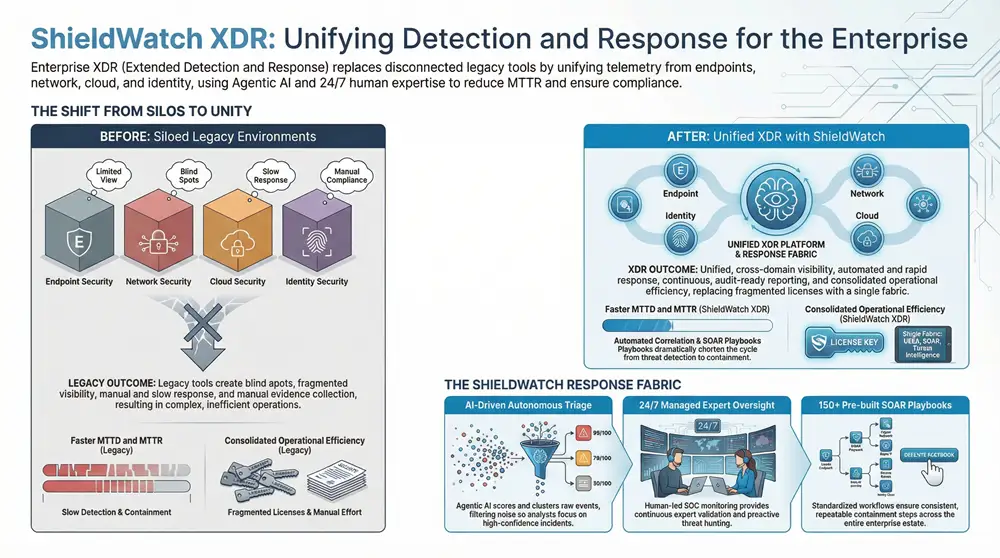
Enterprise-grade XDR (Extended Detection and Response) unifies telemetry from endpoints, network, cloud, and identity into a single detection and response fabric. Large organizations contend with massive log volumes, broad attack surfaces, and strict compliance requirements. Enterprise XDR addresses those challenges by correlating signals across domains, applying analytics, and executing automated and analyst-validated responses to cut dwell time. This article explains how enterprise XDR improves on legacy tools, outlines core architecture and operational workflows, and gives procurement guidance for evaluating scalable XDR platforms.
You’ll find technical primers, implementation best practices, managed service advantages, compliance mappings, and a buyer’s checklist. The sections that follow cover definitions and architecture; how ShieldWatch delivers scalable XDR; the value of managed XDR; compliance support; deployment challenges and mitigations; and practical questions for vendor evaluation.
What is Enterprise XDR and Why is it Essential for Large Organizations?

Enterprise XDR centralizes detection and response by ingesting telemetry from multiple sources, correlating events, and orchestrating containment and remediation. It pulls in data from endpoints, network sensors, cloud services, and identity systems, runs analytics and correlation to surface high-confidence incidents, then triggers automated playbooks or analyst workflows to investigate and fix issues. The outcome is clearer visibility across the attack surface, shorter detection-to-containment cycles, and lower operational overhead compared with disconnected EDR or standalone SIEM approaches. In short: unified telemetry plus automated response reduces mean time to detect (MTTD) and mean time to respond (MTTR), letting security teams scale effectively.
Enterprises adopt XDR primarily to improve visibility, speed, and efficiency — all of which directly reduce business risk and support continuity. The list below summarizes the main drivers that shape XDR architecture and buying decisions.
- Visibility Across Silos: Correlating endpoint, network, cloud, and identity telemetry closes blind spots and exposes multi-stage attacks.
- Faster Investigations: Analytics and correlation shrink alert fatigue and surface the incidents that matter.
- Operational Efficiency: SOAR automation and standardized playbooks remove repetitive work and lower manual triage effort.
Those priorities lead to an architectural question: how does XDR technically unify detection and response? The subsection below explains the correlation and analytics model that makes enterprise XDR effective.
How does Extended Detection and Response unify threat detection and response?
Extended Detection and Response builds a shared telemetry layer that aggregates logs, events, and metrics from endpoints, cloud workloads, network sensors, and identity services. The platform combines ingestion pipelines, feature extraction, correlation engines, and behavioral analytics — often supported by ML — to find patterns single-source tools miss. By connecting an identity anomaly to endpoint activity and network exfiltration, XDR surfaces multi-vector incidents as a single case with rich context, speeding investigation and coordinated containment. Automated playbooks and SOAR integrations allow safe, repeatable responses (for example, isolating a host or disabling a compromised account) while analyst workflows preserve human validation and escalation. Grasping this correlation model clarifies the platform trade-offs to evaluate when selecting enterprise XDR.
Introductory EAV table: compare benefits across dimensions for enterprise decision makers.
The table underscores why enterprises prioritize platforms that reduce manual work and improve cross-domain detection. Next, we explain how a vendor-grade XDR platform can deliver scalable protection for large organizations.
How Does ShieldWatch XDR Deliver Scalable Protection for Enterprises?

Scalable XDR for the enterprise combines high-throughput ingestion, multi-tenant architecture, automation, and analyst validation so coverage stays consistent as data grows. Scalability depends on elastic ingestion pipelines, normalized stores for long-term retention, and an analytics fabric that applies correlation rules, UEBA models, and threat-intel enrichment at scale. Operationally, a layered approach — automated triage followed by SOC analyst validation — keeps false positives low while allowing safe automated containment where appropriate. Those design choices enable predictable SLAs for detection and containment and simplify maintenance across multi-site deployments.
Below is a mapping of core XDR components to measurable enterprise benefits.
This mapping shows how technical choices deliver speed, consistency, and scale. ShieldWatch pairs these architectural elements with product capabilities designed for enterprise rollouts: autonomous triage using Agentic AI; 24/7 human-led SOC monitoring; rapid onboarding with retroactive 90‑day log visibility; 150+ pre-built SOAR workflows; built-in readiness for SOC 2, HIPAA, CMMC 2.0, and ISO 27001; and a unified license that consolidates NG-SEN, ITDR, SOAR, UEBA, and threat intelligence.
What role does AI-driven threat detection play in ShieldWatch XDR?
AI-driven detection speeds alert triage by using Agentic AI to score, cluster, and enrich raw events so analysts see high-confidence incidents first. ShieldWatch applies supervised and unsupervised models, UEBA baselines, and threat-intel correlations to recommend playbook actions informed by past outcomes. In practice, AI filters noise, proposes prioritized next steps, and frees analysts to focus on complex investigations. Analysts validate and tune models to prevent drift — a human-plus-AI loop that keeps automated remediation safe, effective, and measurable in MTTR improvements while preserving governance and oversight.
What Benefits Do Managed XDR Services Offer to Large Enterprises?
Managed XDR (MXDR) layers operational expertise on top of the platform, combining technology with 24/7 human response to help organizations overcome staffing limits and accelerate security maturity. MXDR delivers continuous monitoring by shift-based analysts, proactive threat hunting to uncover hidden compromises, standardized incident workflows aligned to business risk, and SLA-driven escalation to ensure timely containment and remediation. For enterprises with distributed assets or uneven security skills, managed services provide predictable outcomes and let internal teams focus on strategic priorities instead of high-volume alert triage.
The core managed XDR benefits include:
- 24/7 Monitoring and Rapid Response: Continuous detection and on-call analysts reduce dwell time and protect business continuity.
- Access to Specialized Expertise: Threat hunters and incident responders bring current adversary knowledge to supplement internal teams.
- Operational Efficiency: Standardized playbooks and runbooks lower variability and improve compliance readiness.
ShieldWatch operationalizes managed XDR by combining 24/7 human-led SOC monitoring with Agentic AI for alert triage and automation. That mix maintains consistent coverage during peak alert periods and off-hours while using automated workflows to speed containment.
Managed XDR also delivers service-level metrics and reporting for compliance and executive dashboards, improving transparency and aligning security operations with business risk. The subsection below illustrates how continuous SOC monitoring strengthens enterprise posture with a practical scenario.
How does 24/7 SOC monitoring enhance enterprise cybersecurity?
Always-on SOC monitoring detects and escalates incidents regardless of time zone, denying attackers the window they rely on. Shift-based analysts use playbook-driven investigations to validate high-priority alerts, correlate cross-source evidence, and trigger containment actions per SLA. For example, an off-hours identity anomaly might automatically enrich with context, prompt an analyst review, and lead to rapid account isolation and endpoint forensics — preventing lateral movement and data loss. This model shortens detection timelines, keeps stakeholders informed with timely notifications and remediation tracking, and produces continuous compliance evidence.
Introductory EAV table: compare ShieldWatch-managed benefits vs internal-only operations.
That comparison explains why enterprises often adopt MXDR to multiply scarce security talent. Next, we describe how ShieldWatch supports regulatory compliance.
How Does ShieldWatch XDR Support Compliance for Large Organizations?
XDR supports compliance by offering continuous monitoring, centralized logging, and automated evidence collection mapped to common control objectives across frameworks like SOC 2, HIPAA, CMMC 2.0, and ISO 27001. Key compliance features include long-term, tamper-evident log storage, role-based access controls, audit trails of investigative activity, and exportable reports that aggregate detection and response metrics for auditors. By aligning detection rules and retention with regulatory timelines, XDR reduces manual evidence gathering and preserves a clear chain of custody for incidents.
The table below maps XDR features to common compliance controls to show how platform capabilities meet audit needs.
Beyond these mappings, ShieldWatch ships platform-level capabilities that accelerate compliance readiness: built-in support for SOC 2, HIPAA, CMMC 2.0, and ISO 27001. Organizations should request a security and controls review during procurement to verify control mappings and retention settings that meet internal policy and auditor needs. That validation ensures continuous monitoring both detects threats and produces the artifacts auditors expect.
Which regulatory frameworks does ShieldWatch XDR address?
ShieldWatch aligns technical controls to major frameworks commonly required for audits. Telemetry collection and retention support log-based evidence for SOC 2 and ISO 27001; identity monitoring helps satisfy access and privilege controls under HIPAA; and incident response capabilities assist with CMMC 2.0 expectations for timely containment and reporting. Enterprises should validate specific control mappings and retention periods against internal policies and auditor requirements — a tailored compliance assessment from the vendor will clarify configuration and evidence export options.
This compliance overview leads into common implementation challenges enterprises should expect when deploying XDR at scale.
What Are the Key Challenges and Solutions in Implementing Enterprise XDR?
Common challenges in enterprise XDR deployments include integration complexity across diverse telemetry sources, high data volumes that strain ingestion and storage, gaps in internal skills for tuning analytics and playbooks, and the need for phased rollouts to manage change. Addressing these requires staged deployments, pre-built connectors for common systems, tiered retention strategies to control costs, and a balance of automation plus human review to limit false positives. These mitigations shorten time-to-value and help the platform scale with enterprise needs.
Typical implementation challenges include:
- Integration complexity across cloud, on-prem, and identity systems.
- High data volumes and associated storage costs for long-term retention.
- Skills gaps for advanced threat hunting and analytics tuning.
- Change management for alert thresholds and remediation workflows.
Practical remediations exist for each: pre-built integrations reduce connector work, multi-tier retention policies control costs, managed services fill skills gaps, and phased rollouts let teams tune alerts in controlled environments. Understanding these approaches sets realistic timelines and expectations for enterprise deployments. The next subsection describes how ShieldWatch eases deployment and integration.
How does ShieldWatch simplify XDR deployment and integration?
ShieldWatch speeds deployment with rapid onboarding patterns, a library of pre-built connectors, and retroactive log visibility that lets teams analyze historical events immediately. Typical steps include initial connector activation, tuning correlation rules and SOAR playbooks in a test tenancy, phased rollout across business units, and continuous tuning driven by SOC feedback. Pre-built integrations reduce connector effort, and retroactive 90‑day log visibility enables immediate hunting without lengthy re-ingestion. These capabilities support hybrid environments and lift-and-shift migrations by minimizing initial data gaps and accelerating useful detection coverage.
To quantify outcomes, request a deployment timeline and integration checklist during procurement to set clear milestones and responsibilities. The section below offers a buyer-focused framework to evaluate scalable XDR vendors.
Introductory EAV table: deployment components and outcomes.
This deployment checklist shows how structured phases produce faster value and smoother integration across an enterprise estate.
How to Choose the Right Scalable XDR Solution for Your Large Organization?
Choosing a scalable XDR solution requires an objective buyer’s checklist covering architecture, integrations, data policies, automation, managed services, compliance support, and commercial terms. Key evaluation points are the platform’s ability to ingest peak telemetry, support long-term retention, provide pre-built integrations and APIs, demonstrate robust AI/analytics and SOAR playbooks, commit to detection and response SLAs, and offer transparent pricing aligned to enterprise consumption. Validate vendor claims with proof-of-concept tests, ingestion benchmarks, and SLA review to confirm performance under realistic loads.
Use this checklist during procurement to ask the right questions and validate capabilities:
- Scalability & Performance: Can the platform handle peak ingestion and maintain acceptable query latency?
- Integrations & APIs: Are pre-built connectors available for key systems and are APIs open for custom work?
- Data Retention & E-Discovery: What retention options exist and how is historical log access managed?
- Automation & SOAR: Are there ready-made playbooks and can you author custom workflows?
- Managed Services & SLAs: Is 24/7 SOC monitoring offered and what are the response SLAs?
- Compliance Support: Does the vendor provide mappings and reports for relevant frameworks?
Below is a concise summary of ShieldWatch differentiators to help compare vendor strengths without overclaiming. ShieldWatch focuses on Agentic AI for autonomous alert triage, 24/7 human-led SOC monitoring, rapid deployment with retroactive 90‑day log visibility, and a library of 150+ pre-built SOAR workflows — all delivered on a unified platform that consolidates NG-SEN, ITDR, SOAR, UEBA, and threat intelligence under one license.
Introductory EAV table: vendor attribute checklist for procurement conversations.
This buyer checklist helps procurement and security teams structure realistic evaluations and proofs-of-concept that mirror operational loads.
Lists and final guidance for vendor validation:
- Proof-of-Concept Tests: Validate ingestion rates, rule performance, and scenario detection under load.
- Operational Playbooks: Request sample SOAR playbooks and run a scripted incident simulation.
- Reference Scenarios: Ask for anonymized case studies that show deployment patterns and outcomes.
These validation steps complete the procurement cycle and prepare teams for negotiation and onboarding planning.
Frequently Asked Questions
Conclusion
Deploying an enterprise-grade XDR platform gives large organizations unified visibility, faster incident response, and greater operational efficiency. By combining advanced analytics, automation, and human validation, enterprises can manage complex threat environments while meeting compliance obligations. ShieldWatch XDR is designed to help security teams consolidate tools, accelerate detection and containment, and produce audit-ready evidence. To strengthen your organization’s defenses, explore ShieldWatch’s XDR offerings and request a tailored evaluation.
Earn your airdrop on Aster https://is.gd/ZceEI6
Enter your invite code to earn your airdrop on Aster https://is.gd/ZceEI6
Enter your invite code to earn your airdrop on Aster https://is.gd/ZceEI6
Claim Your Exclusive Bonus on AsterDEX https://is.gd/CGTnqR
Fast indexing of website pages and backlinks on Google https://is.gd/r7kPlC
Fast indexing of website pages and backlinks on Google https://is.gd/r7kPlC
Sign up for our affiliate program and watch your earnings grow!
Turn referrals into revenue—sign up for our affiliate program today!
Grow your income stream—apply to our affiliate program today!
Monetize your influence—become an affiliate today!