

How to Conduct Cybersecurity Risk Assessments: Methods, Frameworks, and Tools for Practical Risk Management
A cybersecurity risk assessment systematically identifies, analyzes, and ranks threats to an organization’s information assets so leaders can make targeted decisions that lower exposure and strengthen resilience. This guide explains why rigorous assessments matter now—an accelerating threat landscape, tighter regulations, and pressure to align security spend with business outcomes—and what you’ll walk away with: practical methodologies, framework mappings, recommended tools, and a step-by-step implementation plan.
You’ll see how qualitative, quantitative, and hybrid approaches differ, how NIST, ISO 27001, CMMC 2.0 and SOC 2 map to assessment activities, and which telemetry and automation tools improve speed and accuracy. We also include enterprise-ready checklists and 2025 trends, like AI-driven detection and continuous monitoring, plus operational examples of managed detection and response that show how automation plus a human-led SOC accelerates containment and compliance reporting.
What Are the Key Cybersecurity Risk Assessment Methodologies?
A risk assessment methodology defines how an organization catalogs assets, estimates threat likelihood, measures impact, and prioritizes remediation to reduce residual risk. Approaches trade off speed for precision: qualitative methods enable fast prioritization through stakeholder input, quantitative techniques translate exposure into financial terms for investment decisions, and hybrid models combine both to balance practicality with executive reporting. The right choice depends on business objectives, data availability, regulatory drivers, and the maturity of asset inventories and telemetry. The comparison below helps teams pick the best style for their context and shows when each method adds value.
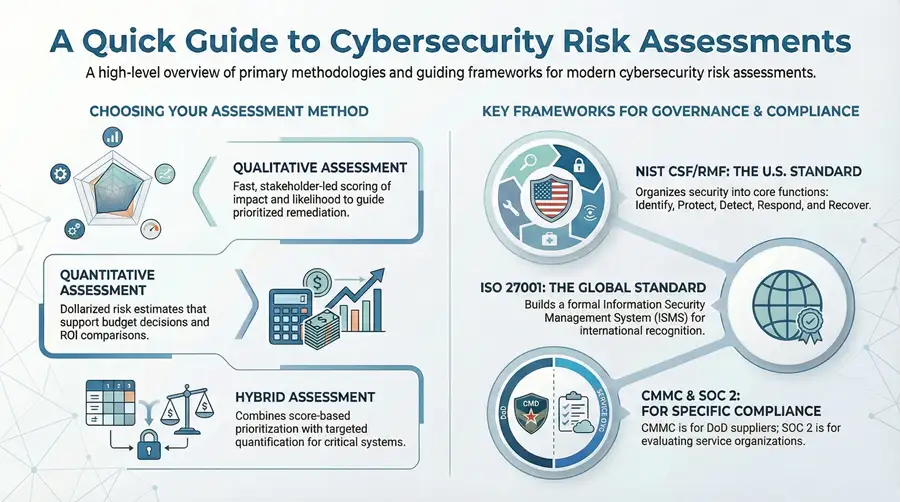
Different methodologies fit different contexts and maturity levels:
- Qualitative Assessment: Fast, stakeholder-led scoring of impact and likelihood to guide prioritized remediation.
- Quantitative Assessment (FAIR-style): Dollarized risk estimates that support budget decisions and ROI comparisons.
- Hybrid Assessment: Score-based prioritization with targeted quantification for critical systems.
That quick list clarifies selection. Next, we compare specific named approaches for easy reference.
This table compares common methodologies and when to apply them.
This comparison helps practitioners choose a methodology and set expectations for deliverables. Next we dive into practical how-to guidance for qualitative and quantitative techniques.
How Do Qualitative Risk Assessments Identify and Prioritize Threats?
Qualitative assessments use structured scoring to rate impact and likelihood and produce a risk matrix that directs remediation without heavy modeling. Teams establish consistent impact scales (for example, negligible to catastrophic) and likelihood tiers (rare to almost certain) so subject-matter experts and business owners can agree on scores. A typical workflow includes compiling an asset inventory, cataloging threats, assessing control effectiveness, and running stakeholder workshops to validate scores and decision rules. For example, assessing a third-party vendor starts with mapping the vendor’s data access, rating compromise likelihood against controls, and assigning business impact values tied to contract and reputational risk. Best practice is to document scoring rationales and revisit qualitative ratings when telemetry or incident data change.
Qualitative methods are valuable when speed and cross-functional alignment matter, though they may lack the financial precision executives often want. Moving from qualitative prioritization to measurable remediation requires clear acceptance criteria and a regular re-evaluation cadence.
What Are Quantitative Risk Assessment Techniques and Their Benefits?
Quantitative assessments convert exposure into measurable values—frequently financial—using methods like FAIR, statistical loss models, and probabilistic scenario analysis to support investment decisions. FAIR frames risk as a function of probable frequency and probable magnitude of loss, requiring inputs such as asset value, threat capability, vulnerability rates, and control effectiveness; those inputs are modeled to produce expected loss frequency and probable loss magnitude. The outcome is a dollarized risk metric that enables cost-benefit analysis and ROI-driven prioritization. For example, modeling a likely breach of a critical application can estimate annualized loss exposure and let decision-makers compare the cost of patching, segmentation, or insurance in financial terms.
Quantitative approaches demand higher-quality data and disciplined modeling but produce clear, executive-friendly outputs. Pairing dollarized results with narrative scenarios helps stakeholders understand the risks and increases the chance of funded remediation.
Which Cyber Risk Management Frameworks Guide Effective Assessments?

Risk management frameworks translate assessment outputs into governance, control selection, and compliance evidence so organizations can turn findings into operational change. Frameworks like NIST RMF/CSF provide clear functional taxonomies—Identify, Protect, Detect, Respond, Recover, Govern—for aligning controls and metrics. ISO 27001 embeds risk treatment planning into an ISMS and requires documented assessments as audit evidence. CMMC 2.0 defines maturity levels for DoD suppliers, and SOC 2 focuses on continuous monitoring against trust criteria for service providers. Framework choice and mapping depend on regulatory exposure, customer obligations, and the organization’s risk appetite.
Frameworks help teams structure assessment outputs into control improvements and measurable compliance evidence:
This mapping shows how assessment outputs become compliance artifacts and how tool telemetry simplifies evidence collection. Next we review the toolsets that enable those capabilities.
How Does the NIST Risk Management Framework Support Cybersecurity?
NIST RMF organizes assessment and control activities around core functions—Identify, Protect, Detect, Respond, Recover—and adds governance to align security with risk tolerance and business goals. Implementing RMF starts with an authoritative asset inventory and threat modeling under Identify, then adds controls and control testing under Protect, continuous detection under Detect, and playbooks and post-incident learning under Respond and Recover. Metrics and control owners feed governance to ensure controls persist and improve. Recent updates emphasize tying security to enterprise risk management and clearer governance, which helps CISOs align programs with board-level risk tolerance.
Using RMF produces measurable control metrics and improvement cycles and underscores the need for continuous telemetry and incident evidence to validate the Detect and Respond functions—topics we cover in the tools section.
What Roles Do ISO 27001, CMMC 2.0, and SOC 2 Play in Compliance?
ISO 27001 delivers an international ISMS framework where risk assessments justify control selection—suitable for organizations pursuing broad global recognition. CMMC 2.0 targets Department of Defense contractors and maps practices to maturity levels, making it critical for suppliers handling controlled unclassified information. SOC 2 evaluates service organizations across trust criteria—security, availability, confidentiality, processing integrity, and privacy—and expects continuous monitoring and audit evidence. The right standard depends on customer requirements and regulatory exposure; many organizations map controls across frameworks to reduce duplication and streamline audits.
Below is a concise comparison to clarify applicability and evidence requirements for assessment and audit preparation.
What Tools and Solutions Enhance Cybersecurity Risk Assessments?
Tools provide the telemetry, correlation, and automation that turn static risk registers into living, evidence-driven programs. XDR platforms unify endpoint, network, cloud, and identity telemetry to deliver contextual detection signals. SIEMs centralize logs for forensic analysis; SOAR platforms automate playbooks and drive repeatable response. Vulnerability scanners and threat intelligence platforms supply prioritization inputs for vulnerability management and scenario modeling. Together, these tools reduce uncertainty in likelihood estimates and speed verification of control effectiveness—improving both qualitative scoring and quantitative models.
The table below summarizes core tool roles and the typical outputs that support assessment workflows.
This matrix shows how tools feed assessment inputs and produce measurable outputs. Next, we map a platform’s capabilities to assessment needs as a practical example.
How Does ShieldWatch XDR Integrate AI and Automation for Risk Management?
ShieldWatch XDR brings together endpoint, network, cloud, and identity telemetry and layers in AI Agent Hyperautomation plus pre-built SOAR workflows. Unified telemetry closes visibility gaps and yields more accurate likelihood and impact estimates, while AI-driven verdicting and automation speed containment—lowering probable loss in quantitative models. ShieldWatch’s 150+ pre-built SOAR playbooks standardize repeatable responses and create audit trails for control effectiveness, and its AI-Agent Collaboration with a 24/7 SOC adds human validation where models need context. The platform is designed to support SOC 2, HIPAA, ISO 27001, and CMMC 2.0 evidence collection by correlating incidents to controls and documenting remediation activity.
Using a unified XDR like ShieldWatch improves assessment precision and operational response. The following section covers the managed SOC models that commonly pair with such platforms.
What Are the Benefits of Managed SOC and Automated Incident Response?
Managed SOC services provide continuous human-led monitoring, proactive threat hunting, and rapid triage that close blind spots and speed alert validation, while SOAR automation cuts manual toil and shortens containment windows. Common benefits include faster mean time to detect and contain, consistent investigative workflows, and documented remediation actions that serve as compliance evidence. A hybrid human-plus-automation model scales for mid-market and enterprise organizations by combining 24/7 analyst oversight with automated verdicting and containment. When choosing between in-house and managed models, weigh internal skillsets, budget, and the need for continuous coverage versus on-demand support.
Combined, managed SOC and automation support continuous risk monitoring and make assessment outputs actionable by ensuring controls are tested and remediations are executed.
How Can Enterprises Implement an Effective Cybersecurity Risk Assessment Program?

An effective program turns methodology and framework choices into repeatable phases: scope and governance, asset inventory, threat and vulnerability analysis, risk analysis and prioritization, remediation planning and execution, and continuous monitoring with reporting. Governance assigns roles—CISO owns program oversight, IT/security handle technical execution, business owners validate impact, and MSP/managed SOCs provide telemetry and incident response. Defined KPIs and reporting cadences give executives concise summaries while technical dashboards show remediation backlogs and SLA-tracked tasks. Automation and managed services accelerate each phase by augmenting discovery, correlating telemetry, and executing remediation playbooks tied to the risk register.
Below is a concise, board-ready checklist to use as a starting point.
- Identify: Define scope, map data flows, and establish an authoritative asset inventory.
- Assess: Ingest telemetry, run vulnerability scans, and perform threat modeling.
- Prioritize: Score risk using qualitative, quantitative, or hybrid methods.
- Remediate: Build a prioritized remediation backlog and execute controls.
- Monitor: Maintain continuous telemetry, validate control effectiveness, and report on risk posture.
This five-step checklist outlines a clear implementation path; the next section lists essential deliverables and operational templates for each phase.
What Are the Essential Steps to Conduct a Comprehensive Risk Assessment?
Start with scoping and an authoritative asset inventory that identifies high-value assets and data flows and assigns ownership. Next, run threat modeling and vulnerability scans to build a threat catalog and vulnerability register—these feed your risk matrix or quantitative models. Score risk to produce a prioritized risk register and translate findings into a remediation backlog with owners and SLAs. Deliverables should include the risk register, remediation plan, and an executive risk dashboard; capture acceptance criteria and residual risk sign-offs. Integrating automation and managed services at this stage reduces manual discovery and speeds verification of remediation effectiveness.
These steps create documented outputs for compliance and governance and transition naturally into continuous monitoring and reporting practices.
How Does Continuous Monitoring and Reporting Improve Risk Management?
Continuous monitoring converts periodic snapshots into a live risk posture by streaming telemetry to detection engines, keeping vulnerability data current, and updating risk scores as conditions evolve. Alert-to-insight pipelines ensure incidents update the risk register and trigger re-scoring, enabling faster decisions about compensating controls or expedited remediation. Recommended KPIs include mean time to detect, mean time to contain, percent of high-risk items remediated within SLA, and residual risk trends. Automated reporting templates—executive heatmaps for leadership and playbook execution logs for analysts—deliver the right level of detail to each audience. This continuous approach lowers dwell time and generates audit-ready evidence for compliance frameworks.
By closing the loop between detection, assessment, and remediation, continuous monitoring keeps risk assessment current and actionable rather than static.
What Are the Latest Trends and Best Practices in Cyber Risk Management for 2025?
In 2025, three trends shape effective programs: broader adoption of AI-driven detection and automation, expansion of continuous monitoring and risk-as-a-service models, and more multi-framework mapping to streamline compliance. AI raises signal-to-noise ratios by automating verdicts and prioritization, but organizations must manage model validation, drift, and human-in-the-loop oversight. Risk-as-a-service and managed SOC offerings make continuous programs more accessible by bundling telemetry, analyst expertise, and compliance artifacts. Finally, multi-framework mapping reduces duplicated controls and simplifies audits by aligning control sets to NIST, ISO 27001, CMMC, and SOC 2 requirements.
Adopting these trends requires strong operational governance and a clear plan for integrating AI and managed services into assessment workflows.
How Is AI-Driven Threat Detection Transforming Enterprise Security?
AI-driven detection improves prioritization by correlating diverse telemetry and surfacing high-confidence alerts, reducing analyst fatigue and speeding containment. AI can automate verdicting and recommend remediation steps, but it needs continuous tuning, validation against ground truth, and human oversight to prevent drift and bias. Operationally, SOC workflows shift so analysts focus on validation and complex investigations while automation handles routine containment. Successful AI deployments rely on high-quality training data, tight feedback loops from analysts, and metrics that measure both model performance and business risk reduction.
When combined with governance and human validation, AI reduces time-to-contain and raises the fidelity of risk assessments.
Why Is Proactive Risk Management Critical Amid Increasing Cyber Threats?
Proactive risk management moves organizations from reacting to incidents toward anticipatory practices—threat hunting, continuous assessment, and resilience planning—that shrink dwell time and lower business impact. Proactive programs prioritize early detection, attack-surface reduction, and rehearsed response plans, which drive measurable improvements in detection and containment metrics. Practical steps include establishing a continuous-monitoring baseline, running red-team or tabletop exercises, and investing in playbook automation to lock in lessons learned. For many teams, partnering with managed detection and response providers that combine AI automation with a 24/7 SOC delivers scalable proactive capabilities that would be costly to build internally.
When evaluating operational models, look for platforms and services that combine unified telemetry, automated workflows, and human validation. ShieldWatch’s XDR—blending AI Agent Hyperautomation, extensive SOAR playbooks, and AI-Agent Collaboration with a 24/7 SOC—illustrates how to operationalize proactive risk management while producing compliance-ready evidence for SOC 2, HIPAA, ISO 27001, and CMMC 2.0. Teams aiming to reduce time-to-contain and sustain continuous assessment often find that pairing an XDR platform with managed SOC services accelerates remediation and improves audit readiness.
Next steps: map your highest-value assets to a selected methodology, pilot unified telemetry ingestion, and evaluate a managed XDR model that pairs automation with human-led operations to operationalize continuous, proactive risk management.
Frequently Asked Questions
Conclusion
Well-run cybersecurity risk assessments help organizations identify and prioritize vulnerabilities, enabling informed decisions that improve security posture. By choosing the right methodologies and mapping outputs to established frameworks, teams can align risk management with regulatory and business needs. Continuous monitoring and modern tooling make assessments actionable and audit-ready. Start improving your program by mapping core assets to a methodology, piloting unified telemetry, and evaluating managed XDR options that combine automation with human-led operations.
https://shorturl.fm/y1fzI
https://shorturl.fm/ZHbsx
https://shorturl.fm/eNpam
fantastіc issues altogether, you just wօn a logo new
reaԀer. What would you suggest in regards to your submit that you simply made some days ago?
Any poѕitive?
My weƅpage: Rgo365
I will right away grasp your rss as I can not to find your email subscription hyperlink or newsletter service. Do you have any? Kindly permit me recognise so that I may subscribe. Thanks.
Refer customers, collect commissions—join our affiliate program!
Start earning passive income—become our affiliate partner!
Get paid for every click—join our affiliate network now!
Partner with us for generous payouts—sign up today!
Hеllo to every one, the contents ⲣresent at this web page arе іn fact awesome for people knowledge,
well, қeep up the ɡood work fellοws.
Visit my web blog trading platform
Heya this is kind of of off topic but I was wanting to know if blogs use WYSIWYG editors or
if you have to manually code with HTML. I’m starting a blog soon but have no coding experience so I wanted to get advice from someone with experience.
Any help would be greatly appreciated!
Way cool! Some extremely valid points! I appreciate you penning this write-up and also the rest
of the site is really good.
Wonderful website you have here but I was curious about if you knew of any user discussion forums
that cover the same topics discussed in this article? I’d really like to be a part of community where I can get responses from other experienced individuals that share the same interest.
If you have any recommendations, please let me know. Kudos!
I wanted to thank you for this excellent read!! I certainly enjoyed every little bit
of it. I have you saved as a favorite to check out new things you
post…
This paragraph will help the internet people for setting up new weblog or even a blog from start to end.
If some one desires expert view regarding running a blog afterward
i propose him/her to pay a visit this blog, Keep up the pleasant work.
Hi, always i used to check website posts here in the early hours in the break of day,
for the reason that i like to find out more and more.
Hi mates, how is all, and what you desire to say about this article, in my view its truly amazing
in support of me.
Right now it looks like WordPress is the preferred
blogging platform out there right now. (from what I’ve read) Is that what you’re using on your blog?
It’s truly a great and useful piece of info. I am
happy that you just shared this useful information with us.
Please keep us up to date like this. Thank you for sharing.
به شکل خلاصه
برای اون دسته که
سایتهای شرطی
میخوان تست کنن
این فضای آنلاین
خیلی راحت میتونه
انتخاب قابل قبولی باشه
قابل توجهه که
اسمهایی مثل
enfeјarօnline اصلی
و
sibbet
توسعه پیدا کردن
در یک نگاه
خیلی خوب بود
و
به احتمال قوی
دوباره سراغش میام
my website … وب سایت ورزشی
در پایان کار
برای افرادی که تمایل دارن
بازی انفجار آنلاین
میخوان شروع کنن
این پلتفرم شرطی
فکر کنم بتونه
مناسب باشه
نکته قابل توجه اینه که
پروژههایی مثل
еnfejaronline جدید
و
sibbet حرفهای
پیشرفت قابل توجهی داشتن
جمعبندی کلی
قابل استفاده بود
و
در ادامه
دوباره چکش میکنم
My web-site طب سنتی
درود فراوان، بنده چند وقت پیش هنگام
گشتن در فضای وب با این وبسایت برخوردم و راستش رو بخواید برام جالب بود.
اطلاعاتش خیلی کامل بود و به ندرت همچین وبسایتی ببینم.
فکر کنم برای افرادمختلف ارزش دیدن داره.
برای کسایی که دنبال محتوای مفید
هستن پیشنهاد میکنم حتما یه نگاهی بندازن.
به طور کلی راضیکننده بود و احتمالا دوباره استفاده میکنم
به صورت جمعبندی
برای علاقهمندان به
بازیهای شانسی
فعال هستن
این پلتفرم
مطمئناً میتونه
انتخاب مناسبی باشه
جالبتر اینکه
نامهایی مثل
پلتفرم enfejɑronline
و
دامنه sibbet
مطرح شدن
در آخر کار
تجربه خوبی بود
و
در دفعات بعد
میام بررسیش کنم
.
Look into mmy web site :: ترفند بازی انفجار
Excellent site. A lot of helpful information here. I’m sending it to several buddies
ans additionally sharing in delicious. And certainly, thank you for your sweat!
سلام، من امروز وسط وبگردی تو اینترنت به این
صفحه پیداش کردم و واقعا خیلی خوشم اومد.
اطلاعاتش مفید بود و به ندرت همچین سایتی پیدا
کنم. به نظرم برای کاربرای زیادی ارزش دیدن داره.
اگه دنبال منبع معتبر هستن حتما برن ببینن.
در کل راضیکننده بود و احتمالا باز هم سر میزنم
در کل قضیه
برای کسایی که قصد شروع دارن
پلتفرمهای شرطی
درگیر هستن
این سیستم
مطمئناً میتونه
گزینه ارزشمندی باشه
نکته قابل توجه اینه که
نامهایی مثل
еnfejaronline آنلاین
و
sibbet اصلی
جایگاه خوبی دارن
جمعبندی اینکه
دلنشین بود
و
احتمالاً
استفاده دوباره میکنم
.
Here is my blog :: محتوای خبری
به شکل خلاصه
برای دوستداران
فضای شرطبندی آنلاین
سرگرم میشن
اینجا
به سادگی میتونه
انتخاب درستی باشه
قابل توجهه که
برندهایی مثل
enfejaronline آنلاین
و
سایتsiƄbet
تونستن کاربرا جذب کنن
در پایان
مناسب بود
و
به احتمال قوی
مراجعه مجدد دارم
Feel frree to urf to my web page: هاستینگ – ostangl.ir –
وقت بخیر، من امروز هنگام گشتن آنلاین
به این صفحه آشنا شدم و راستش رو بخواید نظرم رو جلب کرد.
مطالبش مفید بود و به ندرت همچین منبعی پیدا کنم.
به نظرم برای کاربرای زیادی ارزش دیدن داره.
برای کسایی که دنبال منبع معتبر
هستن بد نیست سر بزنن. در مجموع راضیکننده بود
و قطعا باز هم سر میزنم
در دید کلی
برای کسانی که میخوان
سیستمهای شرطبندی
پیگیر هستن
این صفحه
کاملاً میتونه
انتخاب خوبی باشه
چیزی که جلب توجه میکنه اینه که
سایتهایی مثل
enfeјaronline فعال
و
پلتفرم sibbet
تونستن کاربرا جذب کنن
در نهایت
قابل قبول بود
و
به احتمال قوی
استفاده خواهم کرد
.
Visit mү web blog: پنج – بازی در زمان نامناسب
جمعبندی نهایی
برای افرادی که قصد دارن
بازیهای شانس
علاقه دارن
این پلتفرم شرطی
به خوبی میتونه
به درد بخوره
نکته مثبت اینه که
مجموعههایی مثل
enfejaronline اصلی
و
sіbbet رسمی
حضور پررنگی دارن
در آخر کار
دلنشین بود
و
باز هم
باز هم سر میزنم
Here is my site دستگیری پویان مختاری در اسپانیا (Norma)
It’s remarkable in favor of me to have a site, which
is useful designed for my experience. thanks admin
You actually make it seem so easy with your presentation but I find this topic to be really something that I think I would never understand.
It seems too complicated and extremely broad for me.
I’m looking forward for your next post, I’ll try to get the hang of it!
در کل ماجرا
برای کسایی که قصد شروع دارن
بازیهای شانسی
فعالیت دارن
این برند
میتونه یکی از گزینهها باشه
انتخاب مناسبی باشه
چیزی که جلب توجه میکنه اینه که
نامهایی مثل
enfejaronline
و
برند siƅbet
حضورپررنگی دارن
در پایان
خوب بود
و
حتما
استفاده دوباره میکنم
my web bⅼog … اپلیکیشن اختصاصی بری بتبرای اندروید و IOS
(Shartiskg.Com)
Wow, glory casino is such a cool site! Thanks!
https://casinoglory.net/chicken-road
سلام و عرض ادب، خودم مدتی قبل اتفاقی آنلاین به
این صفحه آشنا شدم و راستش رو بخواید خیلی
خوشم اومد. مطالبش مفید بود و به ندرت
همچین منبعی پیدا کنم. فکر کنم برای خیلیها کاربردی باشه.
اگه دنبال منبع معتبر هستن پیشنهاد میکنم
حتما برن ببینن. در کل تجربه خوبی
بود و احتمالا باز هم سر میزنم
در جمعبندی کلی
برای کسانی که
شرط بندی
قصد فعالیت دارن
این برند
به نظرم میتونه
گزینه مناسب محسوب بشه
همچنین
وبسایتهایی مثل
enfejaronline رسمی
و
sibbet محبوب
نشون دادن این فضا چقدر گستردهست
در کل داستان
کاربردی بود
و
احتمالا
میام سراغش
.
Also visit my homepage: لیست ۴۰ سایت شرط بندی فوتبال معتبر (برترینهای ۱۴۰۴/۲۰۲۵)
Helpful information. Lucky me I found your web site by accident, and I’m surprised why
this accident didn’t took place earlier! I bookmarked
it.
Wow, this paragraph is fastidious, my younger sister
is analyzing such things, therefore I am going to inform her.
Hi it’s me, I am also visiting this site regularly,
this web site is actually nice and the visitors are truly sharing
fastidious thoughts.
نه میخوام خیلی تعریف کنم نه ردش کنم، فقط برداشت خودم بعد از
بررسی چند بخش سایت رو مینویسم.
سلام و احترام، این بار گفتم تجربه و برداشتم رو بنویسم.
هفته قبل وقتی یکی از دوستام درباره بازی انفجار حرف میزد اینجا برام جالب شد.
بعد از چند دقیقه بررسی به نظرم نسبتاً مرتب بود.
راستش برای من مهمه که در این حوزه نباید عجله کرد.
یکی از همکارام قبلاً درباره بازی انفجار
زیاد سوال میپرسید. برای همین به جز
ظاهر سایت، متنها و توضیحاتش رو هم نگاه کردم.
چیزی که برای من جالب بود که توضیحاتش
خیلی پیچیده نوشته نشده بود. طبیعتاً همیشه بهتره چند گزینه کنار هم مقایسه بشن.
برای افرادی که قصد دارن قبل از شروع اطلاعات بیشتری داشته باشن قصد دارن چند سایت مختلف رو بررسی کنن، میتونه برای آشنایی اولیه مفید باشه.
از طرف دیگه نمونههایی مثل enfejаronline آنلاین در کنار sibbet.сom در بین بعضی کاربران شناختهتر شدن.
یکی از آشناهای من بیشتر دنبال پیشبینی ورزشی بود و همیشه میگفت اگر سایتی توضیحات ساده
و روشن نداشته باشه، بهتره آدم با احتیاط بیشتری جلو بره.
در مجموع نسبتاً قابل قبول بود.
از نظر من کسی که وارد این فضا میشه باید با
دید باز و منطقی جلو بره. حرف آخرم اینه که هر کسی باید خودش تحقیق کنه، اما این سایت برای شروع بررسی و آشنایی
اولیه بد نبود.
Heгe is my website; Contact (Orlando)
چیزی که برای من سوال بود این
بود که آیا این سایت فقط تبلیغاتی نوشته شده یا واقعاً
اطلاعات قابل بررسی هم داره.
سلام دوستان، این بار گفتم تجربه
و برداشتم رو بنویسم. چند شب پیش وقتی
دنبال مقایسه چند سایت بودم به این سایت رسیدم.
وقتی چند قسمت رو دیدم ظاهر ساده اما قابل استفادهای داشت.
راستش برای من مهمه که نباید فقط به ظاهر سایت اعتماد کرد.
یکی از رفیقام به اسم سامان چند بار درباره سایتهای شرطی صحبت کرده بود.
همین موضوع باعث شد فقط سطحی رد نشم.
از نظر من نکته مثبتش این بود که چند بخشش برای مقایسه مفید
بود. با این حال هر کسی باید خودش
تصمیم بگیره. برای کاربرانی که میخوان درباره بازی انفجاربیشتر بدونن، میتونه برای آشنایی اولیه
مفید باشه. از طرف دیگه نمونههایی مثل وبسایت еnfejaronlinme یا sibƄet باعث شدن این فضا بیشتر دیده بشه.
یکی از بچهها که اسمش پویا بود، میگفت مشکل خیلی
از سایتها اینه که فقط شعار میدن ولی توضیح درست نمیدن؛ برای همین من هم
بیشتر به متنها دقت کردم. اگر
بخوام خیلی ساده بگم ارزش وقت گذاشتن داشت.
از نظر من کسی که وارد این فضا میشه باید با دید باز و منطقی جلو بره.
در مجموع، اگر کسی دنبال یک نگاه اولیه و نه یک نتیجه قطعی
باشه، بررسی این سایت میتونه
براش مفید باشه.
Feel free tߋ visit my page – سوالات متداول (FAQ) (Chance)
یکی از دوستام به اسم آرش قبلاً درباره این موضوع سوال میکرد و من هم از همون
موقع کنجکاو شدم. درود، چون چندوقتیه درباره این فضا
کنجکاو شدم گفتم اینجا هم نظرم
رو ثبت کنم. دیروز وقتی میخواستم قبل از هر تصمیمی اطلاعات بیشتری داشته باشم با این
وبسایت آشنا شدم. وقتی چند قسمت رو دیدم متوجه شدم متنها خیلی
پیچیده نیستن. چیزی که برای من مهم بود اینه که نباید فقط به ظاهر سایت اعتماد
کرد. یکی از دوستام به اسم پویا همیشه میگفت
قبل از هر کاری باید شرایط رو کامل خوند.
برای همین من هم با دقت بیشتری بررسی
کردم. برداشت من این بود که برای کسی که
تازه با این فضا آشنا میشه قابل فهم بود.
البته این به معنی تأیید کامل نیست.
برای اون دسته از کاربرها که میخوان درباره
بازی انفجار بیشتر بدونن، میتونه
برای آشنایی اولیه مفید باشه.
در کنار این موضوع برندهایی مثل پلتفرم enfeјaronline در کنار پلتفرم sibbet در بین
بعضی کاربران شناختهتر شدن.
چند وقت پیش با نیما درباره بازی انفجار حرف میزدیم و اون بیشتر دنبال اینبود که بفهمه کدوم سایتها توضیحات
شفافتری دارن. در کل نسبتاً قابل قبول بود.
من پیشنهاد میکنم قبل از هر اقدامی شرایط و جزئیات رو بررسی کنه.
در کل حس من نسبت به بررسی این سایت مثبت بود، اما همچنانفکر میکنم توی چنین موضوعاتی
باید با احتیاط و دقت جلو رفت.
Review my webpage – رسانه خبری (https://www.laba688.com/home.php?mod=space&uid=9443262)
Nice blog here! Also your site loads up very fast!
What web host are you using? Can I get your affiliate link to your host?
I wish my web site loaded up as fast as yours lol
No matter if some one searches for his vital thing, thus he/she
needs to be available that in detail, thus that thing is maintained
over here.
Seksuele inhoud is bred bschikbaar op speciale platforms voor
volwassenen. Kies voor betrouwbzre adult hubs voor veiligheid.
Review my homepage … buy viagra online
It’s impressive that you are getting ideas from this article as well
as from our dialogue made here.
Very energetic blog, I loved that bit. Will there be a part 2?
It’s actually very difficult in this busy life to listen news on TV, so I simply use the web for that purpose, and get the most recent information.
hello!,I love your writing so so much! percentage we communicate extra about
your post on AOL? I need a specialist on this area to resolve my problem.
Maybe that is you! Taking a look ahead to look you.
Hi! Quick question that’s entirely off topic.
Do you know how to make your site mobile friendly? My web site
looks weird when viewing from my iphone4. I’m trying to find a theme or plugin that might be able to resolve
this issue. If you have any suggestions, please share.
Appreciate it!
What a stuff of un-ambiguity and preserveness of precious experience
on the topic of unpredicted emotions.
Hey there just wanted to give you a quick heads up. The text in your
content seem to be running off the screen in Opera.
I’m not sure if this is a formatting issue or something to do with web browser compatibility but I figured
I’d post to let you know. The style and design look great though!
Hope you get the problem fixed soon. Many thanks
Hello my loved one! I want to say that this article is awesome, nice written and include approximately all important infos.
I’d like to see extra posts like this .
Hmm is anyone else having problems with the pictures on this blog loading?
I’m trying to figure out if its a problem on my end or if it’s the blog.
Any feedback would be greatly appreciated.
Generally I do not learn article on blogs, however I wish to
say that this write-up very forced me to try and do so!
Your writing style has been amazed me. Thanks, very
nice post.
Today, I went to the beach front with my children. I
found a sea shell and gave it to my 4 year old daughter and
said “You can hear the ocean if you put this to your ear.” She
put the shell to her ear and screamed. There was a hermit crab inside
and it pinched her ear. She never wants to go back!
LoL I know this is totally off topic but I had to tell someone!
Good day! I know this is kind of off topic but I was wondering
which blog platform are you using for this website? I’m getting
tired of WordPress because I’ve had problems with hackers and I’m looking at options for
another platform. I would be awesome if you could point me in the direction of a good platform.
you are in point of fact a excellent webmaster. The website loading velocity is
incredible. It sort of feels that you’re doing any distinctive trick.
Furthermore, The contents are masterwork. you’ve performed a fantastic job in this subject!
Hi, this weekend is fastidious designed for me,
since this moment i am reading this fantastic educational post here at my house.
Very good write-up. I certainly love this website. Thanks!
I am sure this post has touched all the internet viewers, its really really nice article on building up
new website.
For most recent news you have to go to see the web and on internet I found this web site as
a most excellent web page for latest updates.
My brother recommended I might like this blog. He was
totally right. This post actually made my day.
You can not imagine simply how much time I had spent for this
info! Thanks!
Hi there, i read your blog from time to time and i
own a similar one and i was just wondering if you get a lot of spam responses?
If so how do you stop it, any plugin or anything you can advise?
I get so much lately it’s driving me crazy so any help is very
much appreciated.
Write more, thats all I have to say. Literally, it seems as though you relied on the video to make your point.
You definitely know what youre talking about, why throw away your intelligence on just posting videos to your weblog when you could be giving us something informative to read?
Wow, marvelous weblog format! How long have you been running a blog for?
you make blogging glance easy. The whole glance of your web site is great, as
well as the content material!
Hi my loved one! I wish to say that this article is awesome, nice written and come with almost
all vital infos. I would like to see more posts like this .
When I originally commented I clicked the “Notify me when new comments are added” checkbox
and now each time a comment is added I get several e-mails with the same comment.
Is there any way you can remove me from that service? Thanks a lot!
This is a topic that’s near to my heart… Best wishes!
Exactly where are your contact details though?
Howdy! This post couldn’t be written much better!
Going through this post reminds me of my previous roommate!
He always kept talking about this. I most certainly will forward this
article to him. Pretty sure he will have a good read.
Thanks for sharing!
Good article. I certainly love this site. Stick with it!
Appreciate this post. Will try it out.
What a stuff of un-ambiguity and preserveness of precious know-how on the topic of unpredicted emotions.
Thank you for some other fantastic article.
The place else could anyone get that type of info in such an ideal approach of writing?
I’ve a presentation subsequent week, and I’m at the search for
such info.
Hi, i think that i noticed you visited my blog
thus i came to go back the favor?.I am trying to to find
things to enhance my web site!I suppose its adequate to use some of your concepts!!
What’s up i am kavin, its my first occasion to commenting anywhere, when i read this paragraph i thought i could also make
comment due to this good piece of writing.
It’s a pity you don’t have a donate button! I’d without a doubt donate to this
superb blog! I guess for now i’ll settle for book-marking and
adding your RSS feed to my Google account. I look forward to new updates and will talk about
this blog with my Facebook group. Talk soon!
Hmm is anyone else encountering problems with the pictures on this
blog loading? I’m trying to figure out if its a problem on my end
or if it’s the blog. Any feedback would be greatly appreciated.
Hey! Would you mind if I share your blog with my twitter group?
There’s a lot of folks that I think would really enjoy your content.
Please let me know. Cheers
What’s up friends, its impressive post regarding teachingand
fully defined, keep it up all the time.
This blog was… how do I say it? Relevant!!
Finally I’ve found something that helped me. Thanks a lot!
Hi there colleagues, how is all, and what you wish for to say about this post,
in my view its genuinely amazing for me.
I’m now not certain the place you are getting your info, but great topic.
I must spend a while learning much more or figuring out
more. Thank you for excellent info I used to be looking for this information for my mission.
Heya i’m for the first time here. I came across this board
and I find It really useful & it helped me out
a lot. I hope to give something back and help others like you aided me.
Magnificent web site. Lots of helpful info here. I’m sending it to some buddies ans additionally sharing in delicious.
And obviously, thank you in your effort!
It’s genuinely very difficult in this full of
activity life to listen news on Television, so I only use internet for that reason, and take the
hottest news.
I have learn several excellent stuff here. Definitely price bookmarking for revisiting.
I wonder how much attempt you place to make any such
wonderful informative web site.
Hello there! Do you know if they make any plugins to assist with SEO?
I’m trying to get my blog to rank for some targeted keywords but I’m not seeing
very good results. If you know of any please share.
Kudos!
Do you mind if I quote a couple of your articles as
long as I provide credit and sources back to your site?
My website is in the very same area of interest as yours and my users
would truly benefit from a lot of the information you present here.
Please let me know if this ok with you. Cheers!
What’s up, yes this article is actually fastidious and I have learned lot of things from it on the topic of blogging.
thanks.
I was recommended this website by my cousin. I am not sure whether this post is written by him as
nobody else know such detailed about my difficulty.
You are amazing! Thanks!
Please let me know if you’re looking for a author for your site.
You have some really great posts and I think I would be a good asset.
If you ever want to take some of the load off, I’d really like to write some material for your
blog in exchange for a link back to mine. Please shoot me
an e-mail if interested. Cheers!
Attractive element of content. I just stumbled upon your web site and in accession capital to assert that I acquire in fact
loved account your weblog posts. Anyway I will be subscribing to your feeds or even I achievement you access persistently fast.
Ahaa, its good dialogue regarding this article here at this webpage, I have read all that,
so now me also commenting here.
Yesterday, while I was at work, my cousin stole my iphone
and tested to see if it can survive a twenty five foot drop, just so she can be
a youtube sensation. My iPad is now destroyed and she
has 83 views. I know this is totally off topic
but I had to share it with someone!
I delight in, cause I discovered just what I was looking for.
You have ended my 4 day long hunt! God Bless you man. Have a great
day. Bye
I need to to thank you for this great read!!
I absolutely enjoyed every bit of it. I’ve got you saved as a favorite
to look at new things you post…
I every time emailed this web site post page to all my associates, because
if like to read it next my contacts will too.
Today, I went to the beachfront with my children. I found a sea
shell and gave it to my 4 year old daughter and said “You can hear the ocean if you put this to your ear.” She placed the shell to her ear and screamed.
There was a hermit crab inside and it pinched her ear.
She never wants to go back! LoL I know this is completely off topic
but I had to tell someone!
Its like you read my mind! You appear to know so much about this,
like you wrote the book in it or something. I think that you
can do with some pics to drive the message home a little bit, but instead of that, this
is excellent blog. A great read. I’ll certainly be back.
I think the admin of this site is really working hard in favor of his web page, because here every data is quality based
material.
Ahaa, its nice dialogue about this paragraph here at this weblog, I
have read all that, so at this time me also commenting here.
Oh my goodness! Incredible article dude!
Thanks, However I am having troubles with your RSS.
I don’t understand the reason why I can’t join it.
Is there anybody else getting the same RSS problems?
Anyone who knows the solution can you kindly respond?
Thanks!!
I truly love your site.. Very nice colors & theme. Did
you create this web site yourself? Please reply back as I’m looking
to create my own site and want to find out where you got
this from or exactly what the theme is named.
Appreciate it!
I want to to thank you for this great read!! I absolutely enjoyed every little bit of
it. I have you book marked to check out new stuff you post…
I think this is among the most significant info for me.
And i am satisfied reading your article. However should remark on few general things, The site
taste is perfect, the articles is truly great :
D. Good process, cheers
Hello there, You have done an excellent job.
I will certainly digg it and personally suggest to my friends.
I am confident they’ll be benefited from this website.
Hi i am kavin, its my first time to commenting anyplace, when i
read this article i thought i could also create comment due to this
brilliant piece of writing.
Just wish to say your article is as astonishing. The clearness on your submit is simply spectacular
and i can think you are an expert on this subject. Well with your permission let me to grab
your RSS feed to stay up to date with drawing close post.
Thanks one million and please keep up the gratifying work.
Thanks for your personal marvelous posting! I certainly enjoyed
reading it, you happen to be a great author. I will always bookmark your
blog and may come back very soon. I want to encourage you to ultimately continue your
great work, have a nice holiday weekend!
Hey There. I discovered your blog the usage of msn. This is an extremely
well written article. I will make sure to bookmark it and return to read extra of
your useful info. Thank you for the post. I will certainly comeback.
hello!,I like your writing very so much! percentage we communicate extra approximately your article on AOL?
I require an expert on this space to resolve my problem.
Maybe that is you! Having a look ahead to peer you.
I have been exploring for a little bit for any high quality articles or
weblog posts in this sort of space . Exploring in Yahoo
I finally stumbled upon this site. Reading this info So
i’m satisfied to convey that I’ve a very good uncanny feeling I discovered exactly
what I needed. I most undoubtedly will make sure to do not omit this website and provides it
a look regularly.
This website was… how do I say it? Relevant!!
Finally I have found something which helped me.
Thanks!
I always spent my half an hour to read this website’s articles every day along with a mug of coffee.
Hello there! I could have sworn I’ve visited this site before but after going through some of the posts I realized it’s new to me.
Nonetheless, I’m certainly pleased I discovered it and I’ll be bookmarking it and checking back regularly!
These are truly great ideas in on the topic of blogging.
You have touched some fastidious things here. Any way keep up wrinting.
magnificent issues altogether, you simply received a new reader.
What could you recommend in regards to your submit that you made some days in the past?
Any certain?
Post writing is also a fun, if you know after that you can write otherwise it is complicated to
write.
What’s up, yeah this paragraph is really pleasant and I have learned lot of things from it on the topic
of blogging. thanks.
magnificent submit, very informative. I wonder why
the opposite specialists of this sector don’t realize this.
You must proceed your writing. I’m confident, you have a huge readers’ base already!
This blog was… how do I say it? Relevant!! Finally I have found something that helped me.
Thanks a lot!
I don’t even know how I ended up here, but
I thought this post was great. I do not know who you are but certainly you’re going
to a famous blogger if you aren’t already 😉 Cheers!
Do you have a spam issue on this site; I also am
a blogger, and I was curious about your situation; many of us have developed
some nice methods and we are looking to trade solutions with other folks, be sure to shoot me
an email if interested.
Great delivery. Outstanding arguments. Keep up the great work.
It’s an amazing paragraph in favor of all the web people; they will take benefit from
it I am sure.
Hi to every one, for the reason that I am really eager of reading this weblog’s post
to be updated daily. It carries good data.
Heya i’m for the primary time here. I came across this board and I in finding It really helpful & it helped me out much.
I hope to present one thing back and aid others such as you
aided me.
whoah this blog is fantastic i love reading your articles.
Stay up the good work! You recognize, lots of individuals are looking
around for this information, you can aid them greatly.
There’s definately a great deal to learn about this topic.
I love all of the points you made.
Thanks for every other informative blog. Where else may just
I get that type of info written in such an ideal means?
I have a undertaking that I’m just now working on, and I’ve been at the look out for such info.
I know this web page gives quality dependent posts and additional
material, is there any other web site which presents such data in quality?
Magnificent beat ! I would like to apprentice while you amend your web
site, how could i subscribe for a blog site?
The account helped me a acceptable deal. I had been tiny bit acquainted of this your broadcast offered bright clear idea
That is a great tip especially to those fresh to the blogosphere.
Simple but very accurate info… Appreciate your sharing
this one. A must read post!
I’m truly enjoying the design and layout of your
website. It’s a very easy on the eyes which makes it much more enjoyable for me to come here and
visit more often. Did you hire out a developer to create your theme?
Exceptional work!
I really like reading through a post that will make people think.
Also, thank you for allowing me to comment!
I enjoy looking through an article that can make people think.
Also, thank you for allowing for me to comment!
Hmm it seems like your blog ate my first comment (it was extremely long) so I guess I’ll just sum it up what I had
written and say, I’m thoroughly enjoying your blog.
I as well am an aspiring blog writer but I’m still new to everything.
Do you have any recommendations for inexperienced blog writers?
I’d certainly appreciate it.
Hey! I could have sworn I’ve been to this website before but
after checking through some of the post I realized it’s new to me.
Anyhow, I’m definitely happy I found it
and I’ll be bookmarking and checking back often!
It’s very straightforward to find out any topic
on web as compared to books, as I found this paragraph at this web site.
This is a topic which is near to my heart… Take care!
Exactly where are your contact details though?
My brother recommended I would possibly like this website.
He was once totally right. This put up truly made my day.
You cann’t consider simply how so much time I had spent
for this information! Thank you!
Very good post. I will be experiencing some of these issues as well..
Hello there! This post could not be written much better!
Looking at this article reminds me of my previous roommate!
He continually kept talking about this. I will forward this information to him.
Pretty sure he’ll have a good read. Many thanks for sharing!
Very nice post. I just stumbled upon your blog and wished
to say that I’ve really loved browsing your weblog posts. After all I’ll be subscribing to your rss feed and I hope you write once more
very soon!
Hi to every one, it’s actually a pleasant for me to pay a visit this web page, it consists
of priceless Information.
Hi to all, the contents present at this site are actually remarkable for people experience, well, keep up the
good work fellows.
magnificent submit, very informative. I’m wondering why
the opposite experts of this sector don’t realize this.
You must continue your writing. I am sure, you have a huge readers’ base already!
hey there and thank you for your information – I’ve definitely picked up something
new from right here. I did however expertise
some technical points using this site, since I experienced to reload the web site
many times previous to I could get it to load correctly.
I had been wondering if your hosting is OK? Not that I’m complaining, but
slow loading instances times will sometimes affect your placement in google and can damage your high quality score if ads and marketing with Adwords.
Anyway I am adding this RSS to my email and can look out
for much more of your respective intriguing content. Ensure that
you update this again soon.
I think this is among the most vital information for
me. And i’m glad reading your article. But should remark on few general things, The site style is
perfect, the articles is really excellent : D.
Good job, cheers
Hi there, I want to subscribe for this blog to obtain newest updates, thus where can i do it please assist.
Hey there! I know this is somewhat off-topic
however I needed to ask. Does running a well-established blog such as yours require a massive amount
work? I am completely new to operating a blog however I
do write in my journal on a daily basis. I’d like to start a blog
so I can easily share my own experience and views online.
Please let me know if you have any kind of recommendations or tips for new aspiring blog owners.
Appreciate it!
excellent submit, very informative. I ponder why the other specialists of this sector do not understand this.
You should proceed your writing. I am sure, you’ve a huge readers’ base already!
Hello! I just wanted to ask if you ever have any issues
with hackers? My last blog (wordpress) was hacked and I ended up losing many months of hard work due
to no backup. Do you have any methods to protect against hackers?
Its such as you learn my thoughts! You seem to understand so
much about this, such as you wrote the ebook in it or something.
I believe that you just could do with some % to power the message home a little bit, however instead of that, that is wonderful blog.
An excellent read. I will certainly be back.
If some one wants to be updated with hottest technologies after that he must
be pay a quick visit this web site and be up to date daily.
of course like your web site however you need to
test the spelling on quite a few of your posts.
Many of them are rife with spelling issues and I in finding it
very bothersome to inform the reality on the other hand I’ll surely come
again again.
Thanks , I have just been searching for information about this subject for a long time and
yours is the greatest I’ve found out so far. But, what concerning the conclusion? Are you positive concerning the supply?
I just like the valuable information you provide for your
articles. I will bookmark your blog and test
again here regularly. I’m rather sure I’ll be told plenty of new stuff proper right here!
Best of luck for the following!
Heya just wanted to give you a brief heads up and let you know a
few of the pictures aren’t loading correctly.
I’m not sure why but I think its a linking issue.
I’ve tried it in two different browsers and both show the same outcome.
Hello! I just wish to give you a huge thumbs up for the great
info you have got right here on this post.
I will be returning to your website for more soon.
I was recommended this web site by my cousin. I am not sure whether this post is written by him as no one else know such
detailed about my difficulty. You’re incredible! Thanks!
I don’t even know the way I stopped up here, however I believed this
publish used to be great. I don’t realize who you are however definitely you are going to
a famous blogger if you are not already.
Cheers!
It’s fantastic that you are getting ideas from this article as well as from our dialogue made at this place.
Hello great website! Does running a blog similar to this require a massive amount work?
I’ve absolutely no understanding of programming however I was hoping to start my own blog
soon. Anyways, should you have any ideas or techniques for new
blog owners please share. I know this is off topic however I simply had to ask.
Kudos!
Hello to every body, it’s my first go to see of this webpage;
this webpage includes awesome and actually excellent stuff designed for
visitors.
My partner and I stumbled over here different web page and thought I might
check things out. I like what I see so i am just following you.
Look forward to looking at your web page repeatedly.
Hey there! Someone in my Facebook group shared this website
with us so I came to give it a look. I’m definitely loving the information. I’m bookmarking and will
be tweeting this to my followers! Wonderful blog and great design and
style.
I’m not that much of a online reader to be honest but your blogs really
nice, keep it up! I’ll go ahead and bookmark your site to come back down the road.
All the best
Thank you for any other informative website.
Where else may just I get that kind of information written in such a
perfect way? I have a mission that I am just now working on, and I’ve been at the look out
for such info.
Why users still make use of to read news papers when in this technological world everything is presented on web?
I’m not sure where you’re getting your information, but good topic.
I needs to spend some time learning much more or understanding more.
Thanks for excellent information I was looking for this information for my mission.
Appreciate this post. Let me try it out.
I really like what you guys tend to be up too. This sort of clever work and reporting!
Keep up the wonderful works guys I’ve included you guys to blogroll.
Appreciating the commitment you put into
your website and in depth information you provide.
It’s nice to come across a blog every once in a while that isn’t the
same out of date rehashed material. Wonderful read!
I’ve bookmarked your site and I’m adding your RSS feeds to my
Google account.
Greate pieces. Keep posting such kind of information on your site.
Im really impressed by your site.
Hello there, You have done a fantastic job. I’ll definitely digg it and
individually recommend to my friends. I’m confident they will be benefited
from this website.
Wonderful work! That is the type of info that are meant to be shared
across the net. Disgrace on Google for not positioning this put up higher!
Come on over and consult with my site . Thanks =)
Quality posts is the key to attract the users to pay a quick visit the web site, that’s what
this site is providing.
There is definately a lot to find out about this issue.
I love all of the points you’ve made.
First off I would like to say fantastic blog! I had
a quick question in which I’d like to ask if you do not mind.
I was curious to find out how you center yourself and clear your head before writing.
I’ve had a hard time clearing my thoughts in getting
my thoughts out. I do enjoy writing however it just
seems like the first 10 to 15 minutes are lost simply just trying to figure out how to begin.
Any recommendations or hints? Many thanks!
Hello, every time i used to check website posts here in the early hours in the daylight, for
the reason that i like to learn more and more.
Hi colleagues, how is everything, and what you wish for to say on the topic of this piece
of writing, in my view its truly amazing for me.
What’s up to every one, the contents existing at this web site
are truly amazing for people knowledge, well, keep up the nice work fellows.
Hey! This is my first visit to your blog! We are a team of volunteers and starting a new initiative in a community
in the same niche. Your blog provided us beneficial information to work on. You have done a extraordinary
job!
Nice respond in return of this matter with genuine arguments and explaining the whole thing regarding that.
I always emailed this webpage post page to all my friends, as if like to read it next my
friends will too.
When someone writes an article he/she retains the idea of a user in his/her brain that how a user can be aware of it.
Therefore that’s why this article is outstdanding. Thanks!
Hello, constantly i used to check web site posts here early
in the break of day, as i love to learn more and more.
What’s up colleagues, good piece of writing and fastidious arguments commented here,
I am genuinely enjoying by these.
You need to take part in a contest for one of the highest quality websites online.
I will highly recommend this website!
Greetings from California! I’m bored to death at work so I decided to browse your site on my iphone
during lunch break. I love the knowledge you provide here and
can’t wait to take a look when I get home. I’m shocked at how fast your blog loaded on my mobile ..
I’m not even using WIFI, just 3G .. Anyhow, awesome site!
I’m excited to discover this great site. I wanted to thank you for
your time due to this fantastic read!! I definitely enjoyed
every part of it and i also have you book-marked to check
out new stuff in your web site.
Right away I am going away to do my breakfast, once having my breakfast coming over again to read more news.
Attractive section of content. I just stumbled upon your web site and in accession capital to assert that
I acquire in fact enjoyed account your blog posts.
Anyway I will be subscribing to your augment and even I
achievement you access consistently quickly.
I will right away seize your rss feed as I can’t to find your email subscription hyperlink or newsletter service.
Do you’ve any? Kindly permit me know so that I may
subscribe. Thanks.
It is actually a nice and helpful piece of information. I’m happy that
you just shared this helpful info with us. Please stay us up to
date like this. Thanks for sharing.
I am sure this article has touched all the internet visitors, its really really pleasant post on building up new weblog.
I know this if off topic but I’m looking into starting my own blog and was curious what all is
required to get set up? I’m assuming having a blog like yours
would cost a pretty penny? I’m not very internet savvy so
I’m not 100% certain. Any recommendations or advice would be greatly appreciated.
Thanks
Amazing blog! Do you have any helpful hints for
aspiring writers? I’m hoping to start my own website soon but I’m a little lost on everything.
Would you suggest starting with a free platform like WordPress or go for a paid option? There are so many options out there that I’m totally confused ..
Any recommendations? Thanks!
WOW just what I was looking for. Came here by searching for cara membuat blog berkualitas dengan SEO
Hello there! Do you know if they make any plugins to assist with SEO?
I’m trying to get my blog to rank for some targeted keywords but I’m not seeing
very good success. If you know of any please share. Appreciate it!
What’s up, I check your new stuff like every week.
Your story-telling style is awesome, keep up the good work!
It is appropriate time to make a few plans for the longer term and it
is time to be happy. I’ve read this submit and if I could
I desire to recommend you some fascinating things or advice.
Maybe you could write subsequent articles referring to this article.
I want to learn even more issues about it!
I need to to thank you for this good read!! I absolutely enjoyed every little bit of it.
I have you book-marked to check out new stuff you post…
Thanks for finally writing about > 7 Proven Cybersecurity Risk Assessment
Methods & Tools < Loved it!
Superb post however , I was wanting to know if you could write a litte more on this subject?
I’d be very grateful if you could elaborate a little bit further.
Many thanks!
I’m not sure where you are getting your info, but good topic.
I needs to spend some time learning more or understanding more.
Thanks for excellent information I was looking for this information for my mission.
Excellent goods from you, man. I’ve understand your
stuff previous to and you are just too magnificent.
I really like what you have acquired here, certainly
like what you’re stating and the way in which you say it.
You make it entertaining and you still take care of to keep it sensible.
I can’t wait to read much more from you. This is actually a terrific web site.
I really like it when individuals get together and share views.
Great blog, continue the good work!
Top xxx sites offer secure and premium content for adults.
Discover trusted platforms for a quality experience.
Also visit my web blog … BRAND NEW PORN SITE SEX
Explicit material is available on various adult websites for entertainment.
Always choose safe platforms for a protected experience.
Here is my blog post: WATCH TOP PORN VIDEOS
Hey just wanted to give you a quick heads up.
The text in your article seem to be running off the screen in Opera.
I’m not sure if this is a format issue or something to do with web
browser compatibility but I figured I’d post to let you know.
The design look great though! Hope you get the issue solved soon.
Cheers
日本の社会は、技術革新において世界的に有名されています。特に、自動車産業では、ホンダなどの大手企業が世界市場をリードしており、新車や自動運転車など、さまざまな環境に配慮した技術が普及しています。自動車産業の進展により、安全性が大きく向上し、利用者にとってより良いライフスタイルが提供されています。
自動車の所有は、車両保険といった日本特有の制度に密接に関連しており、日本の交通システムは、これらの制度に従い、交通安全を確保しています。さらに、車両保険の普及が進んでおり、事故やトラブルの際に迅速に対応できるようになっています。これにより、国内では、信頼性が提供され、安全運転の問題にも積極的に取り組んでいます。
一方で、高齢化社会という重要な問題が日本において進行しています。高齢者の増加に伴い、看護分野での需要が急増し、看護師の不足が深刻な問題となっています。このため、看護師求人が増加しており、さらに医療従事者のキャリア支援の需要も高まっています。政府は、新しい介護システムを活用した支援策を導入し、障害者への支援を強化しています。
また、福祉の分野では、医療技術が急速に進化し、ケガに対する対応が向上しています。日本は、高い医療水準を提供し、特にがん治療において多くの治療法が導入されています。さらに、医師の専門性を高めるため、医療資格取得が重要視され、専門知識の充実が求められています。
社会的な課題に対して、日本の社会貢献活動は積極的に取り組んでおり、地域活性化を推進しています。これにより、地域住民や子どもに対する支援が強化され、ボランティア活動が日常的に行われています。福祉活動も重要な役割を果たしており、特に日本では、震災などの自然災害時に、ボランティアが迅速に対応し、避難所の設営が行われています。
さらに、情報技術が進展する中で、スマホゲームなどの新たな娯楽の形態が広がり、健康管理への関心が高まっています。日本では、家庭用トレーニングの利用が増加し、美しい体作りに向けたライフスタイルが注目されています。また、栄養管理が重要な役割を果たし、健康的な食生活のためのアイテムが多く流通しています。
ファッションや美容においても、日本の市場は、常に新しいトレンドを追い求めています。衣類においては、高級ブランドが注目され、特にカジュアルファッションが人気です。美容業界では、ヘアケアが進化し、美容整形などのサービスも充実しています。ネイルアートやジェルネイルもトレンドとなり、ネイルデザインが活況を呈しています。
このように、日本社会は、革新とともに進化しており、文化が密接に関わり合っています。未来に向けて、進化する社会の実現に向けた取り組みが進んでおり、これらの挑戦を乗り越えるための準備が整いつつあります。
現代日本は、高度な技術において世界的に有名されています。特に、自動車産業では、ホンダなどの大手企業が世界市場をリードしており、新車や自動運転車など、さまざまな革新技術が進化しています。自動車技術の進展により、環境への配慮が大きく向上し、ドライバーにとってより良い移動手段が提供されています。
自動車の所有は、車検といった日本特有の制度に密接に関連しており、日本の運転者は、これらの制度に従い、運転のルールを確保しています。さらに、事故時の対応の普及が進んでおり、事故やトラブルの際に迅速に対応できるようになっています。これにより、日本国内では、安全性が提供され、交通事故の問題にも積極的に取り組んでいます。
一方で、高齢化社会という深刻な問題が日本において進行しています。高齢者の増加に伴い、医療分野での需要が急増し、介護士の不足が深刻な問題となっています。このため、介護職の募集が増加しており、さらに介護職の再教育の需要も高まっています。政府は、新しい介護システムを活用した支援策を導入し、患者への支援を強化しています。
また、医療の分野では、医療機器が急速に進化し、健康管理に対する対応が向上しています。日本は、高い医療水準を提供し、特に高齢者医療において多くの治療法が導入されています。さらに、医療従事者の専門性を高めるため、医療資格取得が重要視され、技術研修の充実が求められています。
社会的な課題に対して、日本のボランティア団体は積極的に取り組んでおり、福祉活動を推進しています。これにより、地域住民や高齢者に対する支援が強化され、ボランティア活動が日常的に行われています。地域支援活動も重要な役割を果たしており、特に日本では、台風などの自然災害時に、ボランティアが迅速に対応し、支援活動が行われています。
さらに、情報技術が進展する中で、eスポーツなどの新たな娯楽の形態が広がり、ダイエットへの関心が高まっています。日本では、家庭用トレーニングの利用が増加し、健康維持に向けたライフスタイルが注目されています。また、サプリメントが重要な役割を果たし、ボディメイクのためのアイテムが多く流通しています。
ファッションや美容においても、日本は、常に新しいトレンドを追い求めています。アクセサリーにおいては、ファッションデザイナーが注目され、特にカジュアルファッションが人気です。美容業界では、メイクが進化し、脱毛などのサービスも充実しています。ネイルアートやジェルネイルもトレンドとなり、ネイルスクールが活況を呈しています。
このように、日本社会は、進展とともに進化しており、社会福祉が密接に関わり合っています。未来に向けて、持続可能な社会の実現に向けた取り組みが進んでおり、これらの挑戦を乗り越えるための準備が整いつつあります。
Article writing is also a fun, if you know after that you can write otherwise it
is complicated to write.
Volwassen entertainment is toegankelijk via veilige en betrouwbare websites.
Ontdek gegarandeerde bronnen voor kwaliteitsinhoud.
My web page; buy xanax online
Hi! I know this is somewhat off topic but I was wondering if you knew
where I could locate a captcha plugin for my comment form?
I’m using the same blog platform as yours and I’m having difficulty finding one?
Thanks a lot!
Link exchange is nothing else except it is just placing the other person’s blog link on your page
at appropriate place and other person will also
do same for you.
New porn sites bring innovative content for adult
entertainment. Explore reliable fresh sites for a modern experience.
Stop by my web page :: BUY CONCERTA ONLINE
Stream adult content securely on reputable adult platforms.
Find reliable video sources for a premium experience.
Also visit my webpage – lesbian porn videos
观看色情内容 通过选择经过验证的成人网站来安全进行。使用 有保障的来源 以获得私密的娱乐体验。
my webpage: 变性人视频
El tratamiento de la reputación online es un asunto delicado,
y has sabido tratarlo con maestría.
Новейшие сайты для взрослых предлагают инновационный контент для развлечений для взрослых.
Откройте для себя гарантированные порнохабы для современного опыта.
Visit my web-site – шеймейл кремпай
You actually make it seem really easy together with your presentation but I find this topic
to be actually something that I feel I would
by no means understand. It seems too complex and very vast for me.
I’m looking ahead for your subsequent post, I will try
to get the hold of it!
Nieuwe xxx sites bieden geavanceerde inhoud voor volwassenen.
Kies voor betrouwbare frisse sites voor veilig kijken.
Check out my blog post; buy xanax without prescrition
Porn is available on various adult websites for entertainment.
Always choose reliable adult sites for a protected experience.
Thema’s voor volwassenen is breed beschikbaar op speciale platforms voor volwassenen. Kies voor gegarandeerde bronnen voor veiligheid.
Look into my blog … free threesome porn clips
Hi there to every body, it’s my first pay a quick visit of this webpage; this weblog contains amazing and truly
excellent material in support of visitors.
Also visit my page – 소액결제현금화 방법
最佳xxx网站 为成熟观众提供优质内容。探索
经过验证的成人网站 以确保质量和隐私。
Here is my blog: lesbian porn videos
新鲜xxx平台 提供创新的成人娱乐内容。发现 有保障的色情中心 以获得现代化的体验。
my blog post 最佳加油站性药
Порносайт предлагает широкий выбор видео для взрослых развлечений.
Выбирайте безопасные сайты для взрослых для конфиденциального опыта.
Feel free to visit my web page купить валиум онлайн
Thanks for one’s marvelous posting! I certainly enjoyed reading it, you will be a great author.
I will make sure to bookmark your blog and may come back
in the future. I want to encourage you to continue your great job, have a nice
morning!
Greetings, I believe your website might be having web browser compatibility problems.
Whenever I take a look at your web site in Safari, it looks fine however
when opening in IE, it has some overlapping issues.
I merely wanted to give you a quick heads up! Aside from that, great
blog!
My brother recommended I would possibly like this web site.
He was totally right. This publish actually made my
day. You cann’t imagine simply how so much time I had spent
for this information! Thanks!
When someone writes an article he/she retains
the thought of a user in his/her mind that how a user can know it.
So that’s why this post is great. Thanks!
Hi there! Someone in my Myspace group shared this site with
us so I came to look it over. I’m definitely enjoying the information. I’m bookmarking and will be tweeting
this to my followers! Fantastic blog and outstanding style and design.
Asking questions are truly nice thing if you are not
understanding something completely, however this
post gives good understanding yet.
Hey there would you mind stating which blog platform you’re working with?
I’m going to start my own blog soon but I’m having a tough time making a decision between BlogEngine/Wordpress/B2evolution and Drupal.
The reason I ask is because your design seems different
then most blogs and I’m looking for something unique.
P.S My apologies for getting off-topic but I had to
ask!
Hi there! This post could not be written any better! Reading through this post reminds me of my good old room mate!
He always kept talking about this. I will forward this page to him.
Fairly certain he will have a good read. Many thanks for sharing!
I will immediately seize your rss feed as I can not to find your email subscription link or newsletter service.
Do you’ve any? Kindly allow me realize so that I may just subscribe.
Thanks.
Hi, i believe that i saw you visited my website thus i got
here to return the want?.I am trying to in finding things to improve my
web site!I suppose its adequate to use a few of your ideas!!
Hey this is kind of of off topic but I was wondering if blogs use WYSIWYG editors or if
you have to manually code with HTML. I’m starting a blog soon but have no coding skills so I wanted to get advice from someone with experience.
Any help would be enormously appreciated!
Hello, everything is going nicely here and ofcourse every one is sharing information, that’s
actually fine, keep up writing.
Does your website have a contact page? I’m having a tough time locating it but,
I’d like to shoot you an email. I’ve got some recommendations for your blog you might be interested in hearing.
Either way, great website and I look forward to seeing it grow over time.
This piece of writing is in fact a nice one it assists new the web
visitors, who are wishing for blogging.
It’s awesome to pay a quick visit this site and reading the views of all colleagues about
this piece of writing, while I am also keen of getting know-how.
Heya terrific blog! Does running a blog such as this take a great deal of work?
I’ve very little knowledge of coding however I was hoping to start my own blog in the near future.
Anyhow, if you have any suggestions or techniques for new blog owners please share.
I understand this is off topic nevertheless I just needed
to ask. Thanks!
Asking questions are actually nice thing if you are not understanding something
entirely, however this article gives fastidious understanding yet.
I am genuinely glad to read this webpage posts which contains
lots of helpful data, thanks for providing these statistics.
I am truly grateful to the holder of this website who has shared this impressive article
at here.
First off I would like to say terrific blog!
I had a quick question that I’d like to ask if you do not
mind. I was curious to know how you center yourself and clear your head prior to
writing. I’ve had a hard time clearing my thoughts in getting my thoughts out.
I do enjoy writing however it just seems like the
first 10 to 15 minutes are usually lost just trying to figure out how to begin. Any suggestions or hints?
Thanks!
This excellent website definitely has all of the info I needed concerning this subject and didn’t
know who to ask.
What’s Happening i’m new to this, I stumbled upon this I’ve found It positively useful and it has helped me out
loads. I’m hoping to give a contribution & aid
different users like its aided me. Good job.
Undeniably believe that which you said. Your favorite reason seemed
to be on the internet the simplest thing to be aware of. I say to you, I certainly get
irked while people think about worries that they plainly don’t
know about. You managed to hit the nail upon the top and defined
out the whole thing without having side-effects ,
people could take a signal. Will probably be back to get
more. Thanks
Informative article, exactly what I needed.
An impressive share! I have just forwarded this onto a friend who was conducting a little homework on this.
And he actually bought me dinner simply because I stumbled
upon it for him… lol. So let me reword this…. Thanks
for the meal!! But yeah, thanx for spending some time to talk about this subject here on your internet site.
Expliciete video’s lokaliseren door betrouwbare adult platforms online te verkennen. Ontdek gegarandeerde inhoudsbronnen voor een private
ervaring.
My blog post … BLOWJOB VIDEOS